
Growing up in Southern California, where you need a car just to get to the nearest grocery store, it was thrilling to experience a city where you could use at least six different modes of public transportation, all with a single golden key known as the Navegante Card.
In this guide, I’ll explain how to use the Navegante card to travel not only across Portugal’s vibrant capital, Lisbon, but also to surrounding cities like Sintra, Cascais, and Almada.
Uber
When I first arrived in Lisbon, I did not know how to get my own Navegante card. So, I spent the first day using Uber. My main recommendation is to download the Uber app before arriving in Lisbon. You will pay directly through the app, removing the need to have cash on hand. A drive across the city will cost from €6.00-€11.00, which is relatively cheap and entirely worth it considering how safe and efficient the ride will be.
Uber is the best method to use if you do not want to buy a Navegante card. However, if you decide to travel to surrounding cities or districts such as Belém, there are methods that are much more affordable, easy, and fun to take.
Metro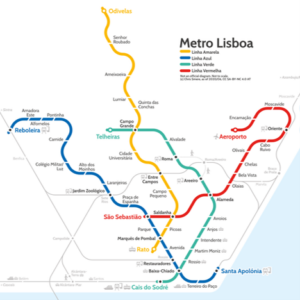
This is by far my favorite method of transportation in Lisbon. As soon as you find a station entrance and walk down the stairs, you will find machines to buy a Navegante card and fill it up with Euro. Then, tap your card and make it through the gates to reach the platforms where you will board the metro cars. My favorite part about the metro is that the signs are large and easy to understand. You just need to know the direction you will travel toward. For example, the end points of the yellow line are Odivelas to the north and Rato to the south. So, if you would like to travel south toward the Principe Real neighborhood, you will need to step onto the Rato platform, enter a metro car, and then get off at your desired stop!
There are four metro lines that are color coded. The yellow line took me from my accommodation to ISCTE, my host university. The green line will take you downtown to the main city part of Lisbon. The last stop, Cais do Sodre, is the main train station that will take you to Cascais, as well as the main ferry stop that will take you to Almada. The blue line takes you downtown toward the coast, similar to the green line. Finally, the red line will take you to Oriente and the airport.
It is really easy to transfer between lines at certain stations. For example, I would use the yellow line in the Rato direction to get to the Saldanha station. Then, I would follow the signs to switch over to the red line.
Buses
Although you buy the Navegante card at the metro stations, you can use it for any form of public transportation. For example, you can tap it on the bus that uses the 724 route and travel around 40 minutes to and from Belém, a must stop! The buses are less crowded, used by locals more than tourists, and their routes are extremely useful. They take you to the areas that are not covered by the four metro lines.
My recommendation is to use Google Maps to find out which route and bus you should use. Then, simply enjoy the peaceful ride!
 Trams
Trams
When researching activities in Lisbon, most articles will tell you to board the famous Lisbon trams such as Tram 28 or Tram 12. However, I was told by some locals that the trams are crowded, touristy, and full of pick pocketers.
I ended up boarding Tram 28 on my very last day in Lisbon out of curiosity. My main recommendations are to wake up early, get in line no later than 9:00 AM, and keep your belongings protected in your lap. I personally had no issues riding the tram, but it is definitely touristy. The trams are more like attractions rather than actual means of transport. Their main routes will take you through historical sight-seeing neighborhoods such as Alfama and Baixa.
Trains
If you buy a more affordable type of Navegante card, you may have to purchase separate tickets to use the trains. However, I can assure you that this is easy to do. All you do is walk up to the train station box office and tell the worker your desired destination. Tell them that you need a return ticket as well and then follow the signs to the train platforms. There will be screens above you that tell you which trains to take.
Before you board the train, make sure to tap the train ticket on the monitors placed along the platforms. This is important just in case a worker asks you for your ticket on board. Use the Roma-Areeiro train station to get to Sintra, and the Cais do Sodre train station to get to Cascais. Both cities were incredible in their own ways, and I highly recommend making day trips to both of them.
Ferries 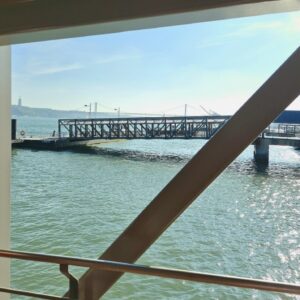
The last main mode of transportation is the ferry. The city of Almada is a 15-minute ride across the Tagus River. Use the Cais do Sodre ferry station, and follow the signs to the ferry platform! The lines to board the ferry were not organized, and the locals and tourists crowd around the entrance. My recommendation is to try and get as close to the front of the line as possible, and then quickly get a seat on board the ferry.
Hopefully this guide has given you confidence to travel around Lisbon and even explore the surrounding cities. There is so much that this country has to offer, and using the Navegante card will give you a glimpse into all the beauty and excitement that is in Lisbon Metropolitan Area!

Kristina Ludwig
Major: Business Administration – International Business
Summer 2026
API in Lisbon – Instituto Universitário de Lisboa (ISCTE)