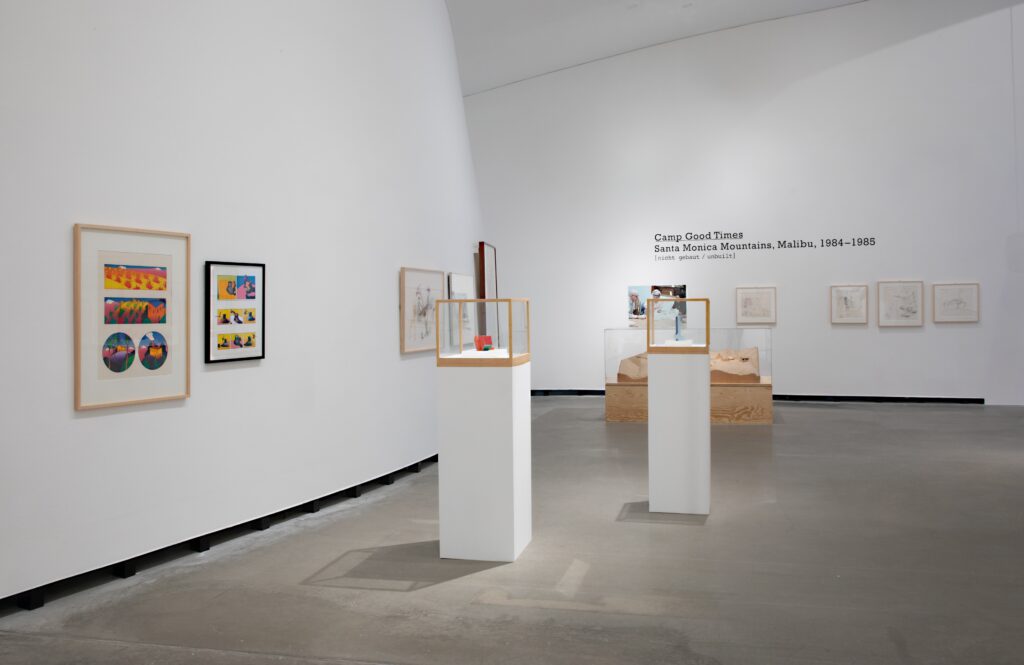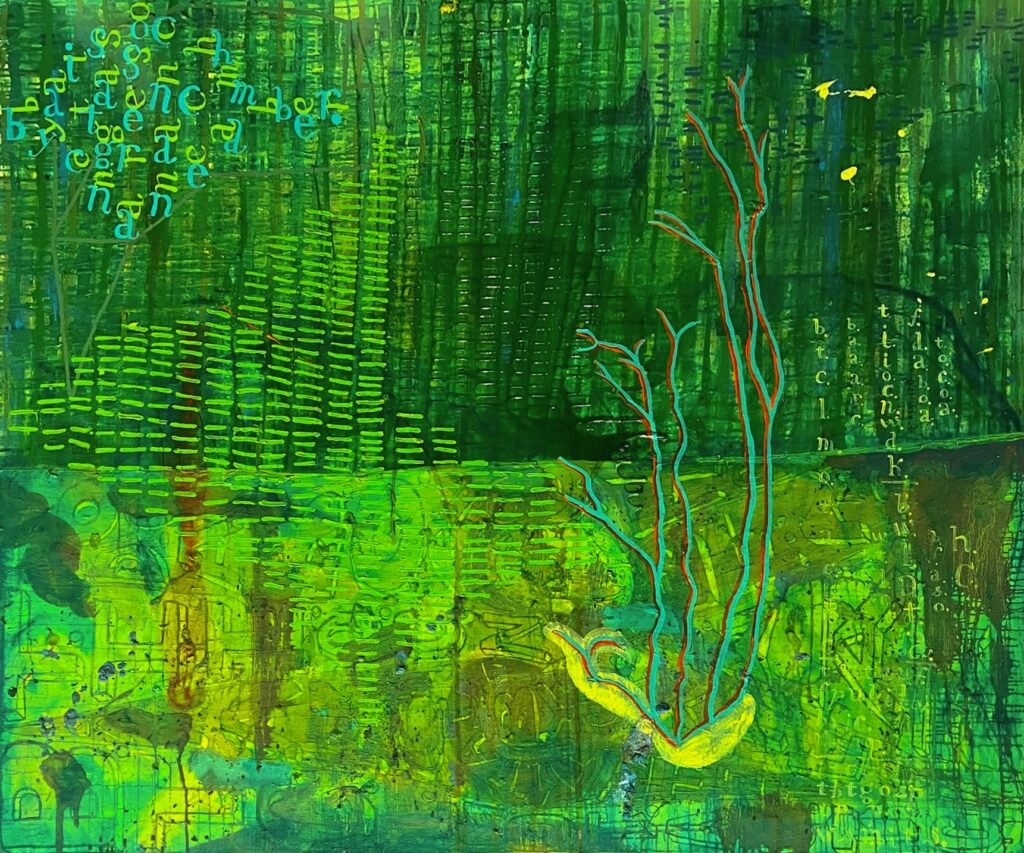
The third floor hallway of Beckman Hall is home to a new exhibition featuring paintings, prints, collages, and embroidery by Steve Roden. This exhibition was curated by Nicole Nguyen (’27) and Rylie Shimabukuro (’26) during their Summer 2025 Internship with the Escalette Collection. As part of this project, they also created an activity booklet designed to help visitors engage with this exciting work.
Through the eyes of LA-based artist and composer Steve Roden (1964-2023), the world is full of endless possibilities if only you listen and observe. So often we force ourselves to find the correct answer, but Roden’s work defies singular meaning, prompting audiences to follow their intuition. Instead of taking things at face value, what if we looked deeper and considered what connections could be made? This exhibition invites you to explore the phenomenon of sensations, let go of your preconceived notions, and discover the magic of Steve Roden.

Student Reflections
Below, Nicole and Rylie reflect on their experiences working with Roden’s art and curating this exhibition.
What did you do for this exhibit? What was it like working with the art and creating an exhibit? What was the most challenging, and what was the most fun? Any final remarks?
Nicole: My role was to create the graphics and visuals for this exhibit! From the tombstone labels to the activity guide, I emulated a graphic style that reflects the vast themes Roden himself explored, such as the five senses, mixed media, and interconnectivity. The process was astounding! First, we documented the various pieces we received from the Estate, and from there, we found a way to group different pieces for the exhibition and theme. We landed on “Sensation” as much of his work is intuitive and personal, and “the Anatomy of Touch” is a significant theme. I think the only challenge I could think of in this project was the tight timeline, but we prevailed! The most fun part was seeing it all come together, with the labels printed and the walls freshly prepped—it felt like an “oh this is actually coming together!” moment. This experience is my first time helping to curate an exhibit, and I am grateful to have worked on it with Rylie and Jessica. I hope others can learn something or appreciate Steve Roden’s work, as we did, by curating the exhibit!
Rylie: I had the fantastic opportunity to research Steve Roden and write the labels for this exhibition. This exhibition was not an easy feat, as initially, his work was challenging to comprehend, and honestly, I am still unsure of what it all means. Through my research, I found it fascinating that Roden could make these connections with model kits and unfinished projects. His work challenged me to pay more attention to the things around me and embrace the endlessness our world provides us with. His work perfectly reminds us that we do not have to know everything and can just be. The most exciting part of working on this exhibition was seeing it all come together. When we finally finished proofreading my labels, printing Nicole’s wall vinyls, and finalizing our activity sheet, it felt like all our hard work this summer had truly paid off. I also loved seeing the art firsthand and Roden’s handiwork up close, and built a bond with them. I hope audiences enjoy this exhibition and challenge themselves to perceive differently and, ultimately, have more empathy and care for the world around us.
Come check out Sensation on the 3rd Floor of Beckman Hall, try out the activity book, and grab a Steve Roden-inspired sticker!
We invite you to explore all the works in the Escalette Collection by visiting our eMuseum.
Wilkinson College of Arts, Humanities, and Social Sciences is the proud home of the Phyllis and Ross Escalette Permanent Collection of Art. The Escalette Collection exists to inspire critical thinking, foster interdisciplinary discovery, and strengthen bonds with the community. Beyond its role in curating art in public spaces, the Escalette is a learning laboratory that offers diverse opportunities for student and engagement and research, and involvement with the wider community. The collection is free and open to the public to view.