
By the author, Jim Doti
One of Lisa Mertins’ special talents is her ability to capture the essence of the storyline in her illustrations. This is critically important, since readers—especially children—often look at the illustrations to get a visual sense of the characters and storyline. Indeed, it’s this interplay between the text and the illustrations that explains why books like
An Adventure on Stage
are called “picture books.”
When I’ve read picture books to my kids and now my grandchildren, I’ve noticed how their eyes dart between the printed words and the pictures. So it’s important for the story to match the text. And now that I have all of Lisa’s wonderful evocative illustrations, I have the opportunity to make revisions to the text to bring them closer together.
For example, in the first illustration of Mrs. Lyons, Lisa shows her holding “The Elves and the Shoemaker” book in back of her.

That’s a really interesting touch, but there is nothing in the text that refers to it. As a result, I changed the text from “…Jimmy notices that Mrs. Lyons is again wearing a string of white pearls around her neck” to “… Jimmy notices that she is holding a book behind her.” That seems to me to be a more realistic observation for a first-grade boy to make. The string of pearls is probably not even on Jimmy’s radar screen.
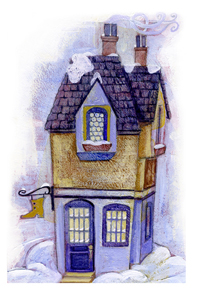
The charming home of the shoemaker and his wife that Lisa painted is not even mentioned in the story. That’s because I didn’t know Lisa would include it in her illustrations. But now that I know she did, I need to include something about it in the text. I did that with the following: “‘The Elves and the Shoemaker’ begins a long time ago in a two-storied gabled home where a shoemaker and his wife live and work.”
Lisa did an amazing illustration of Mrs. Lyons holding up the book to show the class the relevant picture as she tells the story of “The Elves and the Shoemaker.” Lisa’s depiction of the scene is wonderfully inventive. It’s an illustration within an illustration that perfectly reflects the story within a story in
An Adventure on Stage
.
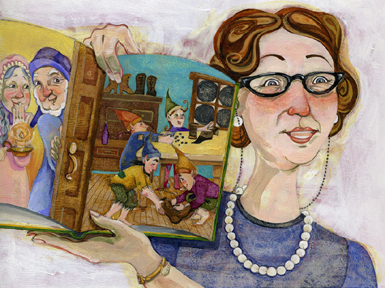
To capture this scene in the text, I first found the part in the story where the shoemaker and his wife are peaking out from behind the door to observe the elves in action. Then I added the following: “Picking up the book to show the illustration, Mrs. Lyons continues. ‘So later in the evening, they hid behind a door and peaked out to find out what was going on.’”
There were some instances where Lisa had to revise her paintings. She wrote about this in her May 30 entry, “Speaking of Drawing Boards,” where she described the process of using Photoshop to make changes to her original paintings.
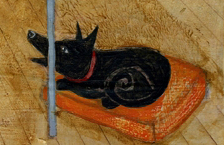
For example, I wrote: “As Jimmy tells his mom the story of ‘The Elves and the Shoemaker,’ Blackie is curled up in his bed, listening to every word.”
But Lisa shows Blackie sleeping. While I could, of course, have changed to text to describe Blackie sleeping, I like the image of Blackie listening to the story. It would help make Blackie more human-like and more interesting. So Lisa kindly went back to the drawing boards to show an attentive Blackie.
Another example of this relates to Mrs. Lyons’ heart-to-heart discussion with Jimmy. In this scene, Mrs. Lyons tells Jimmy that saw him greet his dog while watching from the classroom window. That gave me the idea to show an image of Mrs. Lyons looking out of the window of the school in the illustration related to that scene. Lisa ran with the idea and added a very subtle image of Mrs. Lyons looking out the window. See if you can find her in the following illustration.
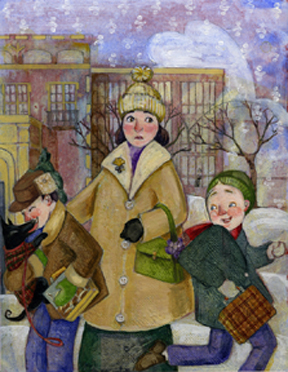
While only the very careful reader will make the connection, I still think it’s kind of neat to do things like this in a book.
Since these examples point to the critical connection between the writer and illustrator, I will continue this discussion next week.
If you enjoyed this article, please consider sharing it!


