Gown Talk – Winter 2024 Chapman University: My Sixty Years...and Counting!
April 1, 2022
FLASHBACK: The following is a remembrance of Chapman over the past sixty years which appeared in “Talk of the Town,” Spring Edition, 2022
As we have just celebrated the 160th Year of Chapman, it is a great time for looking back at some of the school’s history. It is truly unbelievable to reflect on the many changes Chapman has experienced since I enrolled here as a junior history major in the fall of 1961. Nineteen-sixty-one, the memorable year of Dr. Martin Luther King, Jr’s. visit to the college and the 100th Anniversary of Hesperian College’s founding. Yet, with an increase since that time from a student population of roughly 700 to just short of ten-thousand students today, Chapman has retained its dedication to a value-centered education that stresses the vital elements of a liberal arts education.
Now, as a comprehensive university, Chapman offers a multitude of majors offered by eleven colleges. In the early 1960s there were no more than a handful of majors and nearly all undergrads became teachers, ministers, musicians, and business leaders.
For instance, how many colleges today enter a pachyderm into an intercollegiate elephant race? True, we didn’t host the event, but we represented the college by entering “Calvin Coolidge” (who said he would never run again?) into the event at a vacant Orange County State Fullerton field (named “Dumbo Downs”).
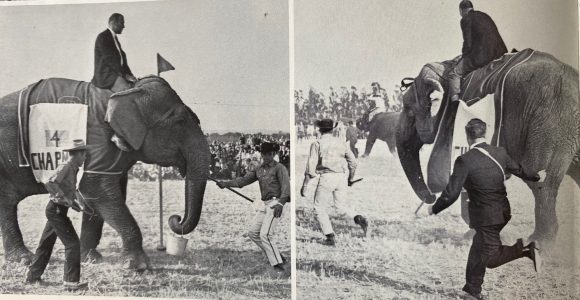
Elephant Races at “Dumbo Downs” – 1962
Another Chapman first, of course, was the Seven Seas Program (now Semester-at-Sea), sponsored by Chapman from 1965 to 1975.
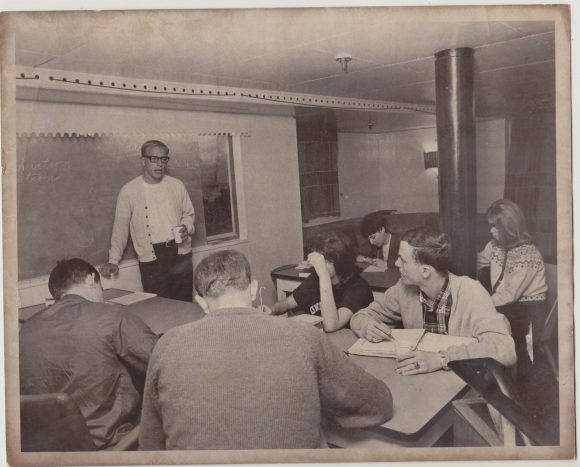
1965 Seven Seas first voyage
Activities and traditions differed then. Women students’ dorm curfew was 10:00 pm on weekdays and midnight on weekends. Mandatory attendance at Chapel on Tuesdays was a long-established tradition and most students resided in the dorms. Just a few years earlier students had been housed in the old buildings along Glassell in Old Towne. The Victorian house at Olive and Palm, which housed about 10 women (and a “dorm mother”), by 1966 had become the Seven Seas offices. My faculty mentor in the program, Dr. Ashleigh Brilliant (yes, that’s his real name!), dubbed it the “Palmolive House,” and in appreciation, the soap company donated products to the school.
The first floor of Roosevelt Hall (then “Founders Hall”) housed the cafeteria until a new facility opened in what is now DeMille Hall, where dining on Thursday evenings and Sunday afternoons required semi-formal attire (skirts or dresses for women, white shirts and ties for men). The only “official’ parking area was a dirt (mud during a rain) lot. Classes were held in Wilkinson, Founders, Reeves, and Smith Halls, and an ancient garage, battered truck, and gas pump adorned the area now covered by the library. The entire college library, by the way, was housed on the second floor of Memorial Hall.
Despite its small size and rustic features, 1960s Chapman was an oasis of culture in sparsely populated Orange County. As one of only two accredited 4-year colleges in the OC, Chapman hosted a variety of special events, including student theatre productions directed by Prof. Henry Kemp-Blair and music programs directed by Bill Hall, along with a speaker’s symposium. The community enjoyed presentations by John Kenneth Galbraith, Helen Hayes, T.H. White, W.H. Auden, and Margaret Mead, to name a few. In 1962, Aldous Huxley presented “Doors of Perception,” about the experimental use of LSD! (Few remembered when Huxley died a year later because he passed on the same day JFK was assassinated; C.S. Lewis also died on that day.)
Class size averaged 10—17 students, and few exceeded 25. Favorite professors included Kurt Bergel, Jim “Killer” Miller, Walter Bock, Bert Williams, Henry Kemp-Blair, Don Booth, Edgar Sholund, who hosted honor students at his home as he performed classical pieces on the piano, and Jim Christian and Ron Huntington, who accompanied students on “field trips” to the gargantuan Pickwick Bookstore in Hollywood.
As “panty raids” yielded to “undie runs,” Chapman evolved into today’s world-class institution, offering a multitude of degree programs supported by student internships, workshops, and networking events. “The ship” and “Calvin” are gone, but our university has evolved into a world-class Research Two institution that hosts students from across the globe. Chapman is widely known for the annual Economic Forecast, Chapman Celebrates, the Huell Howser and War Letters Collections, Dodge College film school, Dr. Marilyn Harran’s Rodgers Center for Holocaust Studies and many other programs.
Finally, through all the years Chapman’s commitment to personalized and value-centered learning has never wavered; the Chapman spirit remains, offering our students a unique “Window to the World.”
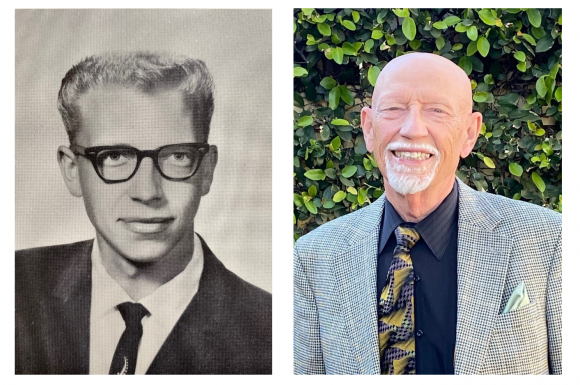
Bill Cumiford then and now!