Beer Brewing 101: Tips and Techniques from Brittany Hanson
July 1, 2015
If these long summer days are giving you the itch to try something new, you might be interested in trying out home beer brewing as a hobby. Brittany Hanson,
public relations assistant
and brewer extraordinaire, says it’s an intense hobby but the refreshing reward and creativity involved make it worth it. Read on to learn tips and techniques for perfecting this craft and on how to get started.
How did you become interested and involved in brewing beer?

I enjoy craft beer and was thinking about getting a new hobby to do with my husband. A friend who brews told me about homebrewing beer and it seemed fun – laborious, but fun, and there’s a pretty good hobby pay-off at the end. Additionally, my grandfather had helped his father brew beer during the Great Depression, was popular on his block in the 1950s for brewing his own and had tips to give. So I bought the kit as a holiday gift for my husband, who was at that time lower on the relationship totem as ‘boyfriend.’ Before I wrapped everything, I read all the books and got us signed up for a class.
Over the last three years we’ve made a lot beer. It’s brewed five gallons at a time – which can be a strain on apartment living. When we got married, we decided it was important enough to us to make beer to serve at the reception: A Blood-Orange Hefeweizen (The Feisty Redhead) and Maple Vanilla Brown (The Tall, Dark and Handsome). It was a grand total of ten gallons. At the end of the night, pretty much all the wine and the other beer were left, but there were only five bottles of our home brew to take home. There were only about 57 guests.
What kind of beer do you brew?
I like my beer the way I like my humor – dark. The lightest beer I brew is a hefeweizen, which is a German wheat beer. The darkest has been a stout. I prefer to use natural ingredients in flavoring, which with my blood orange hefeweizen is great, but on a recent brown-sugar pecan dubbel brew took a turn for the worst. Let’s say it was five gallons of “acquired” taste. That was the first one to “go wrong.”
Any tips for people who might want to get started with at-home brewing?

Yes! I bought my supplies at Stein Fillers in Long Beach, which is also where I signed up for my classes. They have excellent supplies and package “ingredient boxes” for specific types of beers. Also, read John Palmer’s
How to Brew
. I also like the Brooklyn Brew Shop’s books on brewing, which are adjusted for smaller, one-gallon brews. With the huge popularity of micro-breweries, home brewing groups and classes are sprouting up everywhere. Also, proceed with caution! I got a little carried away on time. I experimented with making hard cider out of fresh pressed apples in my juicer and ended up with exploding bottles of what ended up smelling like apple vinegar – my one big fail. Too much sugar in the apple mush, too active yeast and a lot of busted bottles dripping all over my cabinets.
What do you like best about brewing your own beer?
I like it because it’s something I can be creative with. I like odd, acquired food tastes, cooking with interesting ingredients, etc., and this lets me do something a little bigger along those lines at home.
Can you walk us through the process?
I start brewing by scrubbing my kitchen and bathroom with hot, hot, hot water. The same level of clean goes for all the implements: Large spoons, thermometer, my oversize stock pot and the mesh metal tea strainers I use when adding hops all get a scalding bath.
We have a water filter on our tap, but if we didn’t, we would buy the water from the store. The cleanest water you can get, because anything that is present in it will impact the flavor of the beer.
I prefer to lay everything out in the order I’m going to use it in. Tools rest on tin foil, ingredients such as the grains or extract, hops and yeast are grouped together on the kitchen table. You’re also going to need ice – a lot of ice – for the second part of this.
There are different ways of brewing beer. Some people use what’s called a malt extract, while some use all grain. Each has their merits: extract is kinder and more forgiving to a new brewer, all-grain has unique flavoring and characteristics – you just need to have the patience to do it.
The first part is the called the boil. The length of time and amount of ingredients used all depends on the recipe you’re using and what ingredients you need, but you’ll be boiling your grains, adding your extract and steeping your hops in this part. This takes around an hour or so, depending on the recipe again. This is usually when I send my taller half out to pick up the ice. I stay and keep an eye on the brew, stirring occasionally, keeping an eye on the temperature.
Next comes the cooling. I have to do this the low-tech way, by submerging most of the big stock pot in the bathtub filled with ice. Once cooled to the appropriate temperature, we pitch specialized beer brewing yeast specific to our beer type in a sanitized, 5-gallon bucket, then pop an equally sanitized lid on top and let the waiting begin.
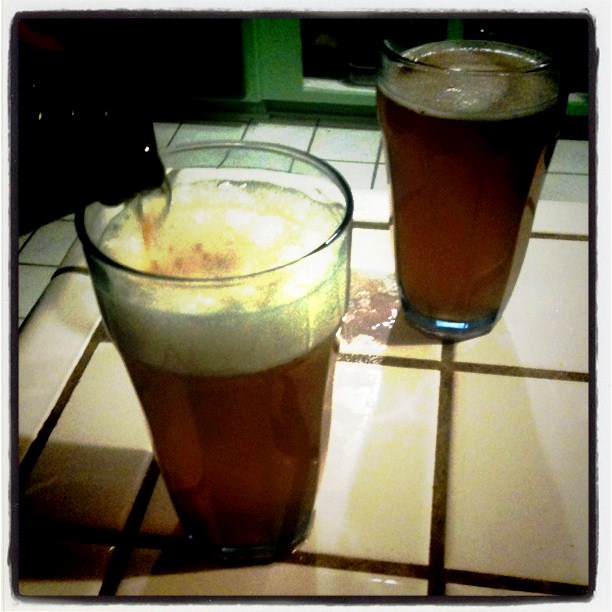
On top of the big bucket, called the fermentation vessel, is a clear plastic tube with what looks like a clear bobble head inside resting on purified water, or most often, vodka (it’s cleaner). This thing allows your beer to breathe and it bubbles. In the first few days, the off-put from the beer and yeast will cause a lot of bubbling. After the course of two weeks, this will have slowed or stopped completely.
Next comes the hard part: bottling or kegging. We bottle, which is tedious. Every bottle and bottle cap must be sanitized inside and out and no outside elements or extra air can touch the beer. This can cause off flavors, souring of beer – a host of problems.
This is also the part where carbonation occurs. So, clean a secondary 5-gallon bucket (again, sanitized), tubing and a racking cane (a device that allows even dispersion of beer into a bottle.
Again, according to directions and ingredient needs, cook a small sugar solution in a pan. Then pour the sugar solution into the cleaned bucket. The fermentation bucket with your beer in it should have spigot on the front. You attach the tubing to the spigot, put the end of the tubing into the bucket with the sugar solution in it, then turn on the spigot and watch. Next, you get the beer into the bottles. Pop the tubing onto the spigot of the second bucket, press the racking cane into the bottom of your bottles, fill them up and then use your capper to cap them. Put your bottles in a safe, dark place.

*
And wait. And if it’s dark beer, wait longer. You know what? Just forget about your dark beer for a month and come back to it. When you do, chill a little, not too much, open and enjoy.