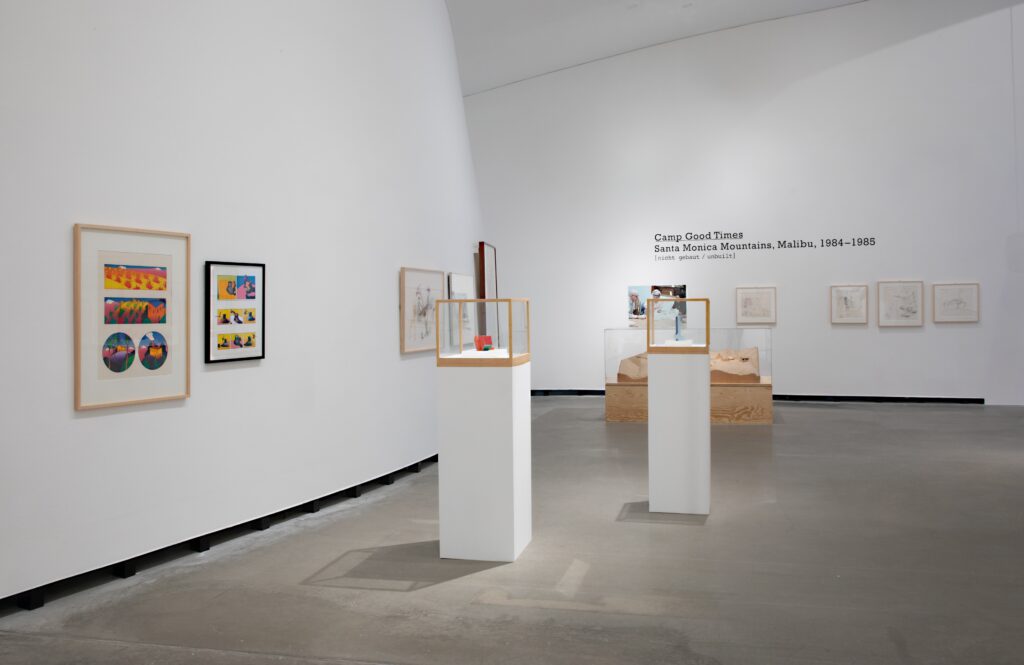
When you think of the Escalette Collection of Art – or any museum – the first thing that probably comes to mind is all the artwork on display. As the Collections Manager of the Escalette Collection, a large portion of my day is devoted to coordinating, and maintaining the nearly 500 artworks on view – a huge task that wouldn’t be possible without our dedicated team of student workers. However, there are other aspects of my work that take place behind the scenes, involving the care of artwork in the collection not currently on display. Although very few people will have the opportunity to see these projects, they are essential to ensuring that all the art in the Escalette Collection is preserved for many years to come. In this blog, I am going to take you into our art preservation center, where we store and actively care for artworks not on display, to share more about the work done there.
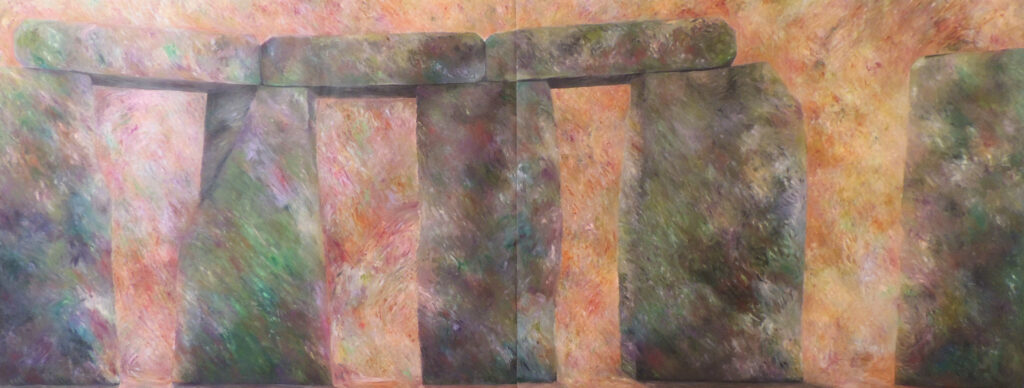
This blog will focus on just one of the many projects we juggle simultaneously in our art preservation center: the process of re-housing two large paintings by Katherine Alexander, titled Stonehenge Series #3: Northeast 6.21/Summer Solstice Sunrise, which form a diptych. This work had been on display at 633 West Palm for many years, utilizing a hanging system that the artist developed, which used Velcro to attach the canvases to a wooden frame. While this technique is sometimes appropriate for hanging small textiles, for the long-term display of large, heavy paintings, the lack of support can cause the canvas to sag and bow. This was the problem that we started to notice in Stonehenge Series #3. While wanting to remove these panels from display, the question of how to store them presented a significant challenge.
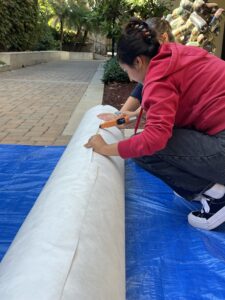
Canvases that are not attached to a stretcher or strainer and are not framed pose some storage problems. If the canvas isn’t supported well enough, or too much pressure is applied to certain areas, the canvas can crease, causing the paint layer on top to crack, and possibly fall off. Since Alexander painted on paper mounted on canvas, these problems were compounded by two surface layers. The sheer size also made typical storage solutions impossible. Before proceeding any further, I took time to research some options. Ultimately, I reached out to the painting conservators at the Balboa Art Conservation Center for their guidance. After several conversations, photos, and brainstorming sessions, we finally determined together that the paper and canvas were well adhered enough to be rolled onto a tube, a technique often used to store textiles and unstretched canvases.
A significant portion of my job involves researching and learning about the most effective methods for caring for the objects in our collection. While there are guidelines and procedures to follow, every object poses its own unique challenges or exceptions to the rules, which are compounded by other restrictions (such as funding, space, time, staffing, etc.). This means that every project, even seemingly straightforward ones, requires a lot of forethought and planning to ensure that we are offering the best possible care that we can. When I am ever in doubt or encounter a situation that I feel unsure about, I always contact a conservator, who can provide additional expertise on how certain materials might react to various scenarios.
With reassurance from the conservator, I was able to move forward with sourcing the materials needed for this project. To roll the panels, we needed a tube that was long enough, but also wide enough that the painting wouldn’t be rolled too tightly. In collections care, we aim to use materials that are as inert and stable as possible, meaning their chemical composition will not change drastically over time, which would also impact the artwork that comes into contact with them. These materials can be purchased from specific vendors, which conduct tests on their products to ensure they are as safe as possible for use with art or other museum objects. Unfortunately, none of these vendors created tubes large enough for these paintings. As a pivot, I was able to source sonotubes – a tube typically used to pour concrete pillars.
While the right size and shape, sonotubes are not archival. This meant that we had to wrap the tubes in an outer layer of material so that the paintings would never come into contact with the sonotube itself. The material selected for this part of the project is Tyvek, a material commonly used in construction to wrap the exterior of houses and prevent mold and water intrusion. This material has also been adopted by conservators and collections caretakers for its inert make-up, resistance to tearing, and non-abrasive surface. Tyvek is used for countless applications, including wrapping artwork for transport, creating dust covers, and lining shelves or boxes.
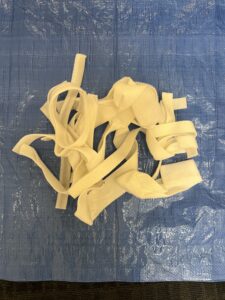
With our sonotubes covered, we could turn our attention to the paintings themselves. The most daunting part of the project was actually removing the panels from the wall. Luckily, the Velcro gave somewhat easily, and we were able to carefully lower each panel onto the ground, where we had plastic ready to protect it. The next immediate problem became the Velcro attached to the back of the canvas. The paintings could not be rolled with the Velcro still attached, as it would create too much uneven pressure, which might overstretch the canvas or crack the painted surface. When discussing this portion of the plan with the conservators, they were particularly concerned about how – and if – the Velcro could be safely removed. It took hours of meticulous work, but we ultimately managed to remove the Velcro. We had very sore hands by the end of this process, but we were glad to have the Velcro removed, as we noticed that the adhesive had started to become gummy with age.
At this point, we were ready to start the rolling process. In this technique, an interleaving layer is required to prevent the painting from sticking to itself when rolled. I chose Reemay for this, a non-woven polyester fabric typically used to cover gardens and plants for frost and pest protection. It is a material that conservators and collection caretakers have also adopted because of its non-abrasive surface, which remains breathable. We placed a layer of Reemay underneath the painting, and carefully started rolling so that the painted side of the canvas would face out. While it may seem counterintuitive, having the painted side out ensures that the surface is never pinched, which could lead to cracking.
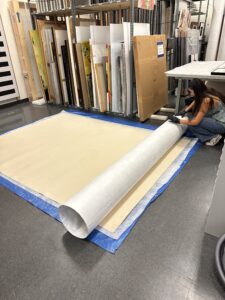
As the last step, we used Dartek, a type of nylon film developed for collection use, to create an outer protective layer for the rolls. Dartek is similar to Mylar plastic, but softer and more tear- and moisture-resistant. This layer keeps the roll together and protects the painting from dust and moisture while in storage. Finally complete, these rolls are now kept horizontally on one of our storage shelves. They sit on two Ethafoam mounts that hold the roll (and the painting) from sitting on itself, which could cause too much pressure.
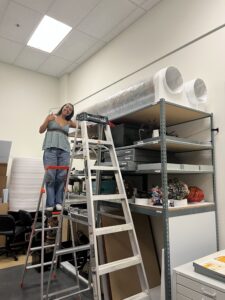
This is an example of just one project undertaken to care for just two objects within the Escalette Collection. While the public will not see these paintings for some time, these efforts ensure that they will be preserved for future enjoyment and research. I also want to acknowledge my student worker, Ysabella Rodriguez (Art History ’27), without whom this project – and many of my projects – would not be possible! Student workers like Ysabella have truly embraced the importance of collections care and demonstrate that passion by becoming invaluable team members to many collections projects.
The effort, knowledge, materials, and practice required to care for museum objects are often not considered when visiting a museum because they take place so far behind-the-scenes. At the Escalette Collection, we strive to bring these kinds of projects out from the shadows so that students, in particular, can gain hands-on experience and learn more about the network of professionals who care for our cultural heritage. The people and communities who care for museum collections are genuinely dedicated to their work, motivated solely by their belief in the importance of ensuring access to our history and culture. As the Escalette Collections Manager, I am very grateful to my museum and art conservator colleagues, whose dedication and expertise I admire and learn from every day.
The next time you visit a museum or look at the art on display on Chapman’s campus, I encourage you take a moment to think about the decisions that have made the object available for you to see!
We invite you to explore all the works in the Escalette Collection by visiting our eMuseum.
Wilkinson College of Arts, Humanities, and Social Sciences is the proud home of the Phyllis and Ross Escalette Permanent Collection of Art. The Escalette Collection exists to inspire critical thinking, foster interdisciplinary discovery, and strengthen bonds with the community. Beyond its role in curating art in public spaces, the Escalette is a learning laboratory that offers diverse opportunities for student and engagement and research, and involvement with the wider community. The collection is free and open to the public to view.