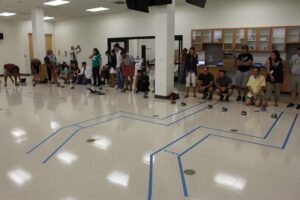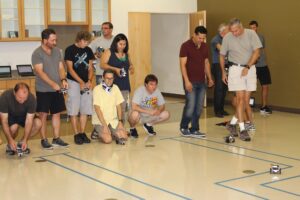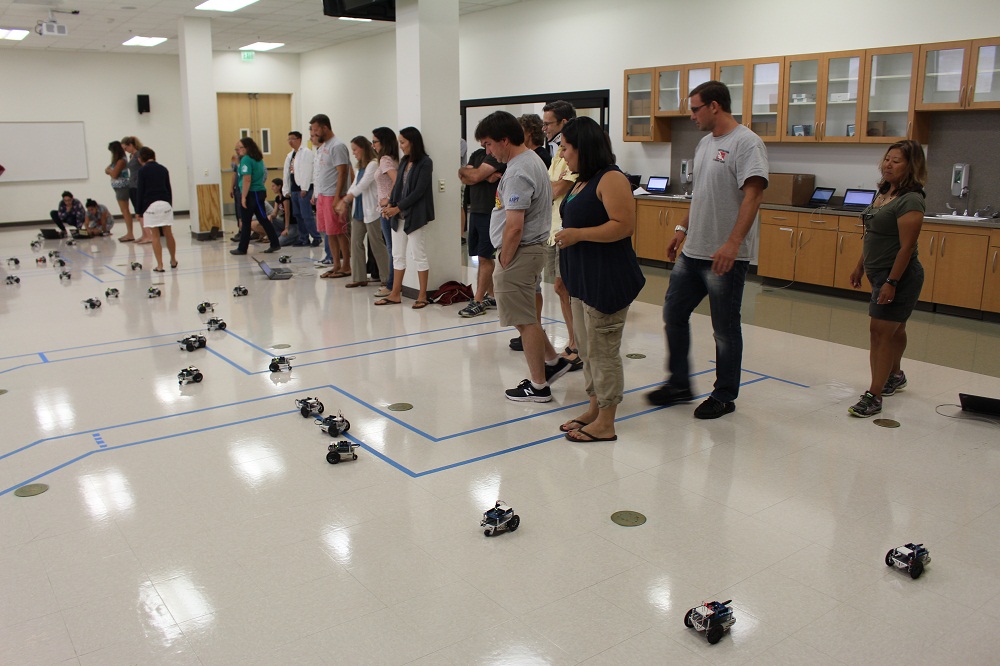
As part of the grant program CASP, Chapman Anaheim Science Partnership, fifty fellows gathered in Crean Hall for a week long course designed to teach creative ways to integrate science in curriculums within middle and high schools across Anaheim.
Dr. Frank Frisch
, Principal Investigator of the grant and Director of Kinesiology Program at Chapman University’s
Crean College of Health and Behavioral Sciences
, states, “Our one week intensive enables our science teachers to embrace science content and pedagogical strategies in ways that can only enrich their classrooms. By extension, we are all served by developing science-literate and science-interested middle and high school students.”
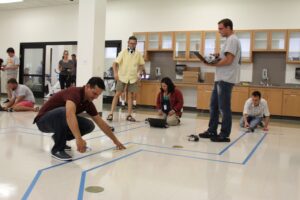
Each fellow was given their own “robot” to program and navigate through a designed course, turn-by-turn. Fellows learned how to write code with software applications and the Arduino operating boards. Presenters Jomar Gonzalo and Julio Gallardo showcased how to program the boards, and helped map out the course. According to Arduino, the operating board, “senses the environment by receiving inputs from many sensors, and affects its surroundings by controlling lights, motors, and other actuators.”

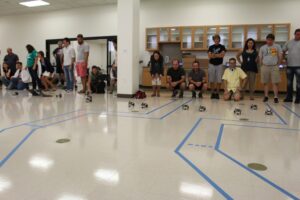
Collaboration was encouraged between the fellows to participate in finding ways to integrate this type of system into their science courses. A friendly race was set up once all fellows had programed their device and winners announced. During the week, fellows also created lesson plans to aide incorporating creative science enrichments into their curriculums.
One fellow stated of the program, “This week was amazing for me, it made me feel invigorated to teach and help students study the marriage between science and tech.”
Uriel Jurado, who teaches Life Science & 7th Grade at Ball Junior High School said of his participation in the summer institute, “This was a very beneficial week for me. (I) realized the importance and relevance of using cross cutting concepts, math, technology, and the Arduino in my science classroom.”
CASP’s Norms for deeper learning:
Collaborate – we help each other learn and solve problems
Communicate – we listen deeply and speak truthfully
Self-direct – we take responsibility for our own learning
Mindset – we embrace challenges
The 3 year Grant Goals:
-
- Design classroom lessons aligned to NGSS for
use during the school year
- Design classroom lessons aligned to NGSS for
-
- Utilize the outreach strategies and methodologies of MESA and student centered learning
-
- Pedagogy development will focus on project based learning (PBL), lesson study, and text complexity
-
- Enrichment activities will focus on increasing the use of technology by teachers and students
For more information on CASP, please contact Nicole Michaelis:
nmichael@chapman.edu