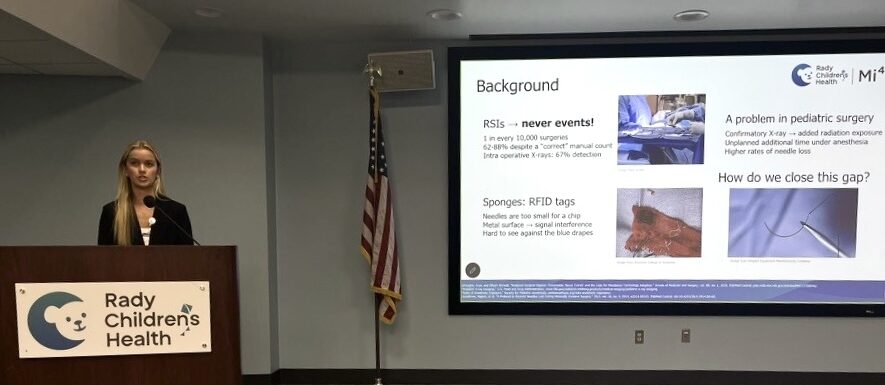
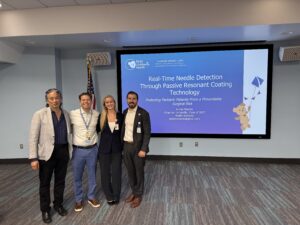
 Chapman University Health Sciences student Amber Roehrs ’27 spent her summer exploring the intersection of pediatric medicine, healthcare innovation and patient safety through the CHOC Medical Intelligence and Innovation Institute (MI4) Summer Internship. From shadowing in the operating room to developing an innovative approach to real-time needle detection, Amber gained firsthand experience turning clinical challenges into potential solutions for the future of pediatric care.
What inspired you to apply for the Mi4 Summer Internship at CHOC, and what excited you most about being selected for the program?
I’ve always been drawn to healthcare, especially to pediatrics. What excited me most about Mi4 was the chance to combine that interest with hands-on innovation, to not just observe how pediatric care works, but to actively think about how it could work better. Being selected meant I would get to collaborate with mentors and peers who were equally invested in pushing healthcare forward, and that combination of clinical exposure and creative problem-solving was exactly the kind of experience I was looking for.
Can you tell us more about your real-time needle detection innovation and how it could improve patient safety and care in the operating room?
A big part of the program involved weekly shadowing rotations, and one morning in the OR I witnessed a suture needle go missing mid-procedure. The search-and-confirmation process to account for it before the case could safely close is what inspired my idea. I started to wonder if needles could be detected in real time instead of searched for after the fact. With guidance from many amazing mentors, I developed a proposal for a passive resonant coating applied to the swage of each needle. The coating would emit a detectable frequency, allowing any needle unaccounted for in the surgical field to be identified immediately. A solution like this could meaningfully reduce retained surgical items and shorten or eliminate the lengthy search protocols that follow a missing instrument, a safety margin that matters even more in pediatric surgery, where patients are smaller, more radiosensitive, and more vulnerable to the risks of prolonged procedures.
What was it like presenting your innovation during Grand Rounds at CHOC, and what did you learn from the experience?
Presenting at Grand Rounds was one of the most rewarding parts of the summer. Standing in front of a large audience with far more clinical experience and expertise than I have was nerve-wracking, but pushing through that discomfort taught me a lot about my own capabilities. It sharpened my public speaking skills and gave me real confidence in defending an idea in front of experts, a skill I know will help me throughout my career in medicine.
How has your internship experience shaped your understanding of the connection between healthcare innovation, research, and patient-centered care?
Mi4 really changed how I think about healthcare. I left this summer understanding that medicine is never static; there is always room to question, improve, and rebuild the systems we rely on. Watching ideas move from a concept into something with the potential to genuinely change patient outcomes is truly inspiring. That process of seeing innovation translate directly into better, safer, and more compassionate care reinforced for me that research and clinical practice aren’t separate tracks. They’re deeply connected, and the best patient-centered care comes from clinicians who are willing to keep asking what could be better.
How do you see this experience influencing your future goals and career in healthcare?
This experience has shaped the kind of physician I want to become. One of our mentors from this summer told us to be a problem seekers, not problem solvers, and that idea has stuck with me ever since. I now see innovation not as a side interest but as a core part of good clinical practice. Coming out of Mi4, I understand how essential it is for healthcare providers to stay imaginative and adaptable, because that mindset of actively seeking out problems, not waiting for them to surface, is what ultimately changes patients’ lives for the better. I plan to carry that mindset with me throughout my medical career.