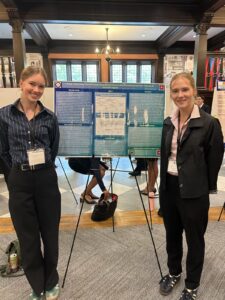
 Interdisciplinary collaboration is at the heart of innovative research at Chapman University. Emma Kochenderfer, a Computer Science and Technical Theatre double major in the Fowler School of Engineering, partnered with Crean College student Natalie Paradiso to explore the intersection of artificial intelligence, psychology, and eating behavior. With mentorship from Dr. Kendra Day, their project, “Hungry Machines,” demonstrates how collaboration across colleges brings together diverse perspectives and expertise to tackle complex research questions. The students recently presented their findings at the National Research Conference at the University of Pennsylvania, showcasing the power of undergraduate research that crosses traditional academic boundaries. Natalie Paradiso ’28 shares her experience co-presenting at this prestigious national conference.
1. What inspired you to explore the connection between interoception, eating behavior, and AI, and how did the idea for “Hungry Machines” first develop?
I wanted to explore this because I enjoy both decision-making and eating disorder research, and combining the two felt like a natural and exciting fit. Eating is a constant stream of decisions made under uncertainty, so building an AI agent that has to make those decisions lets us ask questions about disordered eating in a way that’s hard to do with people. “Hungry Machines” grew out of that overlap.
2. Your findings suggest that the perceived “cost” of hunger may play a larger role in overeating than uncertainty about the body’s signals. What surprised you most about the results, and what could they potentially tell us about human eating behavior?
What surprised me most was that our first hypothesis was wrong. We expected that a noisier internal signal would be the main driver of overeating, but the results showed that reward structure mattered far more. When hunger was costlier than fullness, agents overate regardless of how reliable their signals were. Seeing the data disagree with us was humbling and pushed me to think differently about the problem.
For human eating behavior, it suggests that how aversive hunger feels may matter as much as, or more than, how well someone can read their body’s signals. Because this is a computational model, it is a hypothesis to test rather than a clinical conclusion.
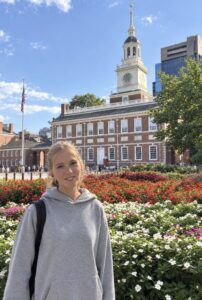
3. What was it like presenting this research at the National Research Conference at the University of Pennsylvania, and what did you take away from sharing your work with researchers and students from other institutions?
Presenting at the University of Pennsylvania, alongside presenters from other institutions, was an amazing experience. It gave us the chance to talk with faculty and students both within and outside our disciplines, and those conversations were the best part.
Alongside the amazing people were the architecture and environment; Philadelphia was a beautiful city to attend a conference. My biggest takeaway is that the best research you can do comes from talking to others. Hearing other perspectives sharpened my thinking about our work and showed me how much a project grows when you share it.
4. How has working on this project—and collaborating with Emma Kochenderfer and your mentor, Dr. Kendra Day—shaped your experience as a Chapman student and influenced what you hope to pursue after graduation?
Working with Emma Kochenderfer was a highlight. She is a computer science and theater double major, and she showed me how to implement complex code using AI agents, which made this project possible. She is truly a delight to work with and someone I hope to collaborate with continuously in the near and far future.
Dr. Kendra Day helped us establish a working framework for the project and was there to troubleshoot when we got stuck. She allows us to drive the project while having an emergency brake.
Together, they showed me what collaborative research looks like and gave me the confidence to keep pursuing topics I’m passionate about. After graduation, I hope to continue researching these questions in new ways, using tools like AI and computational modeling to approach them from fresh angles.