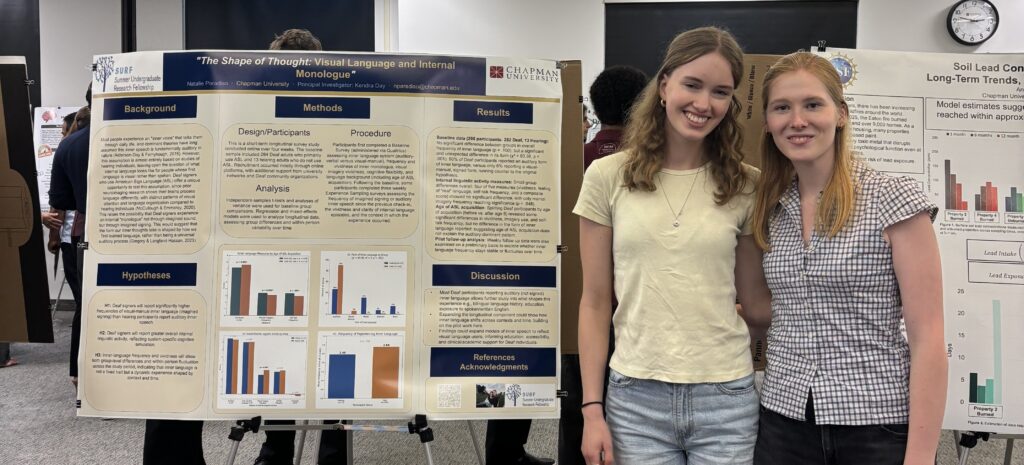
 Sophomore Natalie Paradiso ’28 is exploring how we think, make decisions and experience the world through the intersection of psychology and neuroscience. A Psychology major with a minor in Neuroscience and a member of Chapman University’s Honors Program, Natalie is passionate about psychobiology and decision-making neuroscience. She conducts EEG and TMS/TBS research at the LUCID-AI Lab and has presented her work at conferences including Harvard NCRC and CAMP 8. She recently participated in Chapman’s Summer Undergraduate Research Fellowship (SURF) program, where she designed and conducted her own study exploring the experience of internal monologue in Deaf ASL users. Outside the lab, Natalie serves as Head Psychology Ambassador, Honors Mentor and a member of the Crean College Psychology B.S. Student Council.
What inspired you to explore the experience of internal monologue in Deaf ASL users, and why is this an important area of research?
My interest in this topic actually began outside the classroom. Attending Chapman and living in Orange County introduced me to the Deaf community in a way I hadn’t experienced before, largely through outreach programs and events, such as the Deaf Coffee Chats held on the last Friday of every month at Irvine Spectrum. Being able to sit in on these conversations and build relationships within the Deaf community sparked my curiosity about how Deaf ASL users experience their own thoughts.
It’s a question that doesn’t get asked nearly enough, and I think that’s exactly why it matters. Understanding internal monologue in Deaf ASL users challenges many assumptions in psychology and linguistics that are built around spoken-language experiences. Exploring this helps push the field toward a more inclusive understanding of cognition, one that doesn’t treat hearing and spoken-language experience as the default.
What was it like designing and conducting your own research study through Chapman’s Summer Undergraduate Research Fellowship (SURF) program, and what did you learn from the experience?
Designing and conducting my own study through SURF was genuinely one of the most exciting parts of my undergraduate experience. It pushed me to grow in ways I hadn’t anticipated, and I had the support of Chapman’s resources and research community every step of the way.
Through the process, I picked up technical and methodological skills that I know I’ll carry into future research and professional work. But just as importantly, I gained a much deeper appreciation for everything that goes into producing meaningful research. From the early logistics of study design to the long hours of data collection and analysis, I got to take an idea from concept to results. Seeing that bigger picture made the final product feel so much more rewarding because I understood exactly what it took to get there.
How did working with faculty mentor Dr. Kendra Day and the Chapman research community shape your growth as a researcher? Were there other faculty, mentors or students who inspired you?
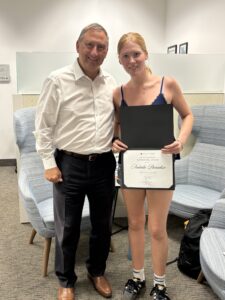
Dr. Kendra Day has been one of the most supportive mentors I’ve had at Chapman, and I honestly don’t think this project would have come together without her. She gave me the resources, guidance and, most importantly, the space to grow as a researcher. She let me try things, fail and try again, which taught me far more than if everything had gone smoothly the first time.
Beyond Dr. Day, I’ve been lucky to be surrounded by a research community at Chapman that genuinely wants to see students succeed. That encouragement made all the difference in how confident I felt taking ownership of my own project.
How would you describe your Chapman experience as a whole?
I fell in love with Chapman from my very first admission tour, and that feeling has only grown since. What stands out most to me isn’t just the classes I have taken; it’s the community. The faculty, my roommate Emma, my friends from classes, everyone I’ve encountered here has been genuinely supportive and invested in helping each other grow, not just individually but alongside one another.
Chapman has given me the freedom to figure out my own path as a student and researcher while making sure I never feel like I am doing it alone. Looking back, that combination of independence and support is what has made my time here so meaningful.