Chapman Engineers Pursue Real-World Impacts through Innovative Summer Research Fowler Engineering’s Summer Researchers Reimagine Interior Design via VR Integration, Reduce Urban Heat Impacts, and More
August 11, 2025
For numerous Fowler School of Engineering (FSE) students, summer break is not only a time for rest and relaxation; it is also a welcome opportunity to engage with rigorous research endeavors across campus. Here at Chapman, engineering students are encouraged to participate in a multitude of diverse research opportunities throughout the year, ranging from independent projects to mentor-guided laboratory experiences. This year, FSE’s summer researchers stretched the bounds of scientific inquiry while exploring topics such as 3D-print applications in electromagnetics and training machine learning models for early Alzheimer’s detection.
We invite you to read on and learn more about these incredible summer engineering researchers, whose work reflects the depth of inquiry and innovation happening throughout the FSE community.
Santa Ana Chapman Outdoor Temperature Thermometer (SCOTT) Lab — Evan Figueroa
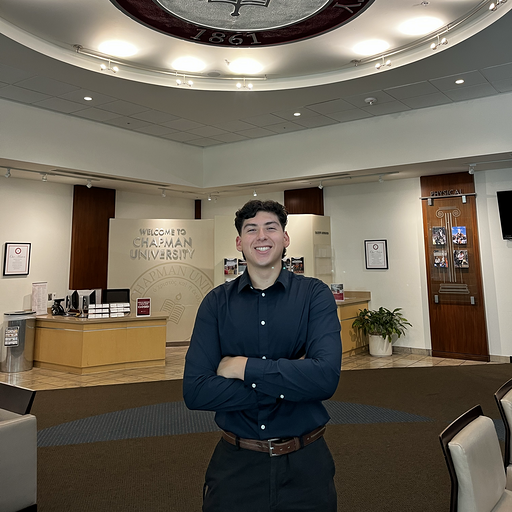
In addition to showcasing his dedication to the scientific community as an avid researcher, Figueroa will further serve the FSE community through the Student Government Association (SGA) during this fall 2025 semester.
The opportunity to bring data-centric, technologically-powered change to local communities drives many Chapman Engineering research endeavors. Evan Figueroa (Computer Engineering, ‘26) is one such student; as a founding member of the SCOTT Lab, Figueroa has spent this summer working alongside the Santa Ana Neighborhood Initiatives and Environmental Services (NIES) Department to develop advanced technologies with real-world impacts.
The SCOTT Lab was jointly built from the ground up by Figueroa and mentor Dr. Thomas Piechota, who both saw a rich opportunity to make a difference in the lives of Santaneros impacted by urban heat. Throughout the summer, Figueroa has worked alongside fellow lab partner Diego Lopez Rubio (Computer Engineering ‘26) to collect data that supports the effectiveness of cool pavement, a reflective coating that mitigates heat being trapped in the pavement through reflection and reduced absorption. This process has involved developing novel devices that can measure and log key temperature data at designated test sites, capturing temperature variations across day and night hours.
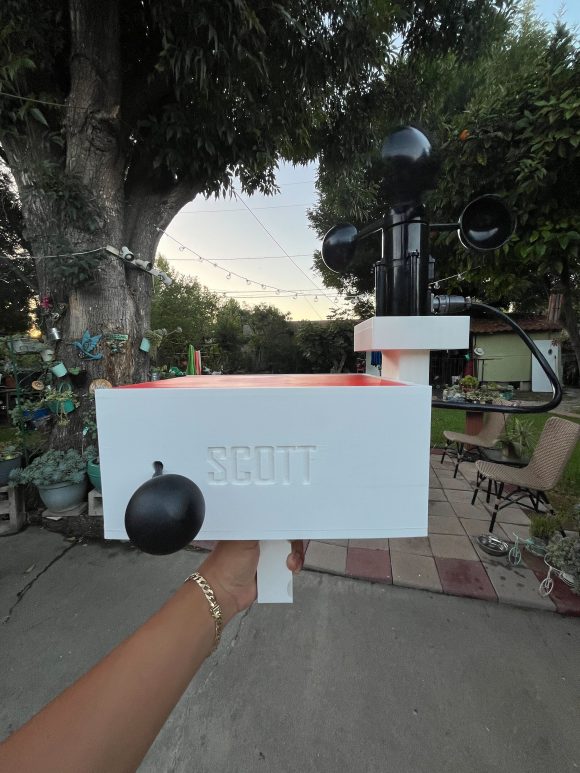
The SCOTT Lab’s device collects data to prove the difference cool pavement can make in areas impacted by urban heat.
For Figueroa, this summer research endeavor also bears immense personal resonance. “What inspires me most as a Fowler engineer is the chance to use my skills to create real impact, especially for communities I care about. As someone from Santa Ana, working on this project feels personal. I am not just building a device; I am contributing to an effort that could improve the quality of life in my hometown,” shared Figueroa.
Following the conclusion of Figueroa’s summer research period, the SCOTT Lab’s device will be handed off to a Grand Challenges Initiative (GCI) group here at Chapman. The new team (composed of incoming freshmen, ready to engage with research from day one) will expand upon their hard work: data collection, data processing, and event organization efforts, as well as working alongside the NIES to educate local citizens and students on the benefits of cool pavement initiatives in their city.
Summer Undergraduate Research Fellowship (SURF) — Hila Livneh & Annika Brown
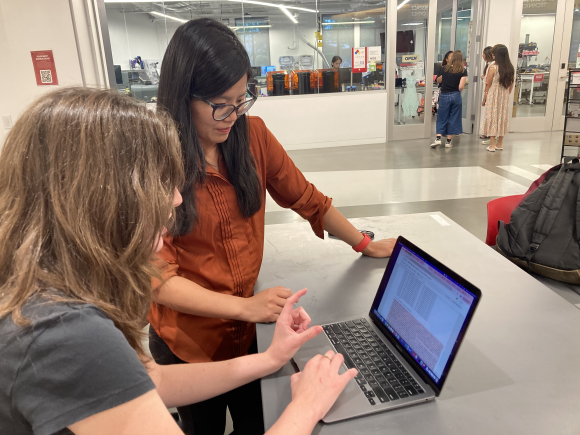
For Livneh, her summer research conducted with Dr. Yuxin Wen (pictured above) has provided a welcome opportunity to explore her ideal path into healthcare and medicine: developing advanced technologies that assist medical professionals.
During this 2025 Summer research season, the Center for Undergraduate Excellence selected two Engineering students to participate in the Summer Undergraduate Research Fellowship (SURF) program: Hila Livneh (Data Science, ‘27) and Annika Brown (Computer Science, ‘26). SURF is an eight-week, paid summer research initiative in which students engage in robust faculty-mentored research, professional development opportunities, and formal poster and oral presentations showcasing their findings.
Livneh’s project seeks to apply a multimodal, human-centric framework to data analysis of patients with Alzheimer’s Disease. Her research developing, implementing, and running neuroimaging data through an advanced learning model can help detect early cognitive decline with increased accuracy, which could drastically improve Alzheimer’s patient outcomes.
“I’m incredibly grateful for the opportunity to participate in this year’s SURF program,” shared Livneh. “It’s given me invaluable hands-on experience that grew my understanding of data science in healthcare. I’m also especially thankful for Dr. Yuxin Wen’s mentorship: her support and guidance have been instrumental all summer!”
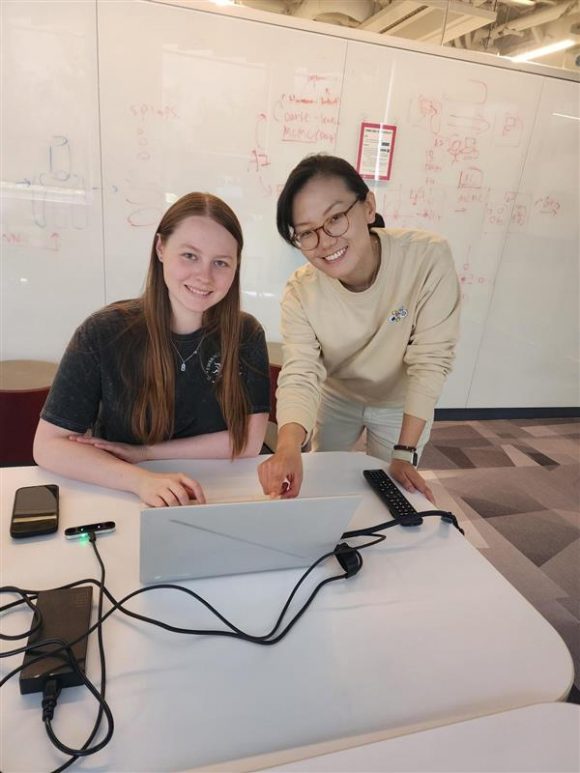
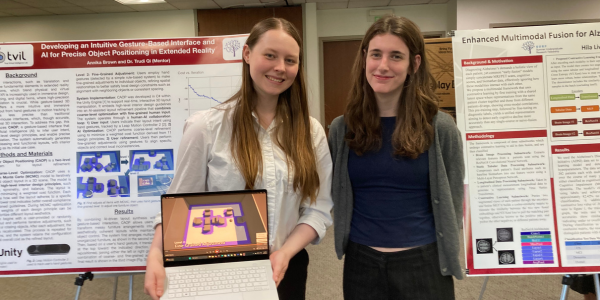
Brown and her research mentor, Dr. Trudi Qi, engage with the versatility of VR/XR environments to imagine novel, creative, and accessible futures.
Another 2025 SURF fellow, Annika Brown, has spent the past two months broadening virtual reality’s (VR) bright future in the field of interior design. Brown’s summer project utilizes a tool she and her mentor, Dr. Trudi Qi, have dubbed “CAOP”—a gesture-based interface that leverages artificial intelligence (AI) to infer user intent, integrate high-level design principles, and enable precise object manipulation. Through Brown’s intensive coding efforts, this extended reality (XR) resource constructs and automatically places furniture items in a virtual room according to interior design rules. Additionally, the program allows users to manipulate furniture in a digital space using precise hand gestures.
“I’m so glad to have gotten the opportunity to participate in SURF this summer and work on research that’s relevant to the field I want to go into!” expressed Brown. “I was a bit nervous about starting such a large project, but the SURF program and my faculty mentor have been very helpful in leading me in the right direction.”
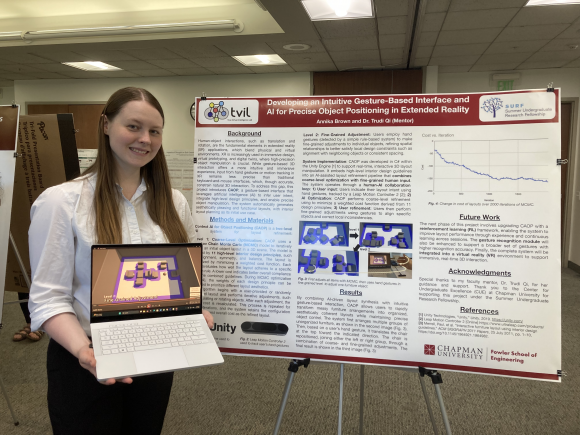
Brown shared her research with the Chapman community at the annual Summer Research Showcase on July 31st, 2025.
Fowler Innovation & Research Excellence (FIRE) Program — Noslen Cruz-Muniz

By pursuing this hands-on experience outside of the traditional semester, engineers like Cruz-Muniz develop practical skills in problem-solving, experimentation, and data analysis in a true-to-life lab environment. Throughout the summer, she has continued to review, identify, and integrate 3D printing with nanoparticles, stretching the bounds of engineering student achievement here at FSE.
For Noslen Cruz-Muniz (Computer Science, ‘27), her summer break has been spent pursuing world-changing electrical engineering research through the Fowler Innovation & Research Excellence Program (FIRE). The FIRE program provides students with financial resources, lab equipment, and time to engage in active, real-world research under the dedicated guidance of a Chapman Engineering mentor. Designed as an accessible introduction to academic research, FIRE invites participants to contribute to meaningful projects of their own creation or engage with their mentors’ research.
Thanks to FIRE’s grant assistance, Cruz-Muniz is taking advantage of this summer to explore a personal research interest: unlocking which nanoparticles are best suited for enhancing electromagnetic applications of integrated 3D printed composites. The applications of this groundbreaking research expand far and wide, with the potential to positively impact technologies across healthcare, wireless communications, and aerospace development.
“Noslen is working on a new class of 3D-printable materials engineered for enhanced electromagnetic performance,” explained Cruz-Muniz’s summer research mentor and Assistant Professor Dr. Nasim Estakhri. “By merging principles from metamaterials and complex electromagnetics, she is creating a new approach for RF and THz device fabrication. The precision and flexibility inherent in 3D printing offer unprecedented opportunities for prototyping and creating high-performance components in many applications such as wireless communication and imaging, and creating enhanced 3D-printable materials is very valuable for such scenarios. Looking ahead, this work lays the foundation for smarter, more efficient electromagnetic devices.”
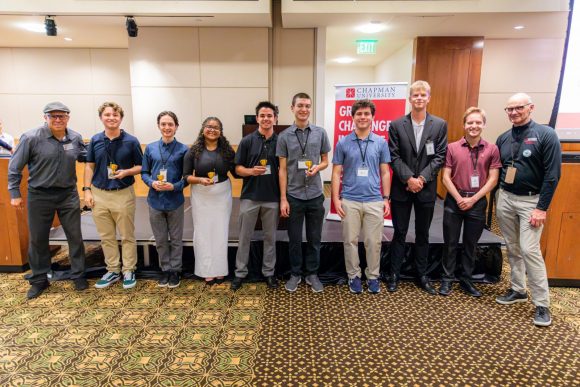
FIRE is not the only research intensive Cruz-Muniz has engaged with in her time at Chapman; this past May, she and her fellow classmates presented their research entitled “AIdentify: Teaching AI Identification Through Repetition” at the Grand Challenges Initiative Spring Showcase. The team was judged and announced as winners under the “Technology / Education” Category.
Above all, Cruz-Muniz spoke to the opportunities offered through research projects with real-world impacts, hoping to inspire her peers to pursue similar avenues.
“What excites me most about being a Fowler engineer is the constant push from our mentors and professors to turn our curiosity into innovation,” said Cruz-Muniz. “This research has been a humbling reminder that there is always more to learn and more ways I can contribute myself educationally. This research opportunity is a big step for me because it gives me a chance to work on a project that can have real-world impacts. I hope to inspire others in the future to constantly push and strive for more as many researchers have inspired me.”