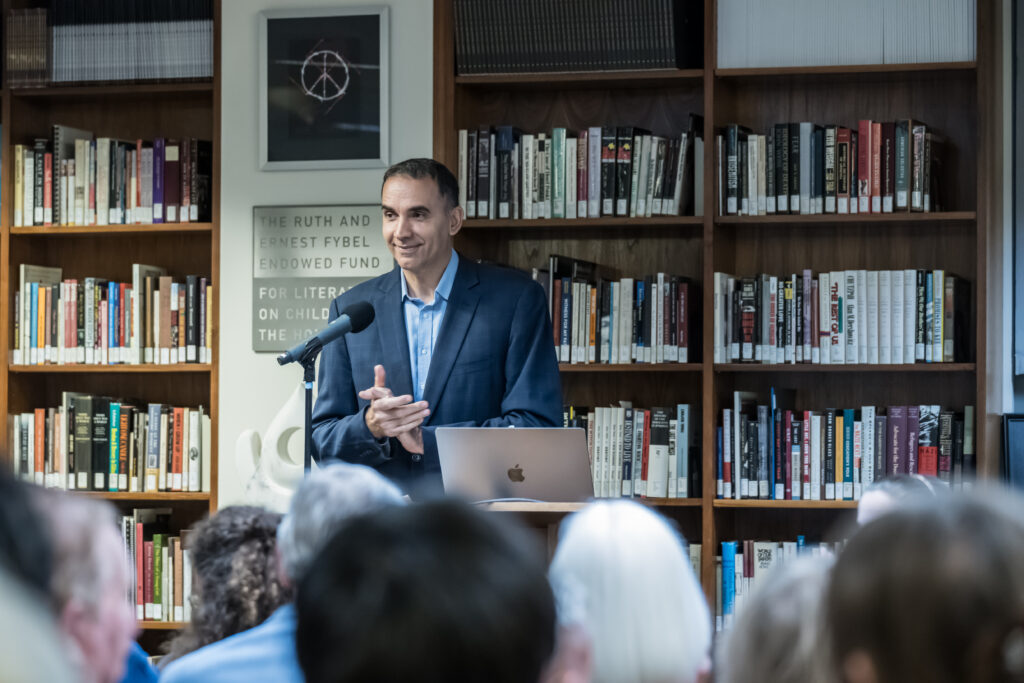
 Please join the Rodgers Center for Holocaust Education in welcoming Stefan Cristian Ionescu, the new Director of the Rodgers Center for Holocaust Education and Ralph and Sue Stern Chair in Holocaust Education. Dr. Ionescu previously held positions at various academic institutions, including Northwestern and Uppsala University.
Researching the history of Romania’s minorities, transitional justice, and legal resistance, Dr. Ionescu investigates how Jewish Romanians fought property confiscation and attempted to postpone deportation through the courts. While he currently teaches, researches, and writes about Holocaust history, this was not his original career path.
“I loved history and participated in historical competitions in middle and high school. But I didn’t want to be a professional historian, so I chose law like my grandfather,” Ionescu explains.
Unlike American universities, where students can switch majors, Romanian universities require students to apply to specific departments, preventing major changes without leaving the university. Ionescu quickly realized that the restrictive methods of law school didn’t match his desire for a creatively engaging classroom. “Professors expect students to read from textbooks, learn them by heart, and reproduce them in exams. I disliked this method of studying,” Dr. Ionescu admits.
After law school, Ionescu decided to pursue his passion for history. He earned two master’s degrees, in Jewish studies and history. For the latter, his studies led him to the Central European University in Budapest, Hungary. There, he was inspired by the diverse perspectives of international students and the US-style engaging methods of learning.
After experiencing the openness of a liberal arts education in Budapest, Ionescu joined the doctoral program in Holocaust and Genocide Studies at Clark University in Massachusetts. His dissertation, which eventually became his first book, “Jewish Resistance to ‘Romanianization,’ 1940-1944,” examined how court cases and petitions attempted to counter General Ion Antonescu’s antisemitic regime’s policies, which included the confiscation of Jewish property during the Holocaust. Ionescu became interested in this topic during high school in Bucharest when he discovered that mainstream Romanian history portrayed Antonescu as a hero and martyr, despite the devastating reality of his dictatorship.
During his doctoral research, Ionescu found consistent resistance to property confiscation in primary sources, indicating that bureaucrats, soldiers, and policemen were often willing to overlook families targeted for deportation or confiscation in exchange for bribes. “For long periods of time, scholars portrayed Jews and other minorities as just passive victims…doing nothing as tragedy befell on them,” Ionescu states. “After reading these primary sources, I saw that survivors often engaged in different strategies that could be seen as forms of resistance.”
After completing his PhD, Ionescu worked at several universities, such as Uppsala University in Sweden and Northwestern University in the US. Now, as Director of the Rodgers Center, Ionescu plans to share Holocaust scholarship with Chapman University and the surrounding areas.
“We are fortunate at Chapman to have a community of survivors, families of survivors, and other people in Southern California who are attending our events. It opened my eyes about the importance of focusing on making scholarship and historical studies available and understandable to broader parts of society, to contribute to a widespread sense of education.”
Ionescu wants Chapman students to know that Rodgers Center events and courses under the Holocaust History Minor are not just for future historians but are important for all. Ionescu believes that multidisciplinary studies can benefit students both interpersonally and in their future careers. In fact, the legal training that so frustrated Ionescu as a student became essential in his scholarly research as a historian.
“My legal training kicked in,” he states, “I saw these petitions and lawsuits everywhere, all submitted by Jews, and these issues of property appearing again and again… which became very interesting from a legal point of view. So, I realized that those years in law school were not wasted.”
Beyond encouraging interdisciplinary study, Ionescu hopes to inspire students to support a strong and open democratic society and remember the importance of building community.
“Don’t let [yourself be] caught by pessimism or ever think that you cannot do anything. You can always do something as an individual… but there is a higher chance of success as a team, as a community. I think this is one lesson I will give students: don’t give up on your ideals, goals, and community. Be resilient. It’s not easy, and it takes effort, but I think it’s very important.”