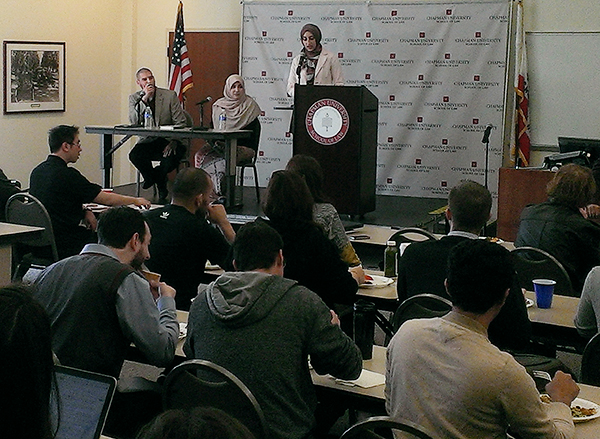
On Tuesday, April 1, 2014 the Fowler School of Law’s Muslim Law Students Association (MuLSA) hosted the “Origins of Islamic Law and its Modern Day Implications” panel. The speakers included Shaykh Jamaal Diwan and Muslema Purmul, two young Muslim scholars raised in America who studied Arabic and Islamic Studies in Egypt for seven years. This is where they learned more about the Shari’ah, Islamic law. Purmul earned her law degree in Sharia from al-Azhar University in Cairo. A regular speaker at local universities on issues pertaining to Islam and Muslims in America, Diwan completed his law degree in Sharia from al-Azhar University in Cairo.
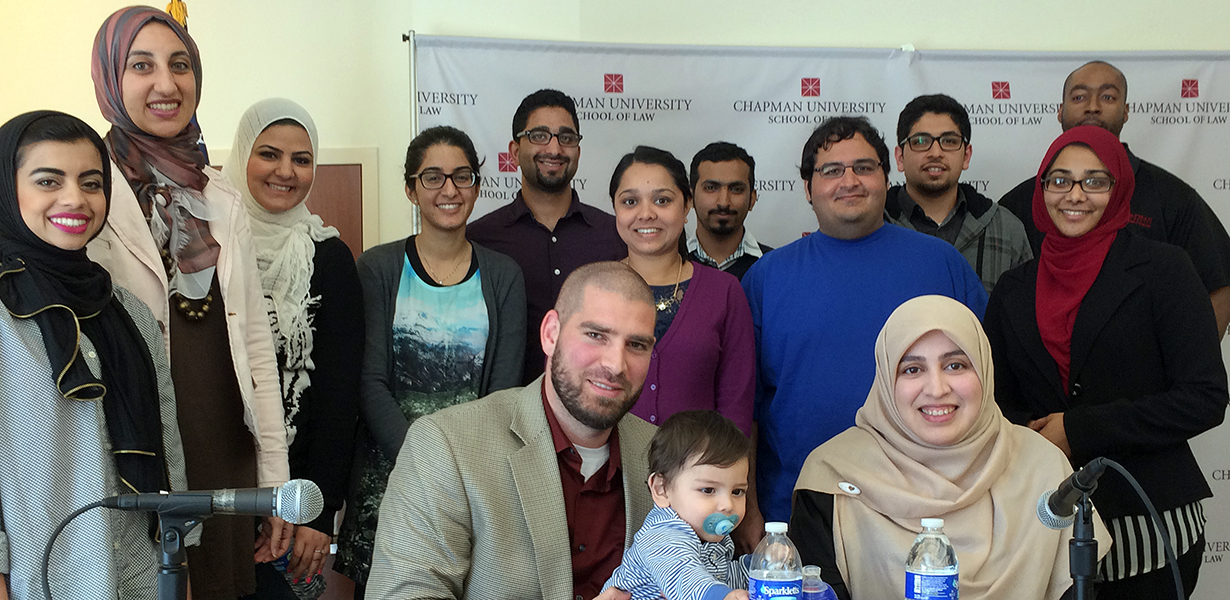
The panelists were a married couple joined in the audience by their toddler son (pictured above)
The panel began with some initial background on the Shari’ah, framing the discussion around questions posed by MuLSA. Diwan said there is a common misapprehension that the Shari’ah is against human rights. But both speakers disagreed with this misapprehension and think there needs to be more thought used when interpreting Shari’ah law. “The best way to overcome these misconceptions is to learn the origins and daily practice of Islamic law,” he noted.
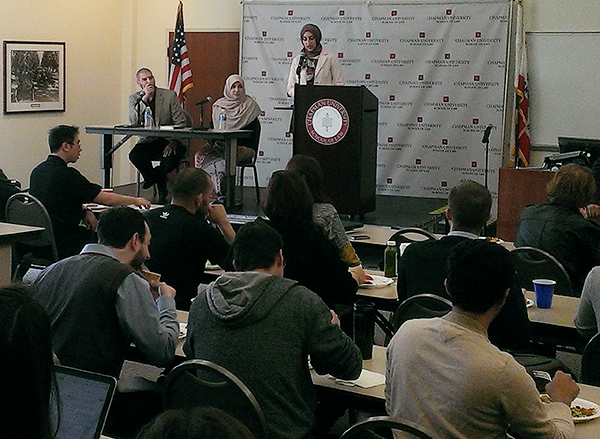
Another misinterpretation Purmul addressed is the treatment of women. When introduced centuries ago, “the Shari’ah was actually a form of liberation for women,” Purmul said. She explained that it gives women the right to choose many things such as who to marry, to divorce, to pick her dowry, voting, etc. Examples of the exclusion and discrimination of women in modern Muslim societies is not religious based, she noted, but is instead a cultural issue.
MuLSA is a student organization at Chapman University Dale E. Fowler School of Law that offers support, education and networking for Muslim students.