Chances are, you’re drawn to the pharmacy profession because you want to make a meaningful impact on patients’ lives. As a pharmacist, you’ll combine science with care to deliver safe, effective treatment.
Deciding how you want to do that can be a challenge. Do you want to work directly with patients in a community pharmacy? Be part of a care team in a hospital or clinical setting? Or would you rather build a career in the pharmaceutical industry, bringing new therapies to market?
As a Pharm.D. student, choosing a specialization may feel overwhelming. Early in your program, though, you’ll begin on-site rotations that expose you to different jobs and workplaces. It’s a great opportunity to clarify what’s most important to you as you start planning for life after pharmacy school. You don’t have to make up your mind right away, but waiting too long can make it harder to get the experience you need for the job you want.
Let’s explore some of the most common career paths this versatile degree opens, along with some of the unexpected directions it may take you.
Career Planning in Pharmacy: Why Specialization Matters Early
A Pharm.D. degree prepares you for a wide range of careers. But you’ll have a better chance of achieving an outcome that meets your goals if you chart your course sooner rather than later.
Most pharmacists work in one of these three sectors:
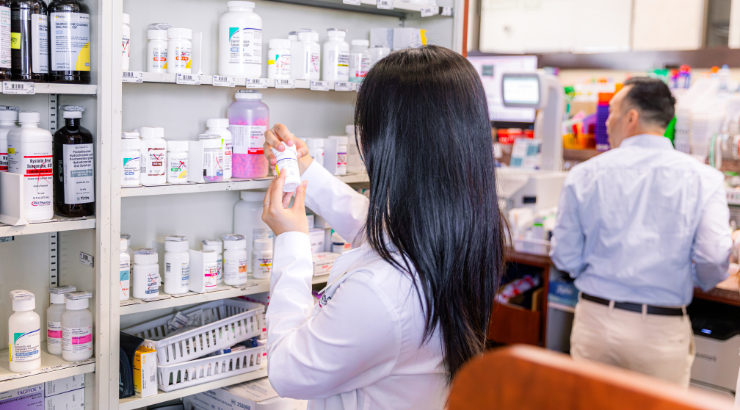
- Community pharmacists are what many people picture when they think of the profession. They work in independent, chain or supermarket pharmacies, engaging directly with patients to dispense medication, compounding, handling specialty medications, and provide advice and education in a fast-paced retail setting.
- Clinical pharmacists work in hospitals or other healthcare institutions. They collaborate with providers to optimize treatment regimens and avoid harmful interactions, while also monitoring patient outcomes.
- Industry pharmacists help bring new therapies to market. They may participate in research, clinical testing, quality assurance, marketing or other aspects of the drug discovery process.
Choosing a direction early helps determine the electives, rotations and extracurricular activities you pursue. It’s an important decision, but not an irreversible one: Your Pharm.D. degree builds a foundation you can fall back on if your interests change over time. (In fact, many pharmacists work in multiple sectors over the course of their careers.)
What to Expect in Community, Clinical and Industry Settings
Deciding the pharmacy path you want to follow is a highly individual decision, one that involves factors such as where you want to live, salary needs, specialization preferences and how closely you want to work with patients. Here’s what to expect from each setting:
Community Pharmacy
Up to half of pharmacists work in retail, independent, compounding, and specialty community pharmacies. It’s the largest of the three sectors.
You’re probably familiar with the responsibilities of community pharmacists because you may have relied on them yourself. As the most public-facing pharmacists of all, these professionals dispense medication and counsel patients. They also administer flu shots and other immunizations, compound medications, and provide advice about over-the-counter medication.
These positions are ideal for students devoted to one-on-one patient care and playing a vital role in strengthening community health. The hours, though, can be unpredictable. While most community pharmacists work 40 hours a week, these often include evening and weekend shifts.
Clinical Pharmacy
About a quarter of pharmacists work for hospitals and health systems, ambulatory and long-term care centers and specialty clinics. You’ll not only serve patients directly in these settings but will also collaborate closely with their doctors and nurses. You’ll participate in rounds and use your professional judgment to recommend effective therapies, as well as monitor them for effectiveness and any adverse side effects.
You can take your training even further by specializing in areas such as oncology, infectious disease and cardiology. That expertise, combined with board certifications such as Board Certified Pharmacotherapy Specialist (BCPS) and Board Certified Ambulatory Care Pharmacist (BCACP), will give an additional boost to your job prospects (and salary).
If you want to be part of a team and solve complex problems, you’d be a good fit for these roles. You’ll often be asked to make decisions in high-pressure situations with little room for error, relying on data and patient histories, along with your own experience. One thing to note: Hospitals and in-patient clinics are staffed around the clock, and you may have to work nights, weekends and holidays, also.
Industry Pharmacy
Compared to clinical and community pharmacy jobs, few pharmacists (less than 5%) are employed in the pharmaceutical industry. But these roles are as influential as they are under-the-radar, encompassing jobs ranging from drug development and laboratory research to regulatory strategy and health economics.
If you’re interested in research, healthcare policy, or the science behind drug pipelines, this field could be a good fit. In addition to pharmaceutical companies and biotechnology firms, you can also find positions with regulatory agencies such as the Food and Drug Administration, managed care companies, and pharmacy benefit managers (PBMs).
Unless you’re directly involved with clinical testing, you’ll have less direct contact with patients than the other two categories. However, you will also have a more predictable, 9-to-5 schedule.
Additional Pharmacy Career Opportunities
Most Pharm.D. graduates work in one of those three sectors, but there are even more opportunities you can find with your degree. You may:
- Teach a new generation of pharmacists in academia.
- Evaluate medications and review prior authorizations for managed care and insurance companies.
- Develop public health initiatives and treatment policy at government agencies such as the Department of Veterans Affairs, the Centers for Disease Control and the Indian Health Service.
- Ensure at-risk populations can access care while serving nongovernmental organizations or other nonprofits.
- Advise other organizations as a consultant or start your own company.
The professional network you cultivate while you’re a Pharm.D. student can help you find these uncommon opportunities, making it even more critical to approach your training with intent.
Rotations: Your Built-In Exploration Tool
Whatever you decide will be guided by hundreds of hours of hands-on experience that you’ll start building almost as soon as you begin your Pharm.D. studies. On-site rotations known as Introductory Pharmacy Practice Experiences (IPPEs) expose you to community and hospital pharmacy settings. Then, in your third and final year in our accelerated Pharm.D. program, Advanced Pharmacy Practice Experiences (APPEs) will provide an even more in-depth look at acute care/medicine, hospital/health system care, and community and ambulatory care.
The point of the IPPE/APPE system is to explore. Along the way, you’ll meet skilled, passionate practitioners eager to introduce you to the field. By the time you complete your rotations, there’s a good chance you’ll find your calling, often in a place you least expected to find it, while meeting mentors and developing your network along the way.
Room to Grow: Open Future Doors With a Pharm.D. Degree
Choosing a career path often comes with a little stress. After all, you’re making a long-term decision based on limited information. Here’s our advice: Even if your first job isn’t a good fit, it’s far easier to change professional direction with a Pharm.D. degree than in many other health professions. Community pharmacists often work in hospitals and other clinics; clinical pharmacists frequently transition to industry roles as science liaisons; and those industry pharmacists have clear pathways to work on policy or in academia.
In fact, paid residencies and continuing education, including additional certifications, make it possible to switch tracks at any point in your career. That kind of flexibility speaks to the universality of a Pharm.D. degree and is just one more reason why it’s so valuable.
Find Your Calling at Chapman
Take your first step to any of these challenging, satisfying careers in the Pharm.D. program at Chapman University’s School of Pharmacy. In just 33 months, you’ll gain the foundational skills every community, clinical or industry pharmacist needs. And you’ll do it in a leading program located in Irvine, California, the heart of Southern California’s biotech and pharmaceutical industry. Here, you’ll have access to research and other opportunities that lead to experience and options once you graduate.
Interested? Contact us to learn more about a degree built on science and service.