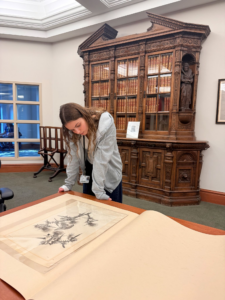
When Cameryn Krauss graduated from Chapman University this past spring with a BFA in Art and a minor in Law and Liberal Arts, she wasn’t finished with campus just yet.
For the past year, Krauss has served as a research collaborator on Invisible Elements, artist and art professor Lia Halloran’s 118-painting project that uses the periodic table as a lens for uncovering overlooked histories across Southern California. The project is anchored by a solo exhibition opening at the Huntington Art Museum in 2028, and Krauss has been laying the groundwork.
Krauss’s path to the project started close to home, in the Art Department’s administrative office, where she worked as a student worker while Halloran served as department chair. “As our professional relationship developed, she invited me to join Invisible Elements as a research analyst,” Krauss said. It was, she added, “an exciting opportunity to contribute to a project that combined art, history, science, and archival research in a meaningful way.”
Invisible Elements pairs each of the periodic table’s 118 elements with a Los Angeles story that has slipped through the cracks of public memory, from the astronomers left out of the history books to the environmental costs of reshaping the region’s landscape.
“The project uses art to bring these hidden stories into public view and encourage viewers to think differently about the histories that surround them,” Krauss said.
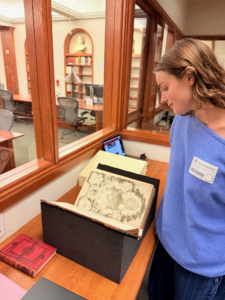
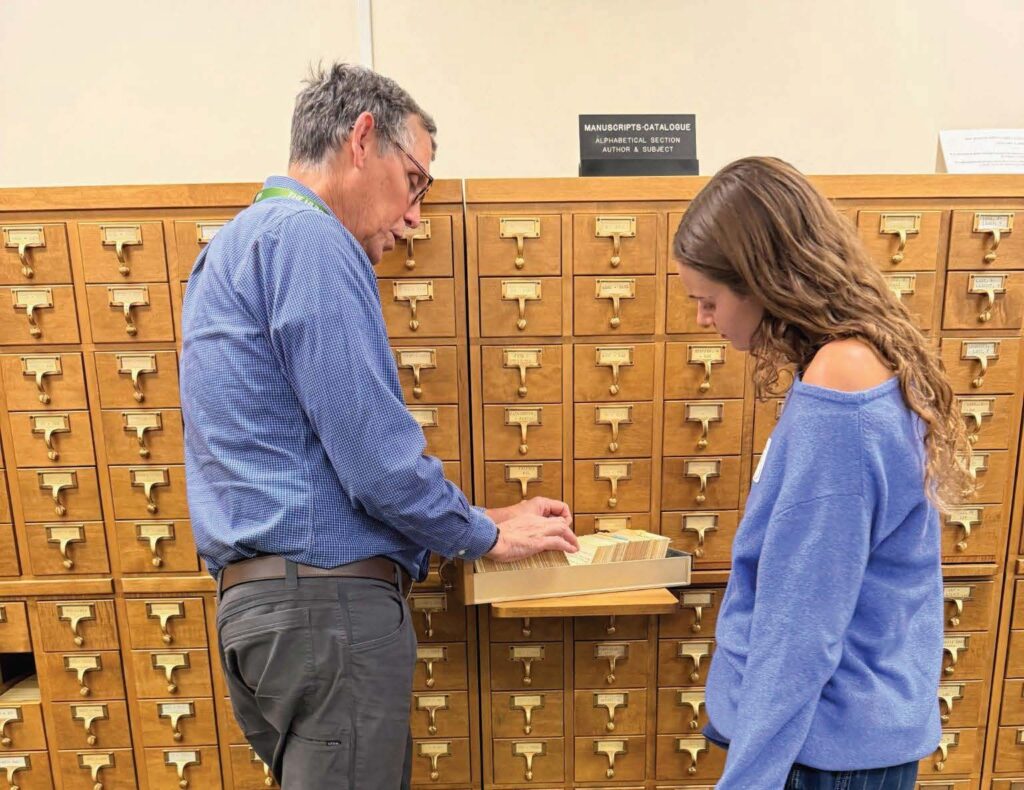
Krauss’s role centers on the archives. She spends much of her time at research libraries and archives, including the Huntington Library, ONE Archives at USC, and the Getty Research Institute, working through letters, photographs, and records to find connections between specific elements and Southern California’s past. For each of the 118 elements, she built out a research folder – notes, archival images, sources, and narrative threads that eventually informed a painting.
Halloran, who worked alongside Krauss on much of this research, described her as “essential to this project.” She credited Krauss with helping walk the Huntington’s gallery spaces with curators to select the exhibition site, and with securing readers’ card access at both the Huntington and ONE Archives at USC.
Much of the day-to-day work happened at the Huntington’s Munger Research Center, where Krauss worked directly with Dan Lewis, the Senior Curator, and his archive staff.
Krauss had a particular talent for finding connections between the elements and historical archives, and two examples stood out to Halloran. The first traces back to the women who worked at Mount Wilson Observatory, mapping the chemical fingerprints of hydrogen and helium. Krauss found their letters in the archives at the Huntington. These women had written in the hope of an opportunity to participate in scientific research and astronomy
“I was deeply moved by the letters written by women who were seeking opportunities to participate in scientific research and astronomy,” she said. Halloran singled out this research as some of the most powerful material to come out of the project.
The second came while the two worked through Octavia Butler’s personal archive together. Halloran recalled going through Butler’s photographs, travel records, and the influences behind her 1993 novel Parable of the Sower, which imagines a Los Angeles consumed by fire between 2024 and 2027.
The novel’s premise took on new weight in light of Butler’s own history: she grew up in Altadena, the same community devastated by real fires in 2025.
“Cam excelled at finding the threads connecting these stories,” Halloran said.
For Krauss, the archives themselves have been part of her education. “Reading about history online is valuable, but standing in front of the original documents creates a completely different experience,” she said. “It transforms historical research from something theoretical into something human.”
The work has also shaped how she thinks about her own path forward. Krauss said the project sparked a strong interest in museums and cultural institutions – particularly how they preserve and share history with the public – and that her studies in Law and Liberal Arts have pointed her toward the legal side of museum and cultural heritage work.
Watching Professor Halloran move between rigorous research and artistic practice left an impression, too. “She has shown me how rigorous scholarship and creative work can strengthen one another rather than exist as separate disciplines,” Krauss said.
Halloran, for her part, said working with curators, archivists, and librarians alongside Krauss has been one of the highlights of the exhibition’s research phase. Of the 118 element folders the project requires, roughly 35 have been fully developed so far, with Krauss continuing her research to help close the gap before the Huntington opening in 2028.
Looking back, Krauss said the most rewarding part has been watching individual discoveries add up to something larger. “It has been especially meaningful to help uncover and share the stories of women and other historical figures whose contributions have often gone unnoticed,” she said. “Knowing that this research will ultimately help bring those stories to a wider audience through art has made the work incredibly fulfilling.”
(Photo header: (left to right) Librarian helping Cameryn Krauss (’26 Art; Law and Liberal Arts minor) with her research on Invisible Elements. Photo courtesy of Krauss.)