Homelessness is often discussed as an individual problem—one caused by mental illness, substance use, unemployment, or personal circumstances. But a recent panel discussion on homelessness and housing policy offered a broader perspective: homelessness is also a systemic issue deeply connected to housing affordability, income inequality, and the policies communities choose to adopt.
As part of Wilkinson College’s Engaging the World (ETW): People and Communities in Motion series, experts Dr. Chris Herring (UCLA), Dr. Jennifer Nations (UCSD), and Dr. Benjamin F. Henwood (USC) examined how communities respond to homelessness and what research tells us about creating more effective solutions.
One of the panel’s central themes was the impact of criminalizing homelessness. Laws prohibiting camping, sleeping in public spaces, or sitting on sidewalks may be intended to address visible homelessness, but research suggests they do little to reduce homelessness overall. Instead, enforcement can displace people from one location to another, separating them from support networks and essential services. People may also lose important belongings, identification, or medications during encampment sweeps.
The panel emphasized that moving someone from a sidewalk does not mean the underlying problem has been solved.
“There are definitely a lot of folks sleeping rough on the street [in San Francisco, for example], and we might very well think that this is a city that tolerates this, has a very high tolerance for homelessness. But just last month, 6000 dispatches to police cars were sent out to address homelessness, and 30 camps are being cleared each week,” said Dr. Henwood.

His comments highlight the disconnect between how visible homelessness is in San Francisco and how frequently the city responds through police intervention and encampment clearances. While thousands of calls may result in people being moved from one location to another, displacement does not address the underlying causes of homelessness or provide people with stable housing. Simply moving people from one area to another does not solve the problem—it only moves it elsewhere.
Research also points toward more effective approaches. San Francisco dropped approximately 64,000 citations related to homelessness, while communities in Denver and Oregon have experimented with alternative responder programs that send trained social workers rather than police officers to certain calls. However, the speakers cautioned against what they called “care washing”—programs that appear compassionate but continue to rely heavily on police involvement or criminalization.
Prevention was another important part of the conversation. Rather than waiting until someone loses their home and then attempting to address the resulting crisis, communities can provide rental assistance before homelessness occurs. Even relatively small subsidies of $300 to $500 per month can help some households remain housed. The panel argued that preventing homelessness is often more cost-effective—and less traumatic—than responding after someone has already lost their housing.
At the heart of the discussion was a fundamental issue: the lack of affordable housing. Programs such as Section 8 can help people remain housed, but they are severely underfunded, with only a fraction of eligible families receiving assistance. High housing costs can also make it difficult for people to use vouchers or transition into permanent supportive housing.

Dr. Henwood, the co-author of the book Housing First (Oxford University Press), discussed Housing First, an assistance strategy that places people in permanent housing immediately, without preconditions.
“Housing First is much more effective when you are trying to end someone’s homelessness,” said Dr. Henwood. “Provided that they have support and services. When people are left on their own to kind of navigate, less than 30 percent, on average, will never make it out of homelessness.”
Ultimately, the discussion challenged communities to rethink what success looks like. Reducing the number of people visible on the streets is not necessarily the same as reducing homelessness. A meaningful solution means helping people obtain stable housing, access the services they need, and build a sense of belonging within their communities.
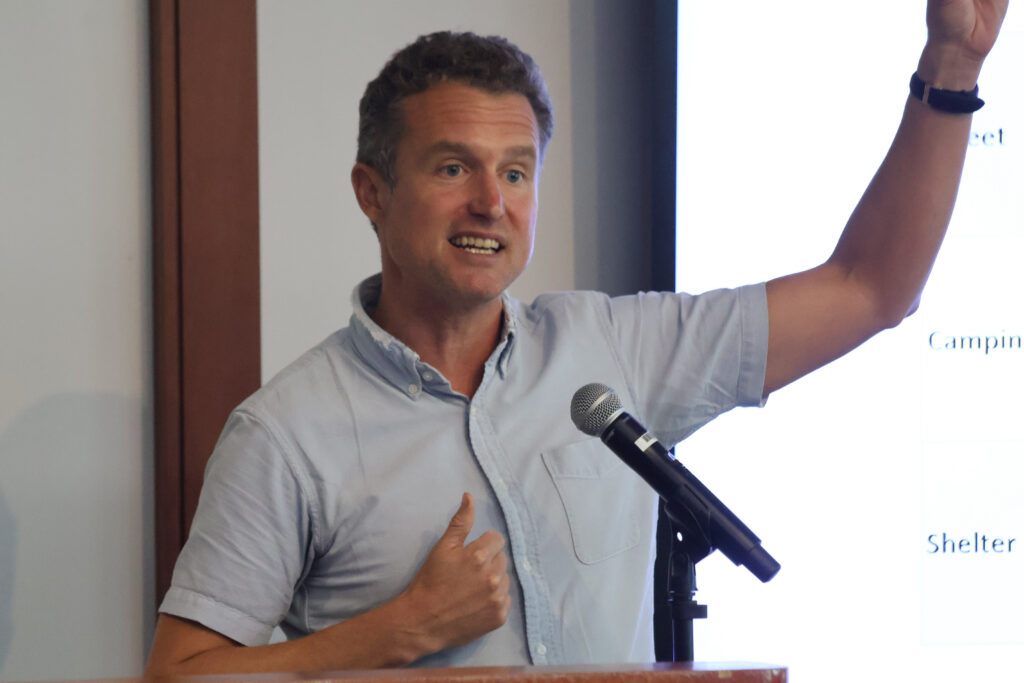
(Photo header: Dr. Chris Herring (UCLA) discusses nationwide homelessness at the ETW kickoff event for fall 2026.) Photo by Ava Brandt (’27 Creative Writing, Documentary Film, and LGBTQ Studies minor).