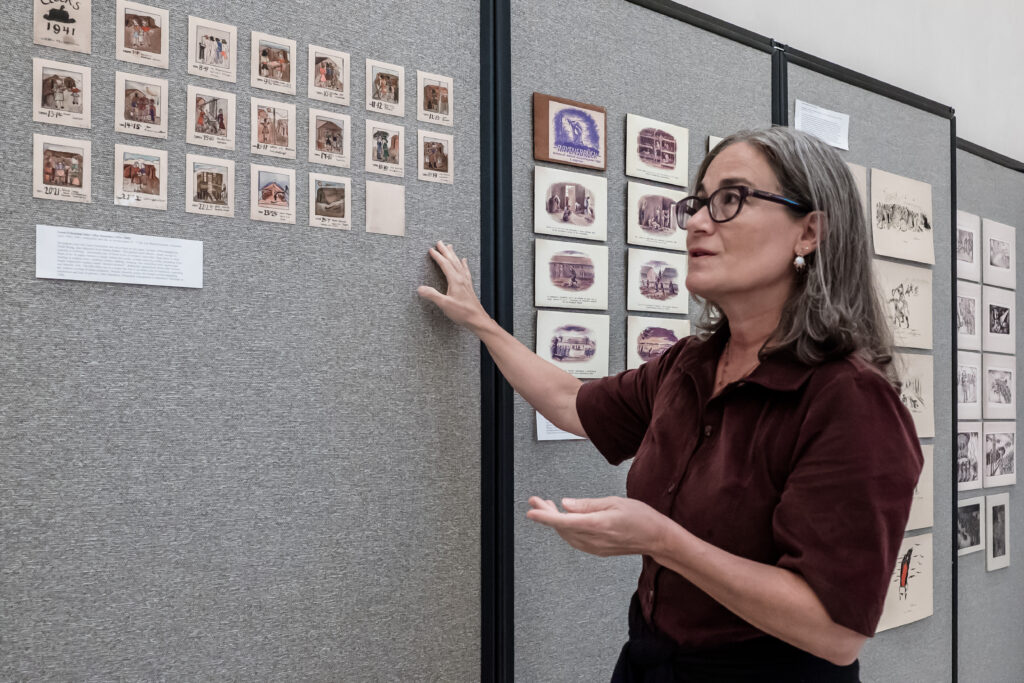
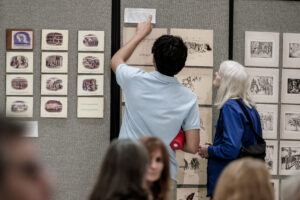
Dr. Rachel Perry (University of Haifa and Gratz College) visited Chapman University to discuss her curated exhibition, Who Will Draw Our History? Women’s Graphic Narratives of the Holocaust, hosted by the Rodgers Center for Holocaust Education. She brought several works from the exhibition to campus, giving attendees the opportunity to experience these powerful pieces firsthand. Through the women’s graphic narratives, the exhibition sheds light on the deeply personal stories, lived experiences, and unimaginable suffering of women who endured the horrors of the Holocaust, ensuring their voices and experiences remain part of history.
Who Will Draw Our History? tells the stories of ten Jewish women who survived the horrors of Majdanek, Auschwitz-Birkenau, and Ravensbrück, as well as life outside the Warsaw Ghetto under “Aryan” papers. In the days immediately following their liberation, these women began documenting their experiences through words and images. Without photographs to capture the atrocities they had witnessed and endured, they turned to visual storytelling to preserve their memories and bear witness to the suffering of Jewish people during the Holocaust, with a particular focus on the experiences of women.
The exhibit featured a variety of artworks, each documenting what was happening in the camps. The exhibit mainly featured pictures, drawings, sketches, and paintings of all different types. Some were entire booklets, while others were collections of Post-it-note-sized artworks. Each artist showcased the horrors of the camps in their own unique ways to shed a more nuanced light on what Jewish people went through during this time and how they were affected by it through the very lens of those who’d gone through it.
One of the major points Dr. Perry emphasized in her explanation of her curation was that many of these female artists understood the importance of their work. While some works served as a means of processing what was happening around them, others served to inform people of what was really going on, even if these women had no idea how they’d get their work into the public eye.
Another point Dr. Perry mentioned was the fact that these pieces are among the closest works we have akin to photos that capture the atrocities of the death camps in singular moments. Any photographs we have from the holocaust were taken by the Nazi regime seeking to glorify and justify the mass genocide. She touched on the importance of visual representation in documentation, and while written testimonies carry so much of what we understand about the Holocaust, visual testimonies are just as pivotal.
The Rodgers Center for Holocaust Education continues its tradition of hosting meaningful and thought-provoking events this year, including its annual Kristallnacht Commemoration on Monday, November 9, at 7 p.m. in the Fish Interfaith Center. This year’s program will explore the extraordinary life of Frieda Belinfante, a proud lesbian, courageous member of the Dutch resistance, and the first woman in Europe to lead her own symphony orchestra. Join us to learn more about her remarkable story of courage, resilience, and groundbreaking achievement.
(Photo header: Dr. Rachel Perry of the University of Haifa and Gratz College discusses the artwork featured in Who Will Draw Our History? Women’s Graphic Narratives of the Holocaust. Photo by Jeanine Hill.)