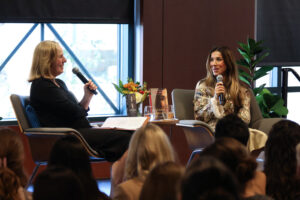
As part of Engaging the World: Leading the Conversation on People and Communities in Motion, Nadia Murad, author, advocate, Nobel Peace Prize laureate, and Distinguished Presidential Fellow in Peace Studies, sat down with Wilkinson College of Arts, Humanities, and Social Sciences Dean Jennifer Keene to discuss her latest book, I Choose My Beginning. The conversation explored the challenges of rebuilding a life after trauma, her family, and the freedom to define herself beyond an international advocate.
In previous visits to Chapman University, Murad discussed her experiences as a survivor of the 2014 Yazidi genocide by the Islamic State as detailed in her New York Times bestselling memoir, The Last Girl: My Story of Captivity, and My Fight Against the Islamic State.
Murad explained that her first book focused primarily on what happened to her and why the world needed to understand sexual violence as a weapon of war. Her second book, however, explores what came after, from the decisions she made to the challenges she faced, and the life she worked to build.
“My first book really looks backward; the second looks forward,” Murad said.
Although the books cover some of the same periods of her life, she explained that she now has a better understanding of what she experienced and shares those stories a little bit differently.
She also recognized that sharing her story had sometimes caused others to define her solely by what she had endured. Despite her work as an activist and her efforts to rebuild her life, she often found it difficult to make people understand that she was more than her trauma.
I Choose My Beginning offers more intimate details of Murad as a person, including her relationships and her efforts to reclaim control over her future.
“Survival is never the end of the story,” she said.
One of the main topics of the conversation was Murad’s experience with the idea of the “perfect victim.” She explained that people often expect survivors to act and look a certain way for their stories to be believed.
In her new book, Murad describes how she was told not to smile, wear colorful clothes, or put on makeup because people expected her to always look sad.
At first, she followed these expectations because she wanted people to understand her story. But over time, trying to live up to these expectations took a toll on her physical and emotional health.
After some time and conversations with her sisters, Murad realized she could continue her work as an activist while also taking care of herself and enjoying the life she had worked so hard for.
“A person can be a strong leader and make a difference while still being a full human being,” she said.
By learning to care for herself, Murad said she became a better advocate, friend, sister, and wife. She wants survivors to know that they should not have to hide their happiness or change who they are to be believed. They should be able to share their stories and live their lives on their own terms.
During the conversation, Dean Keene read a passage from Murad’s book reflecting on the importance of the older women in her community, particularly the influence of her mother.
“She made us proud to be Yazidi and proud to be women. She was killed not because she was useless but because she was too powerful.”
Nadia Murad, I Choose My Beginning, Chapter 25, “The Women,” p. 267
You could feel the emotion in the room. There wasn’t a dry eye in the audience, as those in attendance reflected on the devastating loss Murad has endured.
Murad shared that remembering her mother was once painful, but she now focuses on the strength and love her mother gave her. She described her mother as her greatest inspiration and said she continues to “talk” to her every day.
Murad also shared a story of her niece, Katherine, who was like a sister to her. While they were held captive by ISIS, Katherine gave Murad hope. Even after they were separated, Katherine somehow managed to stay in contact with their family and tried to escape.
After nearly two years in captivity, Katherine attempted to reach safety but was killed by an IED blast before she could escape. Murad said losing her niece made her question whether she could continue her work. However, she remains committed to sharing Katherine’s story to honor her memory and give voice to women and girls who never get the chance to tell their own stories.
By sharing her journey, Murad continues to ensure that the stories of survivors—and those who can no longer tell their own—remain part of the world’s collective memory.
During the talk, she expressed her appreciation for the university community, describing it as a place where she has always felt at home. She reflected on the friendships she has made with students and the meaningful conversations that have continued to inspire her.
Thank you, Nadia. We feel the same way about you.
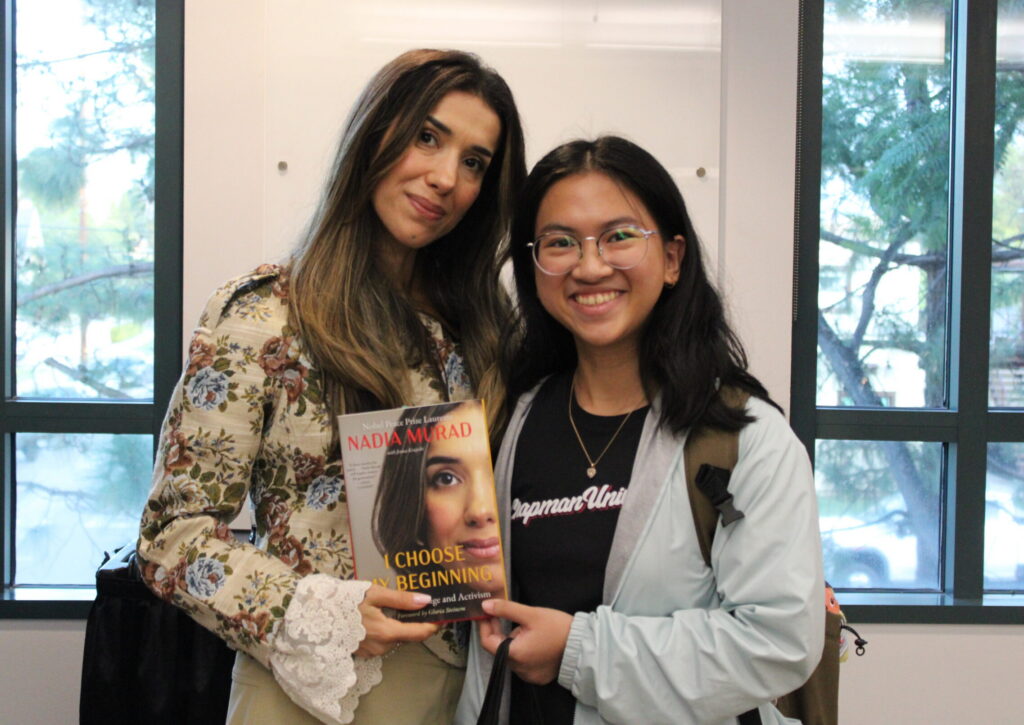
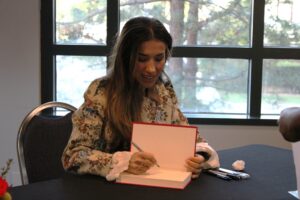
Photo Header: Author, advocate, Nobel Peace Prize laureate, and Distinguished Presidential Fellow in Peace Studies, Nadia Murad, signed books and posed for photos after her talk. Photo by Marisa Lamas (’27 Public Relations, Advertising, and Entertainment Marketing major, CCI minor).