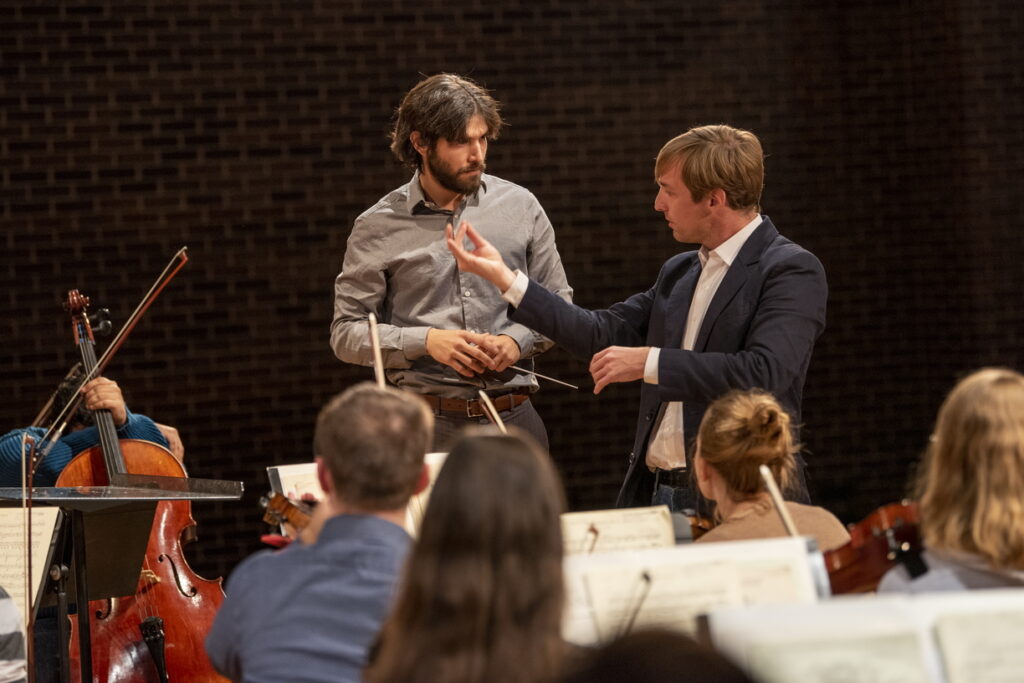
Danko Druško, conductor of The Chapman Orchestra and Director of Orchestral Studies at Chapman University’s College of Performing Arts, comes from a rich background in several disciplines, including both the musical arts as well as athletics, and he often draws connections between orchestra and sports teams.

Recently, Dr. Druško led a consulting session for a Swedish dragon boat racing team, during which he highlighted the links between music and athletics. A dragon boat racing team is a synchronized paddling crew, typically consisting of 10-20 paddlers, a drummer, and a steerer (helmsperson), racing a long, decorated canoe-like boat. This kind of racing is a particularly musical sport, as the rhythm of the paddlers is determined by a steady drumbeat.
Druško shared about his background in both sports and music, and found fascinating connections between the two fields.
Interview: Danko Druško on Orchestras, Sports Teams and Team Psychology
This interview has been edited and condensed.
What drew you to explore the parallels between orchestral performance and sports psychology in your research?
Danko Druško: I grew up living in both worlds. From a very young age, music and sport were never separate for me. There were two ways of understanding myself through discipline, teamwork, and performance. I played multiple instruments and competed nationally as both a musician and an athlete. All of the different activities demand strong physical awareness, rhythm, coordination, and mental control.
As I advanced in both fields, I noticed something striking. The language was different, but the psychology was often the same. Whether you are stepping onto a concert stage or lining up for a national-level competition, the internal questions are similar: How do I manage nerves? How do I trust my training? How do I balance my individual role within a team? This curiosity led me to explore how ideas from musical performance psychology could help athletes and how ideas from sports psychology could help musicians. Over time, it also became clear to me that these principles go far beyond music and sport. They offer valuable lessons for leadership, collaboration, and teamwork in any company or organization.

In the session with the rowing team, how did you frame the connection between musicians in an orchestra and athletes on a team?
I started by focusing on shared physical and mental experiences.
Pulse and synchrony were an immediate connection. In an orchestra, the most basic thing a conductor shows is the tempo. But every musician must feel it inside, not just in their head. Musicians often breathe together, sometimes without even thinking about it. This allows the pulse to settle into the body before the music even begins. In dragon boat racing, the drummer is the one who sets the stroke rate. The boat only moves well when every paddler feels that pulse and breathes in time with it. When breath and pulse match, movement feels smooth and natural.
I also compared the concertmaster, who aligns bow strokes in the strings, to the front paddlers in a dragon boat, who set technical consistency. Both quietly shape the flow of the whole group. From there, we explored topics ranging from breath, endurance, technique, harmony, leadership, and even silence. The athletes quickly saw how these ideas applied to their own experience. The connection became clear – these concepts offer a simple and powerful way to understand teamwork and communication as a whole.

From your perspective, what are the most important psychological principles that both musicians and athletes rely on in high-pressure environments?
Several key principles stand out:
- Trusting their preparation: Both musicians and athletes must let go of conscious control in performance and trust their training and muscle memory.
- Having internalized rhythm and timing: Elite performers rely on an inner sense of pulse and flow.
- Having attentional flexibility: The ability to remain aware of oneself while simultaneously adapting to the group.
- Managing energy: Knowing when to conserve energy and when to give everything is essential, whether in a long symphony or a race.
- Listening: Not just hearing, but continuously adjusting to others in real time.
- Visualizing and preparing: Long before performance day, musicians and athletes mentally rehearse movements, sound, timing, and execution. This cognitive training, going through motions without physically performing them, builds confidence, clarity, and readiness under pressure.

Can you walk us through how this consulting session with the dragon boat team in Sweden first came about?
The opportunity came from conversations with a close friend of mine, Tobias Hochdorfer. We were both athletes when we were younger. We wanted to bring new ideas about teamwork to his company in Sweden, Husqvarna, and to the dragon boat team he is part of.
As we talked more, it became clear how musical dragon boat racing really is. Rhythm, pulse, synchronization, and timing are all key to success. When the Swedish team reached out, we framed the session not as music teaching sport. It was a conversation between two high-performance cultures. I was not there to tell them how to paddle. I was there to help them feel what elite synchronization and shared timing look like in a new way.
How do you see this kind of cross-disciplinary work influencing your teaching and conducting at Chapman?
Over the years, this perspective has actually shaped how I talk to my music students. They benefit from ideas rooted in sports, like training, recovery, and mental toughness.
In conducting, I focus on leadership as guidance, not control. It’s like a coach who sets the stage for success and then trusts their team to perform.
In teaching, I focus on skills that apply beyond music, including focus, resilience, listening, and shared responsibility. These are both artistic and life skills.

What do you hope participants in your sessions ultimately take away from hearing a musician talk about teamwork and the inner workings of an orchestra?
I hope they leave understanding that excellence is rarely about individual talent alone. Whether in a boat or an orchestra, success comes from listening closely, trusting others, and committing fully to a shared rhythm.
At its best, teamwork feels almost effortless. Not because it is easy, but because everyone is aligned. When athletes hear how musicians think about harmony, breath, space, and trust, they often see the same values in their own performance. This recognition builds respect across different fields and shows that top-level performance follows the same basic principles, no matter the arena.