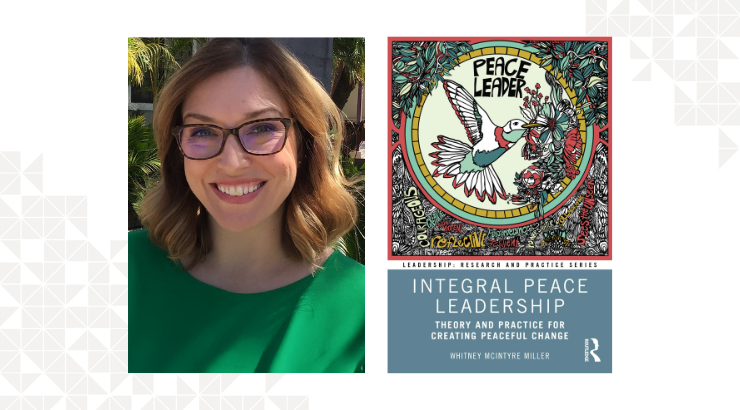
Whitney McIntyre Miller, associate professor at Chapman University’s Attallah College of Educational Studies, has released her first book, Integral Peace Leadership: Theory and Practice for Creating Peaceful Change, published by Routledge. The book draws on more than a decade of research to examine how leadership, peace studies and conflict transformation intersect across diverse global contexts.
McIntyre Miller began developing the integral peace leadership framework more than 10 years ago after identifying a gap in scholarship that examined leadership through a peace lens and peace through a leadership lens. Inspired by integral theory, which she encountered during her doctoral studies, she mapped existing peace and leadership principles across four interconnected areas. Early work on the framework led to a published article in 2015 and helped lay the foundation for the book.
Her research expanded through extensive literature reviews and interviews with community peace leaders around the world. A key turning point came through her collaboration with Euphrates Institute, an international organization that trains community-based peace leaders using the principles of her framework. “I was finally able to connect the theoretical ideas I was developing with the practical experiences of people in the field,” she said.
The book centers on four core areas, Innerwork, Knowledge, Community and Environment, and includes 16 narratives of individuals and groups working toward peaceful change in their communities. McIntyre Miller defines integral peace leadership as “a proactive, intentional approach to individual and collective action built through the interconnected development of skills and practices in order to challenge violence and aggression and create positive, just change.”
Rather than offering a step-by-step guide, the framework provides a flexible way for readers to understand the skills and practices that support sustainable change across settings. One participant featured in the book shared that the framework gave language to the work that she was already doing.
McIntyre Miller hopes the book encourages readers, particularly students and practitioners, to see peace leadership as accessible and actionable. “It does not have to be big or complex,” she said. “We can start with one small thing that helps us reflect on who we want to be and how we want to move in the world.”
Integral Peace Leadership: Theory and Practice for Creating Peaceful Change is now available on Routledge and Amazon.