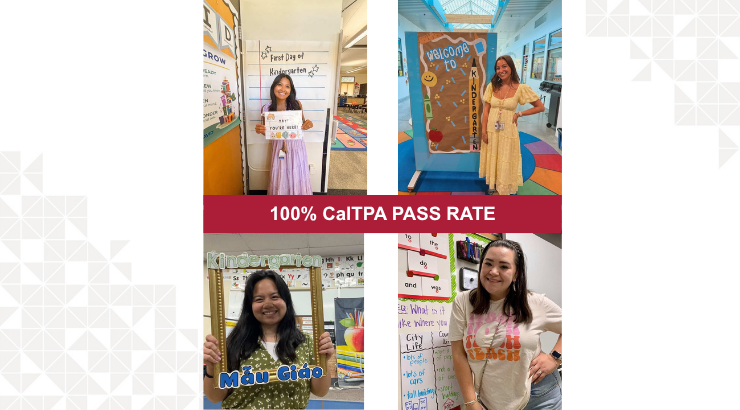
In 2026, every graduating teacher education candidate passed the California Teaching Performance Assessment before the end of student teaching.
Reaching 100% is meaningful. Doing it twice signals preparation, not luck.
For the second consecutive year, every teacher education candidate who graduated from Attallah College of Educational Studies at Chapman University passed the California Teaching Performance Assessment (CalTPA) by the time they received their credential. In 2026, the milestone carried an added distinction: every graduate cleared that bar before the end of student teaching.
That timing matters. Student teaching is the culminating clinical experience, when candidates demonstrate in real classrooms that they are ready to lead a class of their own. Passing the CalTPA before it ends means Attallah’s 2026 graduates entered their final weeks not as candidates still trying to cross a finish line, but as teachers already cleared for professional practice.

WHAT THE RESEARCH SAYS ABOUT PROGRAMS LIKE THIS ONE
California was among the first states to require a teaching performance assessment for licensure, and statewide data show how rare Attallah’s results are. A 2024 Learning Policy Institute brief identified three preparation factors most strongly associated with TPA success: strong program support for the TPA process, frequent and substantive clinical feedback from faculty supervisors, and deep content-specific training in teaching literacy and mathematics. Candidates in programs with the highest clinical feedback ratings were more than twice as likely to pass a TPA across all attempts, compared with candidates in the lowest-rated programs. Literacy preparation showed similarly strong effects, with candidates from the strongest programs showing nearly twice the odds of passing.
These are not incidental features of Attallah’s programs. They are the architecture of its teacher preparation.
THE FELLOWSHIP THAT SHARPENED THE FOCUS
Attallah College Dean Roxanne Greitz Miller, Ed.D. has been direct about the role TPA performance plays in understanding program quality. As a 2023-24 Deans for Impact fellow, she worked with national peers examining what makes teacher preparation effective, with attention to assessments that translate preparation into measurable classroom readiness.
The fellowship sharpened an existing conviction: TPA outcomes are not merely a compliance metric. They signal whether candidates have learned to teach and whether their program gave them the conditions to do so. The trajectory from 97% in 2024 to 100% in 2025 and 2026 reflects that conviction built into program design, from clinical placements to how faculty supervisors observe and respond to candidates in the field.
“This is what preparation should look like,” Dean Miller has said. “Not students hoping they pass, but teachers who have already demonstrated they are ready.”
WHAT IT MEANS FOR ATTALLAH GRADUATES AND THEIR STUDENTS
Every Attallah graduate who enters a California classroom this fall does so with both a credential and documented evidence that they can plan instruction, teach effectively, and reflect on student learning in ways that meet the state’s professional standards for beginning teachers. The CalTPA is designed to assess those capacities, and Attallah’s candidates have now met that standard completely and consecutively.
Students in those classrooms benefit directly. The LPI research underscores that the preparation experiences connected to TPA success are also connected to teacher effectiveness once candidates become teachers of record. When the pipeline from preparation to practice works as intended, it produces teachers ready on day one.
At Chapman University, that pipeline is working.
Source: Patrick, S. K. (with Ko-Wong, L.). (2024). How preparation predicts teaching performance assessment results in California [Brief]. Learning Policy Institute. https://learningpolicyinstitute.org/product/ca-teaching-performance-assessment-results-brief