National Science Foundation Funds Chapman Faculty’s Research in AI Educational Practices and Survival Data Modeling Congratulations to Dr. Wen for earning two National Science Foundation Grants!
December 18, 2025
At Chapman University, engineering faculty are at the forefront of revolutionary research. Fowler Engineering professors are exploring the connections between machine learning, artificial intelligence, and more, in relation to the current world around us. Through faculty-mentored research, students also reap the benefits of creating real change for their communities.
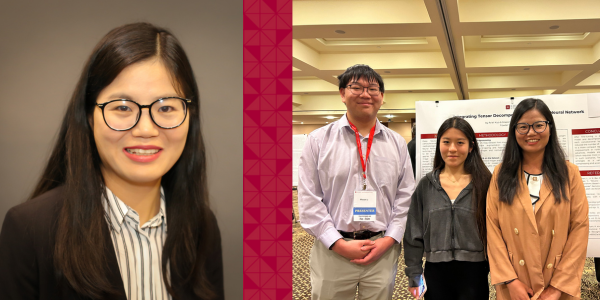
One of the many esteemed faculty researchers who has been awarded funding for two independent research projects is Dr. Yuxin Wen. Dr. Wen has been awarded two grants from the National Science Foundation (NSF) to expand her research in AI practices for undergraduate education and privacy system failure prediction modeling.
The Impact of Grant-Funded Research
Thanks to the financial support from NSF, Dr. Wen expressed the various opportunities presented by her individual grants. Specifically, the career preparation given to students who worked on Dr. Wen’s projects.
“They let me bring students onto the projects as hired researchers, and that gives them real training as they learn the full research process and see how these methods play out beyond the classroom,” she said.
Additionally, the funding has allowed Dr. Wen to “fully explore responsible AI and advanced prediction models” in settings that are “much closer to how these systems operate in practice.” The grants also presented new collaboration opportunities, as Dr. Wen worked with professors from different departments and with partners outside Chapman.
“Overall, the grants make it possible to move from theory to practical impact and involve students in meaningful, hands-on research,” Dr. Wen said.
Advancing AI Practices in Undergraduate Education and Reimagining Survival Data Modeling
Dr. Wen has worked with system failure prediction models since her time as a Ph.D. student at The University of Texas At El Paso (UTEP). “Complex systems, such as manufacturing lines and aircraft components, are difficult to monitor because failures can occur in unexpected ways,” Dr. Wen said. “The data collected is often noisy and irregular, and the underlying processes change over time.”
For her project, “ERI: Enhancing Privacy-Aware System Failure Prediction through Integrated Longitudinal and Survival Data Modeling,” Dr. Wen wanted to address common struggles in traditional approaches to system failure predictions, such as “capturing degradation trajectories, handling censored failure events, and providing reliable predictions under uncertainty.”
In collaboration with fellow faculty, Dr. Franceili Cibrian, as well as UTEP professors, Dr. Md Fashiar Rahman and Dr. Honglun Xu, Dr. Wen also worked on “From Awareness to Action: Integrating Responsible Artificial Intelligence Practice into Undergraduate Engineering Education.” Throughout this collaborative research project, Dr. Wen was motivated by the growing need for students to understand responsible AI.
“This project builds on the observation that students are not often taught how to address ethical and social challenges in AI,” Dr. Wen said.
To help future students make informed decisions in AI, Dr. Wen and her team combined “technical training with ethical considerations.” By using real-world healthcare datasets, Dr. Wen aimed to “help students explore issues like fairness, privacy, and transparency” in AI. Dr. Wen hopes that this research will provide students with the technical preparation necessary for future engagement with responsible AI practices.
Advice for Students
Grant-funded opportunities are continuously available throughout the school year. Dr. Wen offered advice for students and faculty pursuing grants for research. “Stay focused on the problem you want to solve and why it matters,” she said. “Be clear about the impact your work could have and what makes your approach stand out.”
Dr. Wen also stressed the importance of working with institutional partners. “Strong collaborations also make a difference. Make the proposal easy to read so someone outside your area can still understand why the work is exciting and important.”
Finally, she concluded with an important step: “don’t forget to highlight mentoring and training for students.”
Visit Chapman Engineering’s Undergraduate Research and Opportunities website for more information on how to get involved in engineering research.