Chapman Engineering Faculty’s Research on Education for Visually Impaired STEM Learning Secures National Science Foundation Funding “Overall, the grant transformed our idea into a tangible, testable product,” - Dr. Etezadbrojerdi.
January 5, 2026
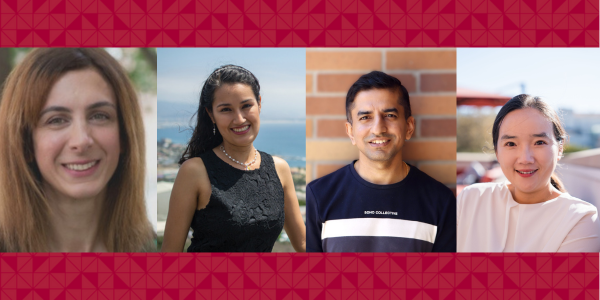
At the Fowler School of Engineering (FSE), research opportunities extend beyond the classroom. For many students, research projects can take more than one semester to progress. For faculty, special topics may be studied and examined for years to come. This year, two incredible engineering faculty demonstrated the breadth and depth of their passion for assistive technology: Dr. Maryam Etezadbrojerdi and Dr. Franceli Cibrian.
This year, Dr. Etezadbrojerdi and Dr. Cibrian secured more than $400,000 in National Science Foundation (NSF) grant funding for their project, “Advancing STEM Learning with Interactive Educational Games for Blind and Visually Impaired Children.”
For this project, the Fowler faculty’s research team consisted of Assistant Professor Rajeev Joshi, Grand Challenges Initiative (GCI) Postdoctoral Fellow Ariel Han, and undergraduate researchers Daniel Tsivkovski, Dylan Ravel, and Brandon Foley. Through the NSF grant funding, Dr. Cibrian and Dr. Etezad hope to revolutionize education for blind and visually impaired children by designing accessible braille displays, specifically for teaching STEM topics in elementary school.
Understanding Blind and Visually Impaired Education
Dr. Etezad and Dr. Cibrian originally conceived the project after they noticed a need for updated educational tools for blind and visually impaired children. “I became increasingly aware that blind and visually impaired students still lack access to educational tools that match what sighted students use every day,” Dr. Etezad said. “That gap motivated me to focus on solutions that could genuinely improve their learning experience rather than just accommodate it.”
Additionally, Dr. Cibrian highlighted the difficulties of traditional assistive tools for their project’s demographic. “Even when assistive tools are available, refreshable braille displays (RBDs) are often extremely expensive, difficult to obtain for classrooms, and not designed with STEM learning in mind,” Dr. Cibrian said.
Recognizing the growing need for advanced yet accessible technology for blind and visually impaired children, Dr. Etezad and Dr. Cibrian worked together to conceptualize RBDs that could translate complex topics in educational settings.
This topic drew the attention of Dr. Han and Dr. Joshi, whose research specialties closely aligned with the project’s respective goals. “It was a great opportunity for me to expand my research in the broader field, have overall experience designing the hardware parts, and learn more about human-centered computing,” Dr. Joshi said.
Dr. Han also had experience in educational settings, which she applied to the project. She said, “I have experience working in educational settings, but lack experience working with students with special needs. That brought my research to consider diverse learners and their needs into the design of educational systems.”
After finalizing their research goals and objectives, the team set out to conduct research beyond Fowler and advance research in RBDs for STEM topics in education.
“Ultimately, the goal was to create technology that could truly level the playing field,” Dr. Etezad said.
The Impact and Importance of Funded Research
Thanks to the funding provided by the NSF, Dr. Etezad and Dr. Cibrian were able to recruit undergraduate student researchers for their project. “This grant allowed us to engage undergraduate students in meaningful research with social impact, giving them hands-on experience in accessibility, Human-Computer Interaction, and inclusive STEM education,” Dr. Cibrian said.
Dylan Ravel, who has been an undergraduate researcher on the project since the 2024-2025 academic year, also assisted the team with coding, testing, and iteration of the system.
“We’re making a website, kind of like an interactive web app with accounts and lots of lessons. I’m working on the integration between the curricula that our research advisors are kind of all working on,” Ravel said. “We’re creating more of an equitable space for visually impaired students to learn at the same pace as students who aren’t visually impaired.”
While explaining the project’s impact on education for blind and visually impaired demographics, Ravel also offered insight into the academic and professional benefits of working on the research project.
“Being able to learn how to use Google Cloud and Google Firebase and all these kinds of higher level programs companies use, has been super valuable to learn,” Ravel said. “I can go into a job interview and if recruiters ask, ‘have you used these cloud-based tools?’ I can answer that I actually have, and I built this whole web app in an environment that allows me to fail and keep working.”
Additionally, Ravel offered insights on how this experience has shaped his professional and academic growth while continuing his education in Fowler.
“I realized how valuable it is and how much fun it is to just work with people of all different backgrounds. Working with our research advisors, hearing their perspectives on these things, they also have a lot of training on the education side. That’s been really valuable,” he said. “At the end of the day, we’re working with enterprise level tools that I wouldn’t necessarily have access to.”
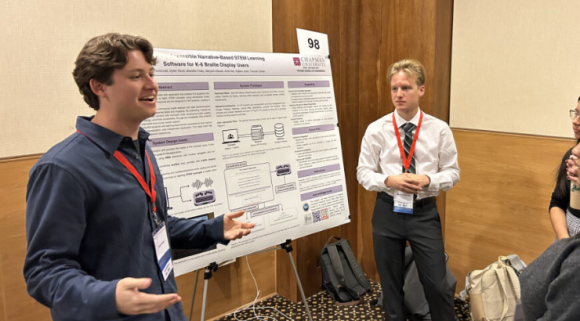
Dylan Ravel (left) and Daniel Tsivkovski (right) presenting their NSF research at the Fall 2025 Student Scholar Symposium.
Maximizing Opportunities with the NSF
Dr. Etezad mentioned the opportunities made possible by the NSF funding, which greatly benefited their research, such as “supporting travel to partner schools for interviews, observation, and user testing,” giving them the “time and structure to run a real research cycle with data collection and evaluation.”
For this project, Dr. Etezad and Dr. Cibrian focused on gathering data from K-12 schools that implemented braille education. The grant supported faculty researchers Dr. Joshi and Dr. Han in their data collection while traveling to those partner schools. “We collected some data from the schools, and then we turned that data into a journal. After that, we were thinking of adding the software,” Dr. Joshi said.
The NSF funding provided resources such as prototype materials for the team’s RBDs and equipment for hardware development. Shortly after gathering the necessary data, Dr. Joshi collaborated with Dr. Han to implement the hardware and software required to produce their RBDs.
“I worked more on designing the software, conducting research, and writing the paper,” Dr. Han said. “It’s important to create adaptive and understandable curricula for those age groups.
“Overall, the grant transformed our idea into a tangible, testable product,” Dr. Etezad said.
How Fowler Fortifies Intensive Research
Dr. Cibrian and Dr. Etezad noted the contributions made possible by Fowler’s support for the project, including lab space, fabrication tools, and student research support.
“Fowler Engineering provided access to shared lab space and fabrication resources needed to prototype and test our braille display,” Dr. Cibrian said. “FSE also provided the visibility for our work through internal communications and events, which helped us connect with new collaborators and participants.”
Dr. Cibrian deemed the institutional support from Fowler Engineering as “critical” due to their assistance in “launching and sustaining [their] accessibility research” while integrating it into opportunities for both teaching and student mentoring.”
“Fowler Engineering provided the infrastructure we needed to carry out the work, from lab space to fabrication tools. Fowler’s culture of hands-on learning aligned perfectly with our goals for developing and testing prototypes,” Dr. Etezad said.
Looking Towards the Future
With 2025 slowly coming to a close, Dr. Etezad and Dr. Cibrian hope to continue their research into the new year. Additionally, they’ve reflected on how this project has impacted their professional development.
“This project has opened doors to new collaborations, both within Chapman and with external partners, which has broadened my network and enriched the quality of my research,” Dr. Etezad said.
“The data from our user studies will highlight opportunities for improving refreshable braille displays and braille-based STEM tools,” Dr. Cibrian said. “The project has strengthened our track record in assistive technology and positioned us as leaders in accessibility-focused computing research at our institution.”
Reflecting on his own experiences, undergraduate researcher Ravel shared advice for students who are pursuing similar opportunities. “Remember you are just as much part of this project as your advisors are, who are doing this full-time,” he said.
Dr. Etezad, Dr. Cibrian, and their team of undergraduate and graduate researchers look forward to fulfilling their project’s mission and improving the technological standards for blind and visually impaired education.
Visit Chapman Engineering’s Undergraduate Research and Opportunities website for more information on how to get involved in engineering research.