Biofuel, Lasers and Global Citizenship The NSF IRES Stockholm Summer Research Experience
September 30, 2025
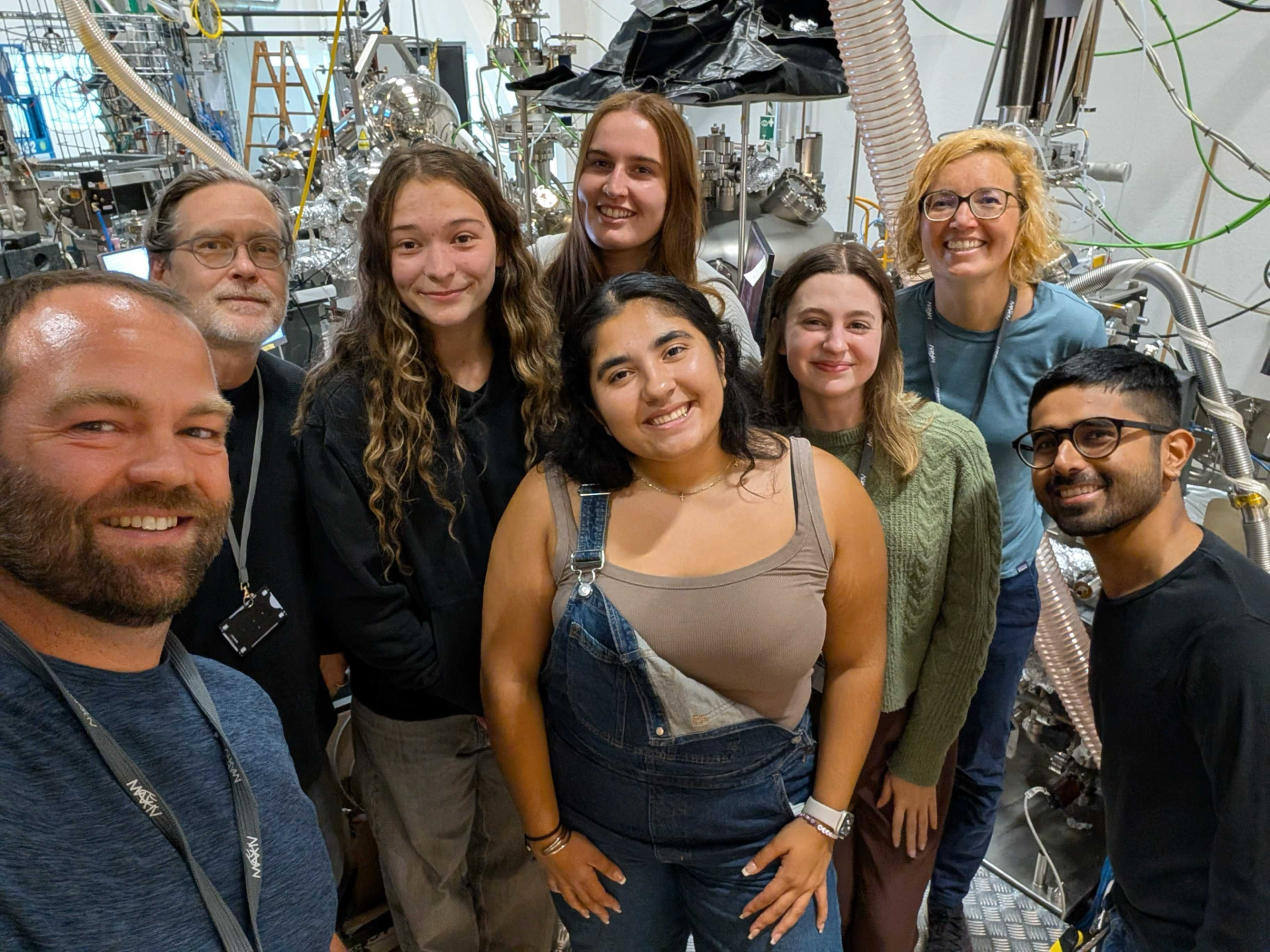
The NSF IRES Research Team at the MAX IV Laboratory in Lund, Sweden this summer. (Photo courtesy of Juliana Jordan)
Four Chapman students recently returned from Stockholm, Sweden after a “life-changing” ten-week summer program researching sustainable biofuel production and storage.
Studying abroad is a defining part of many students’ college experiences. But for those pursuing degrees in the sciences, finding the time for a semester abroad can be challenging. The answer for many STEM students? Summer study-abroad programs, including international internships and research opportunities.
The US National Science Foundation’s International Research Opportunities for Students program (NSF IRES) offers students a chance to conduct research abroad for ten weeks during the summer. This year, NSF IRES sponsored four Chapman students to go to Stockholm, Sweden, and intern under professors researching alternative fuels.
The program pays for all travel and accommodations, as well as a $6,500 stipend for each student. Interns are assigned a research mentor, and work 40 hours a week in state-of-the-art research facilities on AlbaNova university campuses, according to the NSF IRES webpage.
Olivia Guyette ’26, chemistry major, was one of the Chapman students selected for this summer’s NSF IRES program. Guyette previously did research under Professor Jerry LaRue, who acts as an intermediary with the program, and encouraged her to apply. Guyette worked on a research team at the Royal Institute of Technology, one of the Stockholm universities partnered with the program.
During her time in Stockholm, Guyette learned to use high-powered lasers and other equipment exclusive to only a few labs worldwide. Her work involved coding, organizing data, and running tests on stabilizing methods for storing hydrogen fuel, which explodes if not stored properly.
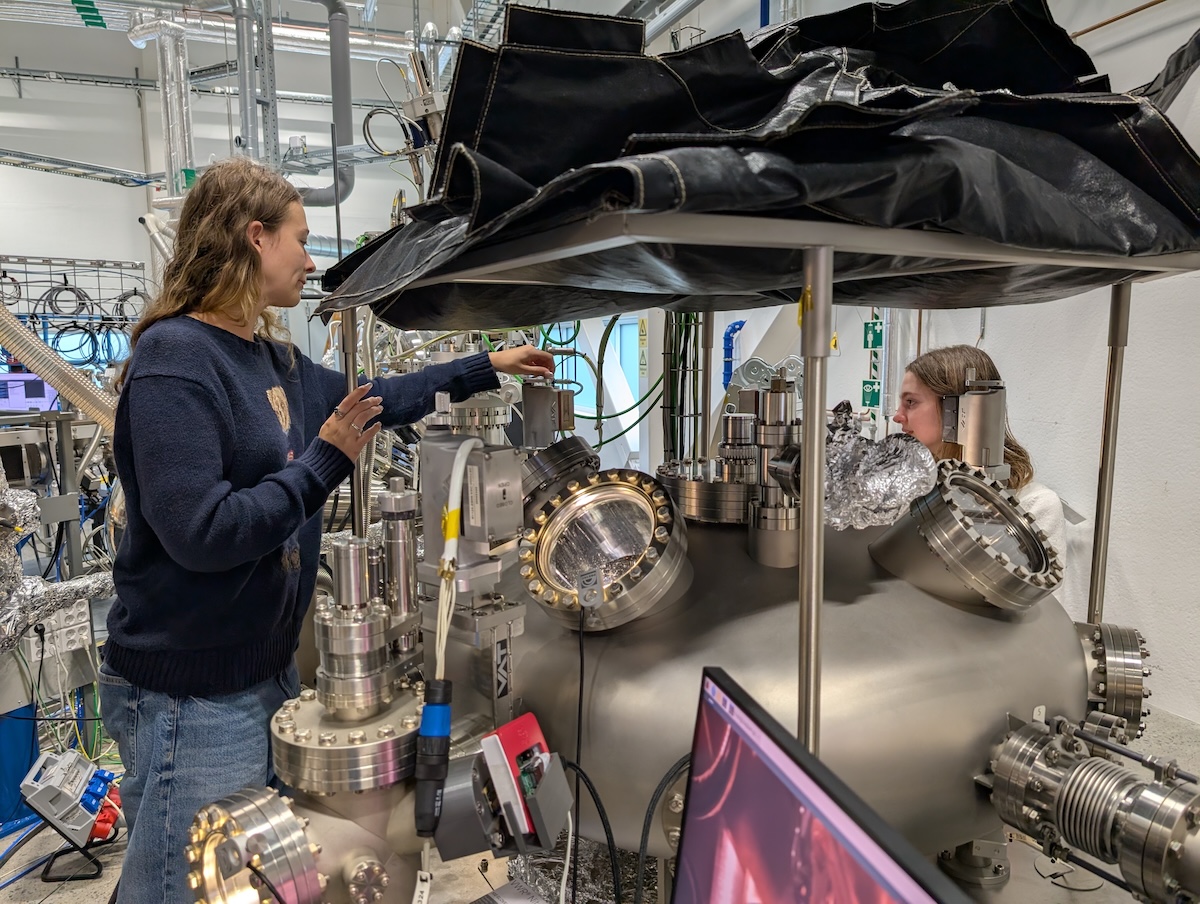
Olivia Guyette ’27 and Juliana Jordan ’26 worked together in the lab, gaining familiarity with advanced equipment. (Photo courtesy of Jerry LaRue)
“We were looking at reactions that happen on a metal catalyst surface. We would shoot a bunch of particles onto the surface, and see how it would react. Then we would shoot it with a laser that ionizes those molecules. They’re trying to break a hydrogen off of the other molecules,” says Guyette.
Guyette says that understanding these reactions may allow researchers to stabilize hydrogen fuel by bonding the hydrogen atoms to other molecules, then separating the hydrogen when it’s ready to be used.
Juliana Jordan ’27, physics and philosophy double major, also interned under NSF IRES this summer. She worked under two different professors at AlbaNova, another of the partner universities. Jordan was involved with two different labs, researching the sustainable creation of effective biofuels and mentoring other undergraduate researchers.
“We were looking at something called scanning tunneling microscopy. Essentially, I was taking really, really close-up pictures of very, very small parts of the surface to the point where you could see the actual molecules on the surface. I think they’re just beautiful. And it uses quantum physics to take these pictures, which is an application of things I’m learning in school, which is really cool,” says Jordan.
Jordan also had the opportunity to go to Berlin for sessions using large, specialized lasers not available in the university labs. These sessions are called “beam times.”
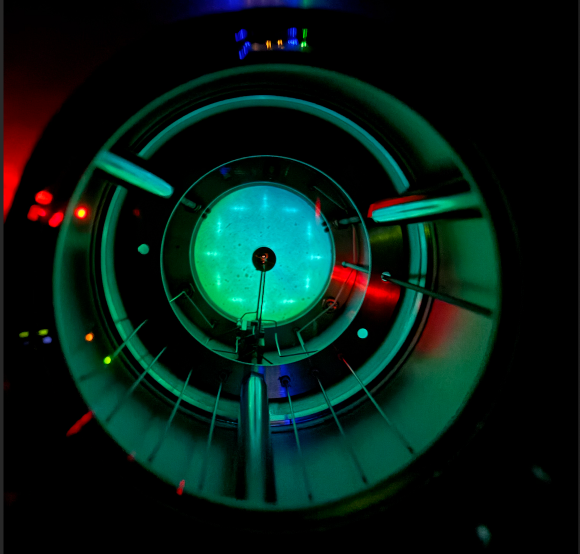
Students used a Low Energy Electron Diffraction (LEED) Machine to study atomic reactions. (Photo courtesy of Juliana Jordan)
“Because it costs a lot of money, you are at the laser 24/7, so you work in shifts. It taught me how much it meant to me to have collaborators — working with other international students at the beginning of the year, and laughing with them while we wait for the laser to heat up, or taking them out to coffee and hearing about their experience in school,” says Jordan.
Both Jordan and Guyette spent time outside the lab on the program’s allotted two weeks vacation, traveling, learning about Swedish culture, and collaborating with other researchers.
Guyette said that the program helped her become more independent. She described getting to know the other international interns, and exploring Copenhagen, Berlin and Paris during her days off as highlights of the trip.
“There were two other people on the program at the beginning, they were from France, and one I became really good friends with. When I had a week off, I had been talking about how I wanted to visit France, and she offered for me to stay at her house with her. So I got to go to Paris for five days! I was the least traveled out of the four girls that went. I had never been out of the country before, but I still got to come back and say I went to four or five countries in total,” says Guyette.
Jordan believes that being part of the program taught her what she wants from her education and career going forward, and helped her grow in confidence.
“I felt before that I could not do research. Like, in order to do this complicated physics research, you had to have experience. But to be able to go there and see it in action increased my confidence going into graduate programs. I hadn’t really thought about what I want my career to look like, and having been able to work in a foreign country, I now want to live and work abroad in the future,” Jordan says.
Although the program’s ten weeks are up, this summer’s research projects are far from complete. The student researchers will be credited on multiple papers for their work this summer, once their findings are verified and published and a few years time, according to Jordan.
Both Guyette and Jordan once doubted that they would be able to go abroad in college without delaying graduation; NSF IRES gave them a chance that they call “life-changing.”
The NSF IRES application is now open for Summer 2026.