Chapman University Hosts Inaugural National Conference on Advancing Research in Quantitative Reasoning in STEM Education
January 27, 2026
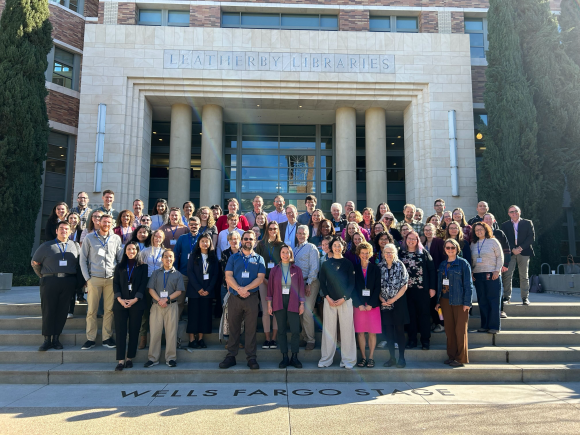
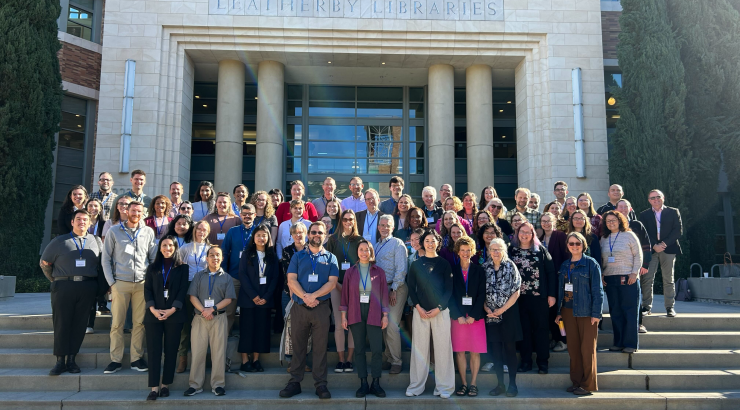
Conference goers pose for a group photo. Credit: Nyomi Johnson
Earlier this month, nearly a hundred attendees converged upon Chapman University for a landmark two-day conference focused on “Advancing Research on Quantitative Reasoning in STEM Education.” Co-hosted by Schmid College of Science and Technology and Attallah College of Educational Studies, the event attracted researchers, educators, and practitioners from 46 institutions across 26 states, reflecting a wide national commitment to improving quantitative reasoning skills among STEM students.
Provost Michael Ibba officially welcomed the conference attendees, emphasizing the critical importance of quantitative reasoning research and STEM education in today’s data-driven world. He also highlighted Chapman’s growing strength in STEM education research, supported by multiple faculty hires in education and discipline-based education research across Schmid and Attallah Colleges.
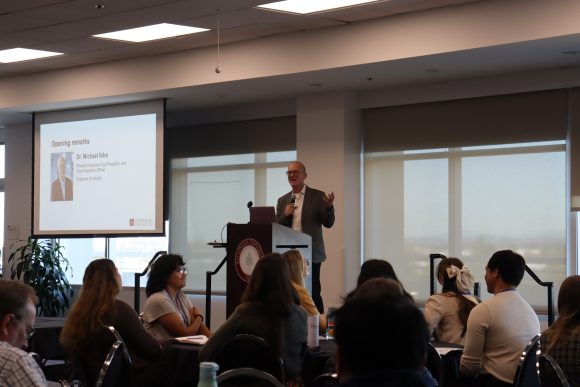
Provost Ibba kicked off the conference with a warm welcome. Credit: Liz Wakamatsu
Quantitative reasoning—the ability to interpret, analyze, and use numerical data—is widely recognized as a foundational skill for success in STEM fields and in everyday decision-making. Yet despite its importance, many students struggle to master these skills, and educators often lack evidence-based tools and strategies tailored to diverse learning environments.
The packed conference agenda addressed this gap, featuring 30 short talks, 5 plenary speakers, and 10 engaging poster presentations. Attendees explored a wide range of topics, including innovative teaching methods, cognitive frameworks supporting quantitative literacy, assessment approaches, and strategies for integrating quantitative reasoning across STEM disciplines. In addition, the conference fostered rich interdisciplinary discussions among education researchers across STEM fields and from both K-12 and higher education settings.
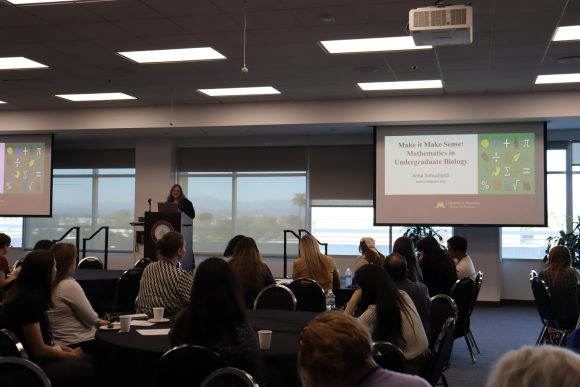
Dr. Anita Schuchardt, University of Minnesota, gave a talk titled, Make it Make Sense: Mathematics in Undergraduate Biology. Credit: Liz Wakamatsu
“One of our goals was to foster conversations among STEM education researchers across disciplines who often don’t have the opportunity to engage and share ideas with one another,” said Associate Professor of Biology Jeremy Hsu, one of the conference organizers and a biology education researcher leading a National Science Foundation-funded project investigating how students learn quantitative reasoning in biology labs. “It was remarkable to hear the varied perspectives shared across disciplines and witness the engaging discussions the conference sparked.”
The conference also provided valuable opportunities for trainees – both at Chapman and beyond – to present their work, receive feedback, and build professional networks. “Connecting with scholars from other fields was invaluable,” said Joelle Prate, a postdoctoral researcher with Chapman’s Grand Challenges Initiative. “The conference challenged me to think differently about how we can bridge disciplines to enhance our approaches to quantitative reasoning.” Adriana Quiros, a Ph.D. student in education in Attallah, concurred, stating, “Interdisciplinary learning spaces, like the one this conference provided, are essential – they are so important in supporting the analysis and interpretation of educational processes across multiple disciplines.”
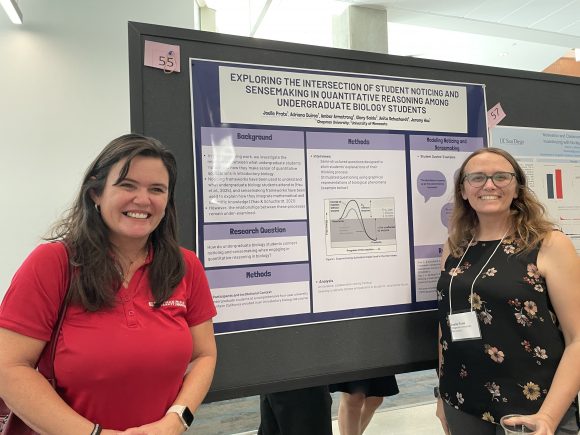
Adriana Quiros, Ph. D. student, and Joelle Prate, Ph.D., enjoying the poster session. Credit: Jeremy Hsu
In addition to Hsu, the other conference organizers were Tara Barnhart, Assistant Professor of Education; Sonja Cwik, Assistant Professor of Physics; Dan Dries, Assistant Professor of Chemistry and Biochemistry; Doug Havard, Assistant Professor of Education; and Nicol Howard, Associate Professor of Math.
The university is already starting to plan for the next iteration of this conference, to sustain interdisciplinary collaborations and continue advancing quantitative reasoning research in STEM education. This event exemplifies Chapman University’s growing leadership in STEM education research and its commitment to fostering collaborative, interdisciplinary approaches that enhance teaching and learning. By hosting such influential gatherings, Chapman not only advances scholarship but also strengthens connections between researchers, educators, and students at all levels.