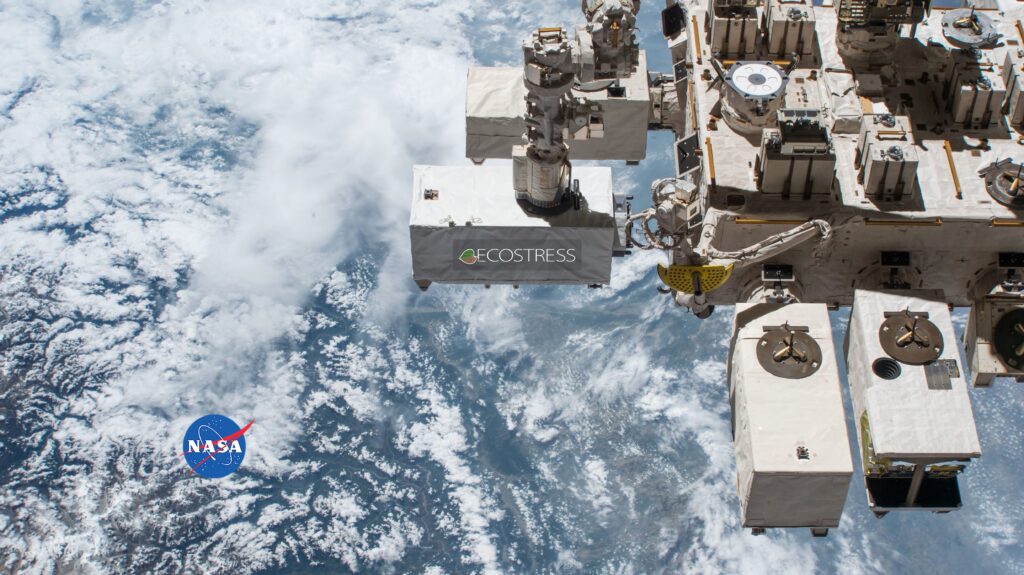
NASA recently awarded Schmid College’s Dr. Joshua B. Fisher two grants, totaling over $1.5M, to fund research in collaboration with the International Space Station (ISS), to track ecosystem complexity and build a famine early-warning system.
Dr. Fisher is a climate scientist and associate professor of environmental science, policy, and management in the Schmid College of Science and Technology at Chapman University. He was previously a NASA scientist at the Jet Propulsion Laboratory, at the California Institute of Technology, where he helped launch the ECOSTRESS missions to the ISS. Now, Dr. Fisher is using data from multiple instruments on the ISS and other satellites on two new projects to support conservation efforts and combat food crises.
Ecosystem Biodiversity
The first of Dr. Fisher’s new NASA grant projects uses data collected from the ISS to understand the complexity, biodiversity, and productivity of Earth’s ecosystems.
Dr. Fisher and his colleague from JPL, Dr. Dan Sousa, now a professor of geography at San Diego State University, teamed up on a proposal in 2020 combining data from various systems on the ISS. Dr. Fisher and Dr. Sousa believed that combining data from a variety of instruments from different types of missions would paint a more comprehensive picture of ecosystem biodiversity. At the time they were not selected for grant funding, but in 2024, Dr. Fisher, Dr. Greg Goldsmith, a Schmid professor of biology, and postdoc student Gabriela Shirkey submitted a second proposal to NASA. In June of 2026, they received word that NASA had revisited their proposal and awarded them grant funding.
Dr. Fisher and his team are currently analyzing data from multiple ISS missions, including the Global Ecosystem Dynamics Investigation instrument, which uses lasers that see the structure of ecosystems, space thermometers from ECOSTRESS, and cameras that can see the nutrients in the leaves, leaf structure, and even if they are photosynthesizing.
“We know that more complex ecosystems are more productive. By having these lenses on different ecosystems all over the world to look at the complexity of ecosystems, we can now capture their inherent biodiversity that you can see when walking through a forest. But now we can do it all over the world. The goal is to put these cameras together to capture the complexity of ecosystems around the world,” says Dr. Fisher.
All of the instruments used for this project are already on the ISS, so Dr. Fisher and his team are primarily analyzing incoming data. They are using AI to track how the data interacts on the micro and macro levels, and use a number of “ground truth sites” to check the AI’s work against reality.
Going forward with this grant, Dr. Fisher described the process as: “Analyze data, run models, check, validate, publish papers, rinse and repeat.” But he also uniquely extends this work to his teaching at Chapman, along with Dr. Goldsmith and Dr. Shirkey, in “ENV 231: Observing Earth from Above” where undergraduate students can earn general education credits while gaining hands-on, real-world experience analyzing data from the ISS.
“I’m getting a lot of people taking it for GEs because it’s interesting and not a basic math class. A lot of students who are afraid of science or math take it. It’s not just problem sets; it’s real world experience. Some of my best students were Dodge College film students. You just have to be a student who’s motivated and inspired. The rest is on me to be able to teach it,” says Dr. Fisher.
Human Flourishing and Economic Stability: Next-generation Food Security Warning System
The second of the two NASA grants will fund a food security warning system using NASA data to predict famine conditions around the world and mobilize aid sooner. The project is the brainchild of Dr. Fisher and his colleague, Dr. Krishna Krishnamurthy, now a climate scientist with the Green Climate Fund. During their time at Oxford University back in the late 2000s, they developed the idea of tracking ecosystem health and productivity to look for early signs of famines and droughts that other early warning systems might miss.
Dr. Krishnamurthy had worked for the UN World Food Program, and was well versed in famine aid and the flaws in the existing system. Together, he and Dr. Fisher synthesized Dr. Fisher’s expertise in remote sensing technology, or the study of Earth from space, with Krishnamurthy’s experience to propose a SMART model to predict famine conditions.
“Krishna asked why we couldn’t do better at predicting these food crashes. Because if you knew the food crash was going to happen, you could save millions of lives. But once it happens, it’s too late because it just takes too long to mobilize and distribute food for tens of thousands of people. By then, people are migrating, starving and dying,” says Dr. Fisher.
While famine early-detection systems do exist, they only have around an 80% accuracy rate, often underestimating severity and missing millions in crises. The breakthrough for Dr. Fisher came while working on ISS missions such as ECOSTRESS and SMAP. SMAP, which launched in 2015, tracks soil moisture all over the globe. Dr. Fisher and Dr. Krishnamurthy found that just before a region experiences drought and famine conditions, SMAP detects fluctuations in soil moisture.
Scientists call those early fluctuations “tipping points.” They exist across data, including temperature, biodiversity, levels of greenhouse gasses, and so on. These tipping points can mean the difference between a thriving coral reef and an ocean too warm for coral to survive, causing the whole reef ecosystem to collapse.
“There is a temperature threshold at which life can exist. You can walk on the beach one day, but the next day it’s hotter, the sand’s hotter. Then suddenly you walk on the beach and you burn. Your skin can’t sustain that temperature threshold, and you get a third degree burn. So a lot of the statistics have been done to see how certain systems have the capacity to buffer and absorb, until they can’t anymore,” says Dr. Fisher.
SMAP can detect tipping points three to six months before they happen, which gives the UN enough time to mobilize large-scale food aid before the worst of a famine hits. Dr. Fisher describes the tipping point detection capability as being like a wearable heart monitor for the planet, predicting heart attacks in time to do something about them.
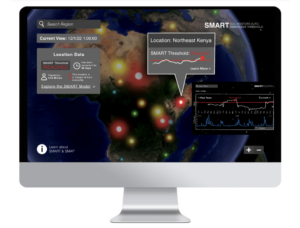
Dr. Fisher says that since they began analyzing this data for food security, they have caught every single food crisis. This accuracy is unparalleled in food security warning systems.
“We’re never wrong. That’s crazy in science; that never happens. It’s usually 60% right, or you make marginal improvement, but we’re never wrong on this. If there’s a drought happening, we know when there’s going to be a food crash. The UN World Food Program said this has the potential to save millions of lives,” says Dr. Fisher.
The project is funded by NASA’s INNOVATE, a program meant to bring together researchers and private sector partners to use existing technology in new ways. The grant awarded Dr. Fisher and his team nearly a million dollars in June, twice the usual funding for such research.
Dr. Fisher’s team includes two researchers from the Space Science Institute: Ryan Stonebreaker, the software engineer building the data analysis models, and Scott Davidoff, who is developing a user-friendly, human-centered version of their early-warning system. The system is designed to run automatically so that the teams at the Microinsurance Catastrophe Risk Organisation, which focuses on disaster relief, and the UN World Food Program can reference it without having to analyze raw data themselves. They can focus on mobilizing and distributing food to get to people in need.
Dr. Fisher and his team use data from NASA and Hydrosat, a commercial space company where Dr. Fisher serves as the Science Lead. Each day he and the research team are downloading the data from SMAP and Hydrosat, and running their computational analysis models so the researchers don’t have to do it all by hand. Their primary task right now is understanding what the UN needs in a program like this, and coding the model and the user interface to match those needs.
Wrap Up
Dr. Fisher says that his research is helping Chapman gain greater recognition in the scientific community for being at the forefront of science and creating a positive impact on the world. Students at Chapman have the ability to work alongside the world’s top scientific experts in their field to produce real scientific change.
“We are doing the most cutting edge work in this field. At Chapman, you can come out of high school and right into working with data from the International Space Station, finding disasters, helping people, and winning awards for it. Chapman students can feel proud.”