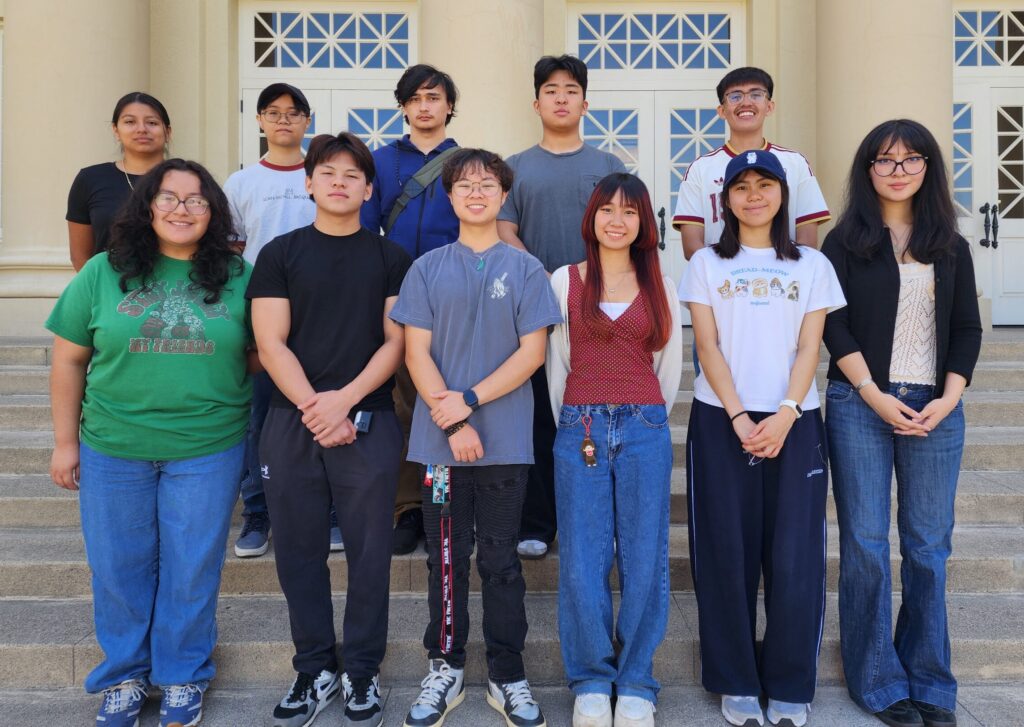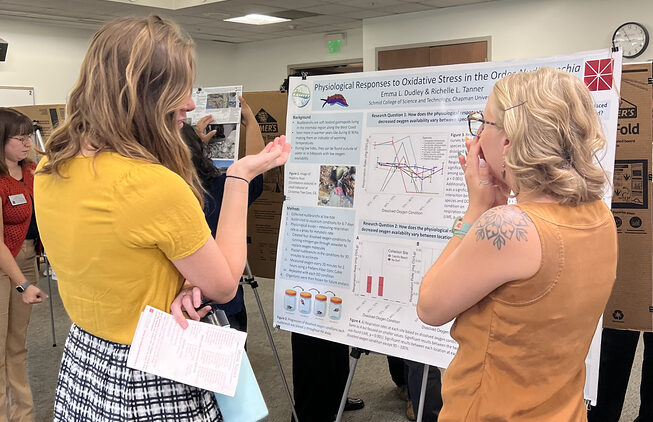

Dr. Vincent Esposito received two NASA grants from the Astrophysics Research and Analysis program in the first half of 2026 for his research on generating water from rocks for space travel, and on what certain chemicals can tell us about temperatures and environments lightyears away from Earth.
Dr. Esposito is a computational chemist and assistant professor of Chemistry at Schmid College. His current research focuses on astrochemistry and how chemistry on Earth can assist space travel.
PAHs: Space’s Molecule Thermometers
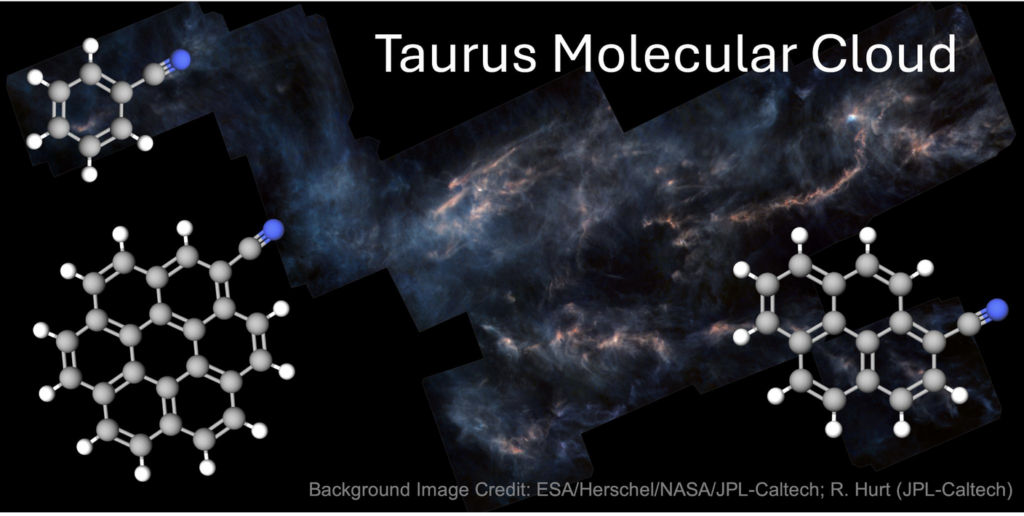
The first of the two NASA grants will fund Dr. Esposito’s research on a class of molecules that can tell researchers a great deal about the deep space environments, where they are found in large quantities. Polycyclic aromatic hydrocarbons, or PAHs, are large chemicals made from rings of carbon atoms. On Earth, they form when organic materials like wood, coal and natural gas burn, but researchers have found them all over deep space, between stars, and forming the structure around galaxies. PAHs tend to take on the properties of their environment, including temperature and pressure.
These molecules were discovered in space when researchers on the Spitzer Space Telescope found their infrared signals near other celestial bodies in the late ‘80s. Now, Dr. Esposito is using these PAHs to study the regions of space around them.
“On Earth, I could put a thermometer in a glass of water and it’ll tell me what the temperature is. We can’t do that in space, so these PAHs act as our thermometer. There are so many of them and they take on the characteristics and properties of that environment. They’re taking in radiation from all the stars around them, then they emit infrared light. And we can detect the infrared light with telescopes like the James Webb Space Telescope. Based on the light we detect, we can figure out what their chemical properties are and from that, infer what is happening up in that environment,” says Dr. Esposito.
Dr. Esposito has teamed up with Dr. Ryan Fortenberry, a professor of chemistry at the University of Mississippi, and Dr. Christiaan Boersma, a senior research scientist at NASA. They are analyzing infrared data from the James Webb Space Telescope to detect different types of PAHs in space.
“We have infrared astronomy, which detects vibrations. Radio astronomy shows how molecules rotate. The molecules can move, rotate and vibrate. And so this happens in all different wavelengths across the electromagnetic spectrum,” says Dr. Esposito.
Certain types of PAHs have been detected with radio astronomy. Now, Dr. Esposito wants to see if they can detect those same molecules using infrared astronomy. This particular NASA grant goes towards the computations of the data coming from the James Webb Space Telescope.
Experiments on the scale needed to study astrochemistry are time-consuming, challenging, and expensive to perform with the limited resources on Earth, so Dr. Esposito works with other scientists from all over the world. Researchers at the High Field Magnet Laboratory and Free Electron Lasers for Infrared Experiments (HFML-FELIX) facility in the Netherlands, such as Dr. Piero Ferrari, share laboratory data with Dr. Esposito and his team to improve computational accuracy, and the computations then expand our knowledge to systems that experiments can’t reasonably accomplish with current technology.
Interstellar Dust and Ice: the birth of planets could help us create water in outer space
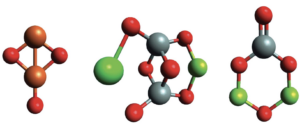
The second NASA grant will investigate how interstellar dust forms to better understand how planets take shape. This same process can possibly work in reverse to generate water from rocks.
Rocky planets like Earth form from molecules bonding together and freezing, then growing to become interstellar dust that gathers together into larger and larger structures to make a planet. While researchers understand many of the steps involved, the chemical process that causes molecules to grow into dust and ice remains largely unknown. Dr. Esposito is part of a group of researchers studying how the foundational molecule groups can grow large enough to build a planet, with the similar goal of developing low-energy ways to synthesize water in space.
“One of the most fundamental problems of space travel is water. Humans need water to grow food, to drink, to do everything. Water is probably the most important thing in the Universe. But it is also extremely heavy, so bringing water with us places is energy-intensive. The idea is finding how we can get water from the environment where we’re going. We’re thinking about the Moon, and there is ice and water up there in the polar craters. But it’s not exactly sustainable to extract it directly, so trying to create water in situ on the Moon is a really big field of research. A byproduct of this research that we’re doing is creating water from the rocks,” says Dr. Esposito.
When dust grains, like metal oxides, react with hydrogen, it produces water. Dr. Esposito theorizes that the process could be recreated with moon rocks. Hydrogen compressed into liquid is much lighter to transport than water. Researchers are already doing this on Earth, but current processes require a lot of energy and heat.
“The idea behind our project is that you won’t need any of that heating. If you just put water or hydrogen gas on a rock and let solar energy warm it up, then we can create water,” says Dr. Esposito.
Wrap-Up
Dr. Esposito and his co-investigators submitted their proposals in January of 2025, and received their grant funding in early June. They are now working on the foundational calculations for both research projects. Dr. Esposito says he is grateful to be part of NASA’s current research projects.
“Theory is difficult to get funded from agencies because it’s very predictive. So the fact that we got both of these grants funded in the same cycle, in the same program is outstanding.”