Ashley Agatep ’27, an environmental science and policy student in the Schmid College of Science and Technology, was recently awarded a prestigious Barry M. Goldwater Scholarship. The Goldwater Scholarship is one of the top honors for sophomores and juniors pursuing research in the natural sciences, mathematics, or engineering in the United States. Ashley received the recognition for her work on collecting and analyzing thermal inequities in public parks in Los Angeles County using satellite data.
We had the chance to speak with Ashley to learn how she got involved in environmental science research, and how important it is to understand and improve the environments we live in to ensure communities get the support they need.
The Development of Ashley’s Research
Ashley’s interest in environmental science research and advocacy drew her to Chapman University, where she has pursued a major in Environmental Science and Policy. She was involved in habitat restoration, volunteering, and environmental advocacy projects in high school, which inspired her to pursue environmental research as soon as possible. This passion allowed her to secure a spot in Dr. Joshua Fisher’s (an associate professor of environmental sciences in Schmid College) research lab the summer before her first year at Chapman.
“I ended up cold-emailing my current advisor, Dr. Fisher, saying I was incredibly interested and would love to eventually be involved in his research that utilized NASA’s satellites to examine global ecosystem change and socio-environmental health,” says Ashley, “Instead of waiting until I started freshman year, Dr. Fisher invited me to start learning and working with his lab the summer of my senior year, and I’ve worked with his lab ever since!”
For the past three years, Ashley has worked as a researcher on the NASA Community Action for Equity and Environmental Justice grant. This grant is a collaborative project between Communities for a Better Environment and various universities, including the University of California, Irvine and Chapman University, that, in Ashley’s words, “utilizes a novel combination of community-based participatory research methods and satellite data to identify, analyze, and develop actionable solutions to environmental hazards in Los Angeles County.”
While working under this grant, Ashley has facilitated community mapping sessions, listening sessions, and leadership training academies to understand the lived experiences of Southern Californians in Los Angeles County.
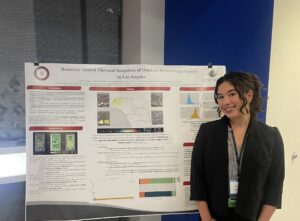
She says, “These interactions have informed my research questions, leading me to investigate disparities in public park access and quality, the distribution of industrial air pollution, and decreased health outcomes from these environmental injustices, utilizing satellite data.”
The project’s findings were recently published in the article “Thermal Inequities in Public Parks and Open Spaces in Los Angeles Determined by Remote Sensing,” where Ashley is the lead author. The study found that public spaces in the underserved South Los Angeles area experienced higher surface temperatures due to a lack of cooling surfaces and resources compared to those in West Los Angeles.
Her research has inspired recent articles by CBS News and the OC Register exploring the health risks for Southern Californians driven by park inequalities. Ashley notes, “Working on this project has shown me the immense role scientists have in aiding communities- through providing data-driven analyses and resources that can support lived experience and advocacy.”
Environmental Science’s Impact on Policy and Change
Ashley has demonstrated a deep-rooted dedication to environmental policy, grounded in her belief that the environment is not a neutral backdrop for society. She says that, “decades of peer-reviewed research and advocacy from impacted communities have shown us that the environment in which you live, down to the zip-code, drastically changes your life expectancy, health, and quality of life. From air pollution, access to green spaces, access to clean water, and so much more, these environmental factors govern our lives, and therefore, we all have a stake in fighting for the environment.”
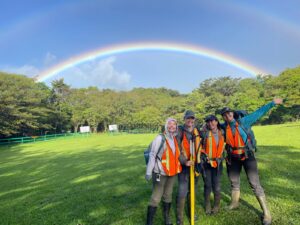
Ashley notes that her “passion for environmental advocacy came from the realization that the environment is not a passive, separate part of our lives, but something that encompasses and impacts every aspect of social justice, public health, and global security. Environmental health is inseparable from public health. Environmental justice is inseparable from social justice. In a constantly evolving world, it becomes essential to articulate these interconnections.” As a Goldwater Scholarship recipient, Ashley plans to continue her research in environmental science to generate actionable outcomes to improve environmental health.
Thoughts on the Goldwater Scholarship
When asked about how she felt about being a 2026 Goldwater Scholar, Ashley said, “The Goldwater Scholarship was incredibly meaningful to me as it has given me great confidence in my potential as an aspiring scientist. It excites me to join this community of scholars who have gone on to make meaningful contributions within the scientific community, and I hope to become one of these scholars! The Center for Undergraduate Excellence has been such a wonderful resource and part of my experience here at Chapman. Working through these scholarships, with the guidance and encouragement of the center, has truly helped me align my goals for the future and figure out my identity as a student and scientist!”
Future Plans in the Field of Environmental Research & Advocacy
Continuing her work in environmental research, Ashley will intern at the National Oceanic and Atmospheric Administration during the summer of 2026, where she will synthesize existing research and community-based efforts on extreme heat. She hopes to analyze the data to generate actionable plans that can lead to effective change to support the environment.
After graduating from Chapman, Ashley plans to pursue a PhD in environmental sciences to continue her action-based research and drive advocacy efforts to inform changes in environmental policy.