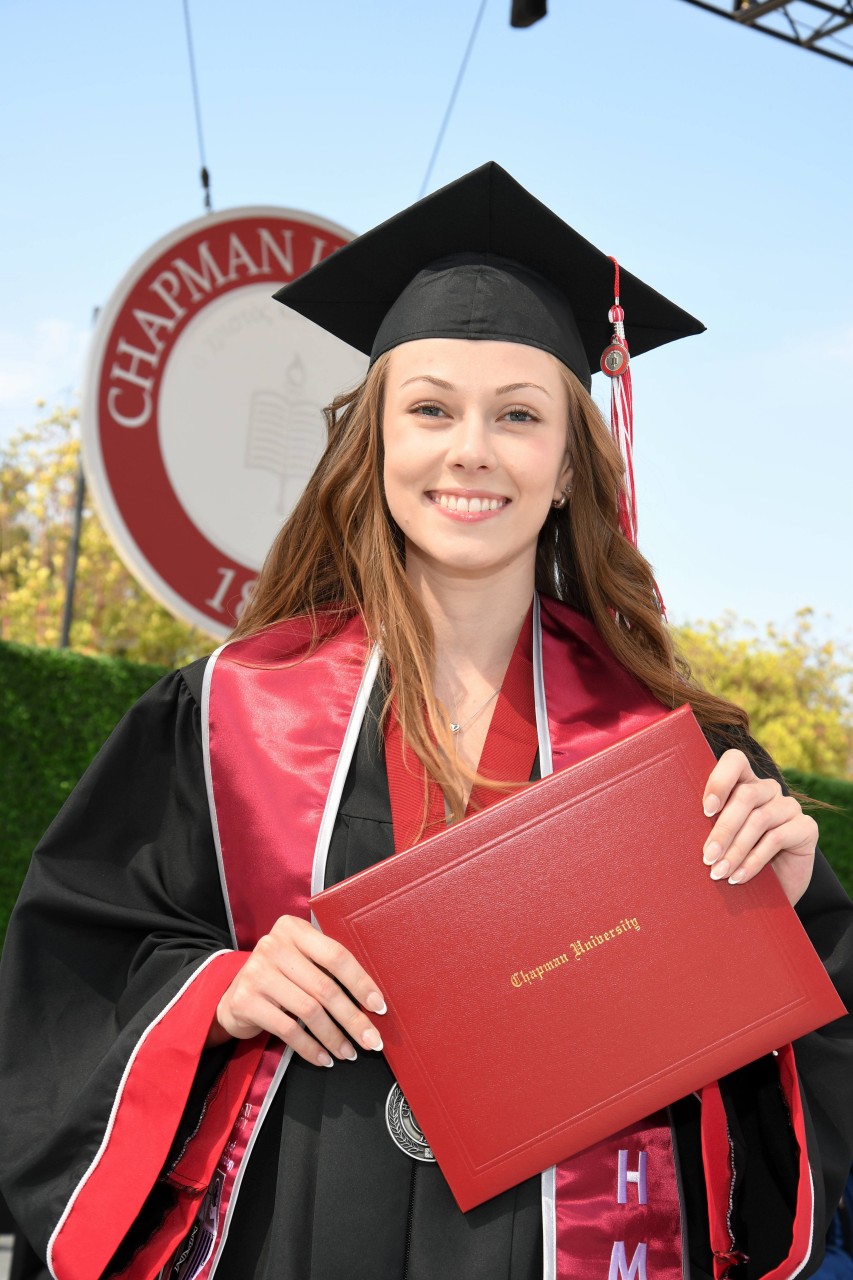
Schmid College is thrilled to share that Abbygail Caine ’25 was recently named a 2026 NSF Graduate Research Fellowship Program (GRFP) awardee.
The NSF GRFP supports the scientific and engineering workforce in the United States by providing funding to graduate students pursuing research in science, technology, engineering, and mathematics (STEM) fields, including STEM education. Recipients of this fellowship receive financial support to assist with the cost of tuition in addition to being offered opportunities to engage in professional development and international research projects. Awardees must have demonstrated their ability to produce significant research contributions to scientific inquiry and discovery within their field.
Abbygail Caine ’25 graduated from the Schmid College of Science and Technology at Chapman University with a Bachelor of Science in Biological Sciences, with an emphasis in molecular biology. After graduating, she became a PhD student in the Lampe Joint Department of Biomedical Engineering at North Carolina State University and the University of North Carolina at Chapel Hill. Here, she has engaged in research to develop and characterize novel decellularized extracellular matrix (dECM) biomaterials for regenerative medicine applications. Caine was kind enough to share her thoughts on her academic and research journey, which began at Chapman and continued into her doctoral program.
Research Involvement
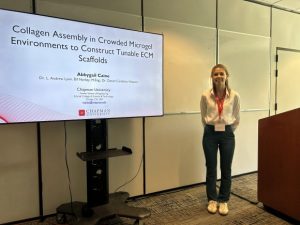
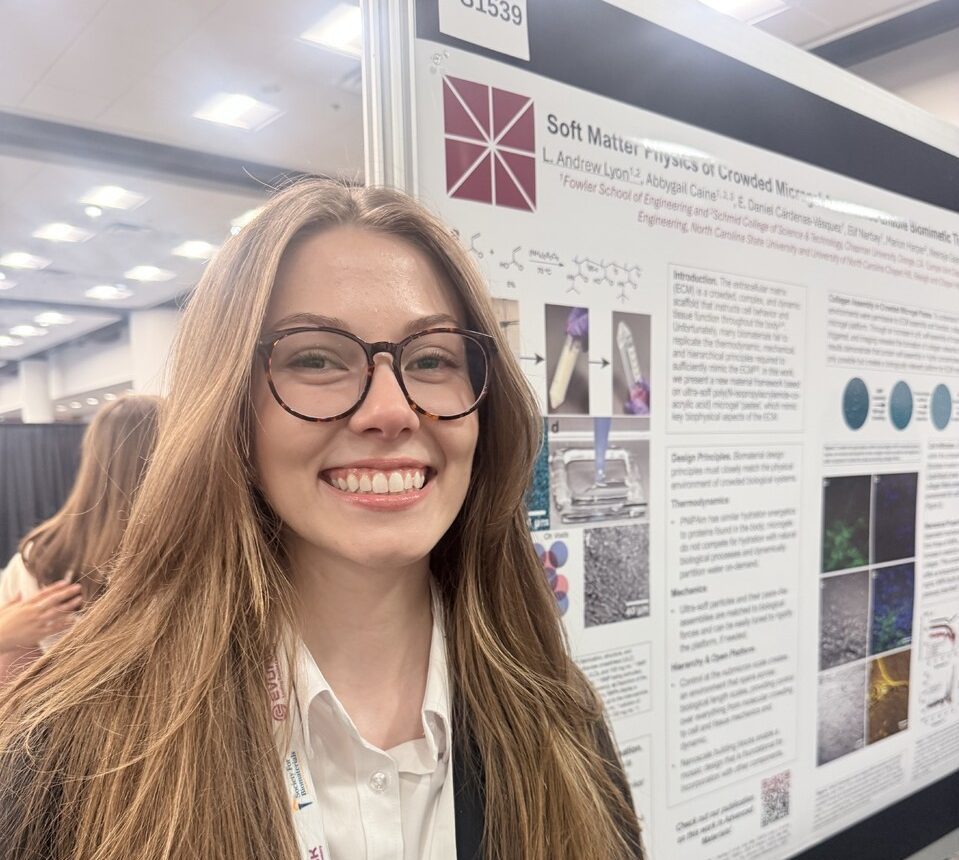
Caine’s research journey began at Chapman through her participation in the Grand Challenges Initiative, a required curriculum for all Chapman STEM students that teaches them to engage in scientific inquiry and discovery. Caine worked with a group interested in tissue regeneration, where her path first crossed with her long-term mentor, Dr. Andrew Lyon. She joined his lab, where she worked on “developing biomimetic materials to better replicate the extracellular matrix (ECM), focusing on how structural and mechanical properties influence biological function. [Her] research centered on engineering composite systems made up of microgels and collagen.”
Caine’s experience working in Dr. Lyon’s lab was foundational to her academic development, and she says it was “one of [her] favorite parts of [her] Chapman experience.” She discovered a passion for biomaterials and regenerative medicine which she says helped her gain “confidence in communicating scientific ideas, presenting at conferences, and contributing to publications,” ultimately preparing her to pursue a PhD and compete for opportunities like the NSF Graduate Research Fellowship.
Future Endeavors
Now that Caine is an NSF Graduate Research Fellow, she plans to continue in her work in regenerative medicine by “developing predictive biomaterial systems for wound healing applications.” Specifically, she will be “designing composite materials that integrate decellularized extracellular matrix (dECM) with fibrin to better mimic the complexity of human tissue.”
Once she completes her PhD program and her time as an NSF Graduate Research Fellow, Caine wants to pursue a career in the biomedical space that allows her to engage in research, innovation, and entrepreneurship. She says her “long-term goal is to develop accessible and effective therapies that address unmet needs in healthcare, particularly for underserved populations.” She hopes to use her research to generate real-world solutions.
Tips for Students
When asked what she would say to students interested in getting involved in research at Chapman, Caine encourages them to put themselves out there and be proactive by reaching out to professors. She emphasizes that it is important not to be afraid to talk to professors, even if students don’t feel fully qualified to work in a research lab. Having curiosity about a research topic and being willing to learn will make you an invaluable asset to any team. Caine’s most notable piece of advice for students is to “take the time to understand why the research matters, not just what you are doing day-to-day. That mindset will help you stay motivated and get more out of the experience.”
For any Chapman students interested in pursuing a graduate degree, Caine encourages focusing on gaining research experience and learning to think independently. She says that, “Graduate school is less about knowing everything and more about being able to ask meaningful questions and solve problems.” Students do not know everything going into a program, but it is important to know how to find answers. Caine also encourages students to find mentors, both inside and outside the sciences, to challenge and support them throughout the academic process. She emphasizes that “having the right mentors can make a huge difference in your trajectory.”
Special Thanks
When asked if she would like to say anything to her mentors at Chapman University, Abby said, “I am incredibly grateful to the mentors and professors at Chapman who shaped my journey.”
She noted that she would “especially like to thank Dr. Lyon for being an exceptional mentor and PI, and for bringing [her] into the world of research. His guidance and belief in [her] potential gave [her] the foundation to grow as a researcher.” Caine also extends her thanks to Dr. Melissa Rowland-Goldsmith for “being not only a great professor,
but also a mentor and friend, and for showing me the meaning and importance of community involvement, which has had a lasting impact on how I approach both science and service.”
Finally, Caine wanted to thank Dr. Christopher Kim, Dr. Hagop Atamian, and Dr. Jean-Louis Bru for their support, encouragement, and dedication to teaching. She says, “Each of them contributed to my growth in meaningful ways, both academically and personally, and I am incredibly appreciative of everything they have done for me.”
We are incredibly proud of Abbygail and cannot wait to see the amazing things that she will continue to discover as a researcher. Congratulations!
For anyone interested in learning more about applying to the NSF GRFP, visit the Application Resources webpage. The Center for Undergraduate Excellence is also available for Chapman students in every major who are interested in learning more about research, fellowship, and scholarship opportunities.