Schmid students spend countless hours studying, but in SCI 320, they become teachers and mentors for a few hours a week.
SCI 320 – “STEM in Action” is a Schmid class that was created in partnership with Higher Ground Youth and Family Services, an Orange-based nonprofit after-school program serving underprivileged K-12 kids in a variety of subjects. Each semester, Chapman students spend their Friday afternoons developing and presenting interactive STEM activities and mentoring children in Higher Ground’s After-School Enrichment program. For many of the Higher Ground kids, this is their only exposure to hands-on science education.
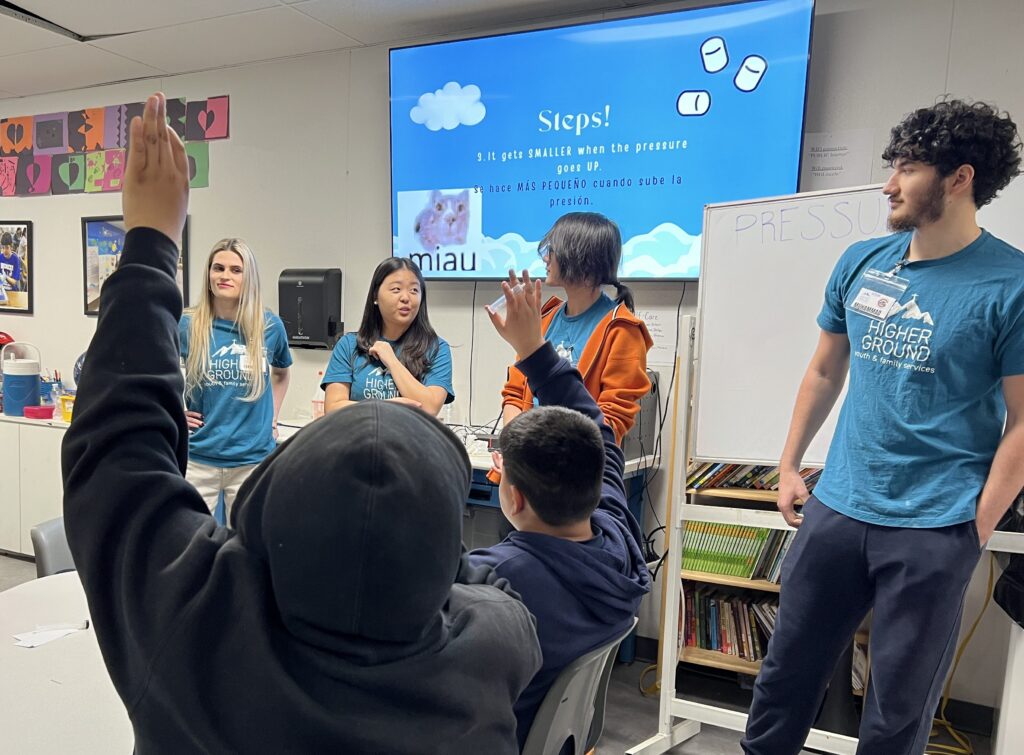
Back in March, Schmid College’s student blog writer, Mariel Sheets ’27, had the chance to tag along to the first “STEM Day” of the semester. In a portable classroom at Lincoln Park in Anaheim, the Spring ‘26 SCI 320 class led their first interactive science experiments with fifth and sixth-graders. For the K-12 kids, it was their first interaction with returning SCI 320 students and professors in several months, but for our Chapman students, it was the culmination of weeks of preparation.
Since the start of the spring semester, the class had conceptualized the experiments, adapted them to be engaging and accessible for different age groups, studied teaching techniques for STEM, and honed their public speaking skills to get ready to teach this special audience.
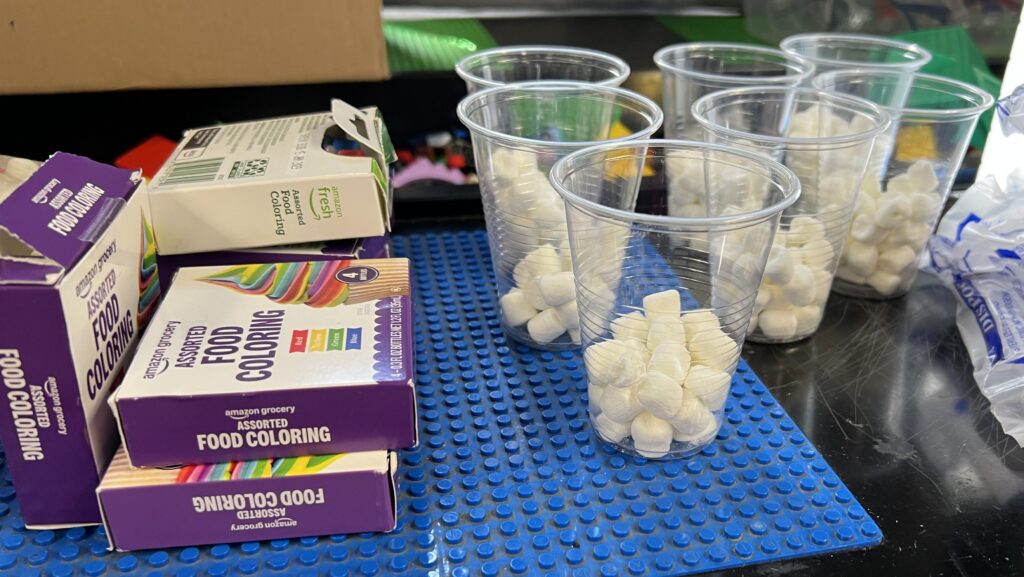
The day’s experiment showcased the connection between volume, pressure, and density. The kids got to make a cloud in a bottle, using flexible plastic bottles with “chemical liquid” (rubbing alcohol) inside, twisting the bottle before releasing to create a sharp drop in pressure to form a cloud. One child was so fascinated by the experiment that he asked one of the professors how he could recreate it at home to show his mom.
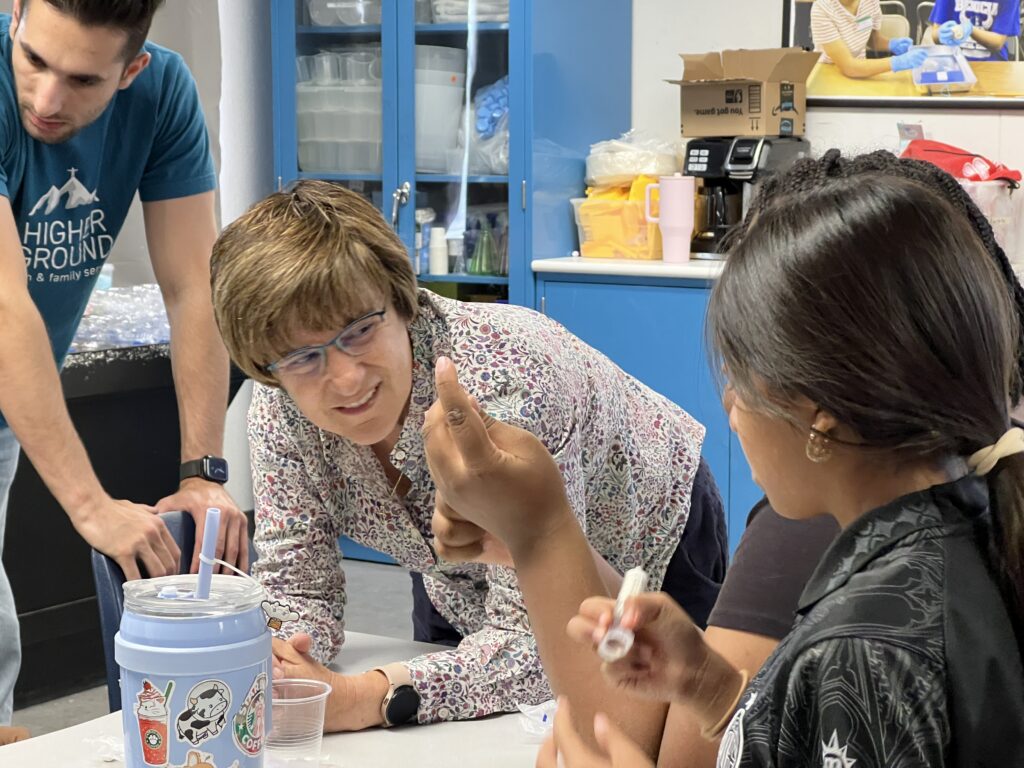
“That’s exactly what we want,” says Dr. Melissa Rowland-Goldsmith, or Dr. RG to her students, a professor of molecular biology at Schmid College. She first connected with Higher Ground after watching a student documentary entitled “The Happiest Place on Earth, Not…”
“I’ll never forget that film. There were a bunch of kids in an overcrowded apartment, on the balcony, looking across the street and watching the Disneyland fireworks. That’s as close as they were ever going to get to Disneyland. The film zoomed in on one of those kids in his home life, then his time at Higher Ground. There was a profile of Joe Baldo, who is the one who founded Higher Ground. Joe was in the audience at the screening. At the reception, I made a beeline straight to him. I said, ‘I’m a professor here at Chapman. How can I help? I teach biology.’ I was just so moved. He said very emphatically, ‘We really, really need you,’” says Dr. RG.
Dr. Lauren Dudley, another Schmid Professor at the time, saw the same documentary. She created the SCI 320 class to work with Higher Ground, teaching college students the principles of service-learning, mentorship, and STEM education. Dr. RG, who started out working with student clubs to help Higher Ground, now oversees the class alongside Professor Mo Hijazi ’24, a former SCI 320 student who chose to return to Higher Ground before continuing to medical school.
“One of the biggest things about those STEM Days is that everyone shows up, and it’s all hands on deck. We do the science experiment with the kids, and we have about 45 minutes per group for two groups each Friday. One of the coolest things about that whole experience is just seeing excitement in the kids. It’s an opportunity for our Chapman students and the Higher Ground kids to get to know each other. Our avenue for it just happens to be STEM,” says Hizaji.
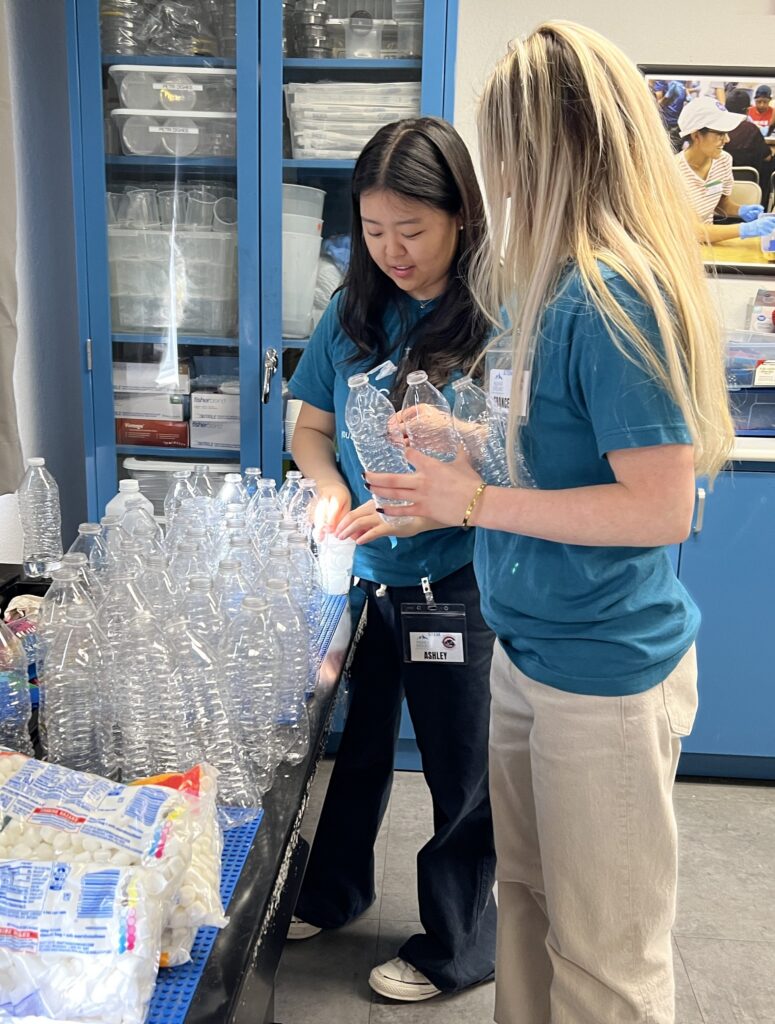
The SCI 320 students don’t just teach the Higher Ground kids science; they also spend time building connections and mentoring outside of the classroom.
Eleven of the fifteen Chapman students lead experiments with one age group, while the other four play soccer with the other age groups or spend time inside playing video games or making art. The SCI 320 groups shuffle each week, so that each student gets to present experiments.
Mirabella Romano is a graduating senior (‘26) who took SCI 320. She will be taking over for Hijazi to teach the classes starting in the fall 2026 semester.
“When you get there, the kids run up to you and hug you. They’re like, ‘When am I going to see you? When are you doing a presentation?’ These kids have to meet a lot of different people, and a lot of these people don’t stick around for them. So coming back each week and being a stable person that they can come and talk to about whatever is going on in their life or just talk about science has probably been the most influential part of it,” says Romano.
Romano is pursuing pediatric medicine, and credits Higher Ground with inspiring her to apply for her current internship with the Children’s Hospital of Orange County.
“Before Higher Ground, I had worked with kids, but I had never really dove in as deep as I did for this class. It’s a little uncomfortable at first to move away from always talking with adults or people your own age, and bring yourself back to what childhood is like. In doing that, I really recognized that kids have a whole different world in their eyes,” says Romano.
Hijazi says he hopes that his students will carry their experiences at Higher Ground into their future careers and continue to give back to their communities.
“Regardless of what career you go into, if you just take a couple hours out of your week, you could share something beautiful with a child that has never even imagined it. We’re able to show these kids that they belong in those spaces where they maybe haven’t seen someone who looks like them. That’s really what drives me. That’s what drives a lot of people that take this class. I hope that continues forward,” Hijazi says.
STEM 320: “STEM in Action” is offered every semester and is open to any student with a major or minor in Schmid College, the Fowler School of Engineering, or the Crean College of Health and Behavioral Sciences.