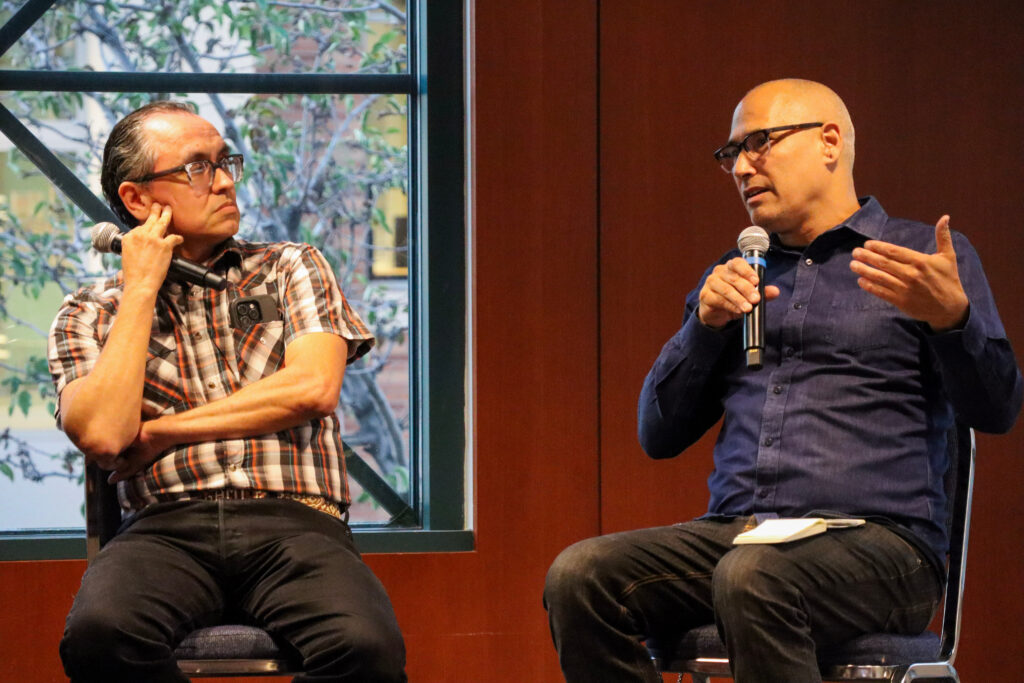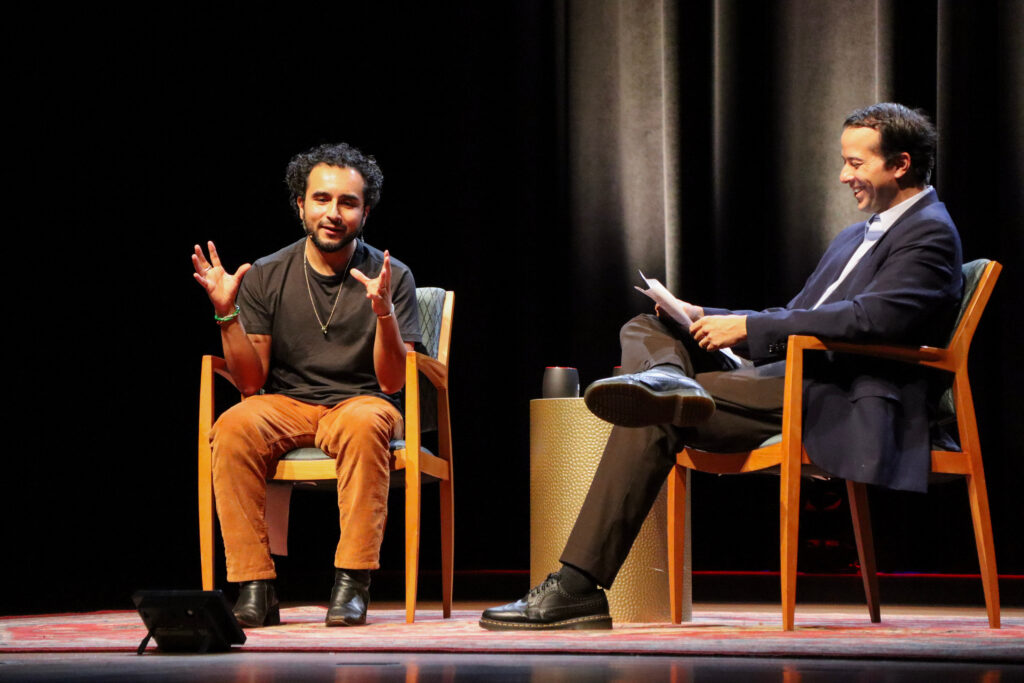
This edition of Wilkinson College’s Arts, Humanities, and Social Sciences From Our Eyes is written by newsletter editor Selah Sanchez (’27 Creative Writing; CCI minor). Sanchez recently attended the ETW Keynote Speaker event with author Javier Zamora. Zamora spoke about his 3,000-mile journey as a nine-year-old child from El Salvador to the United States. Sanchez reflects on Zamora’s talk and gives us a sneak peek inside his book.
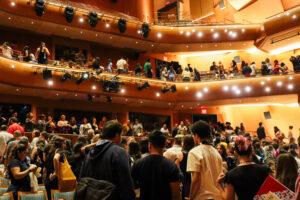
I took my seat in the Musco Center for the Arts about 15 minutes before Javier Zamora’s Keynote Address began, and there was already a moderate crowd. I recognized several faces, from faculty to fellow classmates. But there were also community members who came just to hear him speak. Most of the audience (including me) also carried copies of his memoir in hopes of staying behind for the signing. Regardless of the reason they were there, there seemed to be a collective excitement to hear him speak, and for good reason.
Zamora is a very accomplished man, having won several awards and fellowships for his writing. He is renowned for his poetry collection Unaccompanied and his recent memoir, Solito, both of which explore his identity as an immigrant from El Salvador in the wake of the Salvadoran Civil War. His novel specifically chronicles his journey as a child, alone, from El Salvador to America. But that’s not all there is to him. I realized this quickly once the talk began, when he was introduced by Dean Jennifer Keene (History) and engaged in a moderated discussion with Dr. Mateo Jarquín (History).
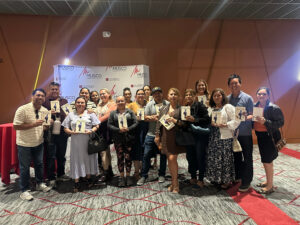
What really strikes me about Zamora– both onstage and in his writing– is his sense of humor. Solito is written from the eyes of his nine-year-old self, and much of how his child self processes the world is understandably very innocent. At times, that innocence is heartbreaking. Other times it’s funny. On stage during his keynote discussion, he jokes around as any of my cousins would at a family gathering. And when I met him at the book signing, he smiled warmly at me. He speaks very frankly about his experiences in a way that is approachable and resonant.
Solito is an emotionally heavy book that Zamora describes as long in the making. It starts with a young Zamora, who leaves his grandparents and aunt in El Salvador to make the journey to “La USA,” where his parents are. Unable to attain a visa, his family hires a coyote, or people-smuggler, who places him on a harrowing journey by bus, boat, train, and eventually on foot across the Sonoran Desert to Arizona– a voyage overall that should have taken two weeks and ended up as nine. On his journey, he is intimidated, stolen from, and is even incarcerated by border patrol. But traveling with him are three individuals– a mother named Patricia, her daughter Carla, and Chino, a young man who acts as a protective older brother figure through their hardship.
Zamora talked a lot about healing throughout the talk– healing of the inner child, healing from the trauma of the journey, and healing from the disillusionment of reality in the States. But as soon as he shifted his focus from convincing the world that his experience is valuable to healing and validating that journey for himself, he said the process came much more easily to him. That’s not to say it was completely easy– he also spoke of his experience in therapy, strained relationship with his parents, and moving back to Tucson, Arizona, where he crossed the border into America. This reminded
me of something someone said in my class on the subject of writing memoirs– “the more personal, the more universal.” In other words, when one writes authentically and vividly, the universal elements of the human experience shine through, and readers see themselves even in the most unexpected narratives. I can’t think of a better example of this phrase in practice than Solito. For in healing himself through his writing, Zamora encourages many others like him to be seen.
This year’s Engaging the World theme is “Leading the Conversation on People and Communities in Motion,” and I couldn’t imagine a better speaker for this than Zamora. His entire story encapsulates that. Although he was alone on his way to “La USA,” he found a community of people that stood with him no matter how hard their journey became. Truly, having a testimony like Zamora’s sheds much-needed light on the inner life of the child immigrant, of whom he was one of so many, even to this day, and one that many would benefit from reading about. When his second book, which will pick up right where Solito left off, comes out, I hope to be among the first to read it.
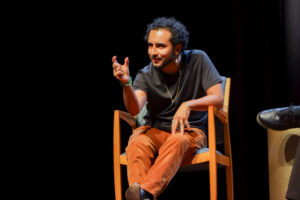
Pictured in header: Author and Keynote Speaker Javier Zamora at the 2026-2027 Engaging the World: Leading the Conversation on People and Communities series with Dr. Mateo Jarquín (History). Photo by Violet Gude (’29 Broadcast Journalism, CCI minor.