
Artificial intelligence is changing how people work, create, and make decisions. The Minor in Collaborative Intelligence teaches you how to work alongside intelligent systems with skill and judgment. It is open to every major and starts in Fall 2026.
Preparing for the workforce
Almost every field is now asking the same question: what happens when the work is shared with a machine? Graduates who can answer it well are the ones who get hired.
COIN builds three abilities that travel with you into any career. You learn to actually use computing tools and AI copilots, not just talk about them. You learn to explain technical work clearly to people who need to act on it. And you learn to judge when a system should be trusted, questioned, or redesigned. The minor prepares you for roles in product and UX, communications and content strategy, data and insights, policy and governance, and design leadership.
Ahead of the curve
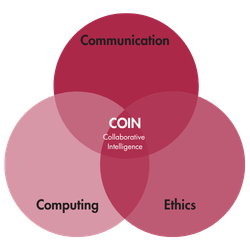
Most universities treat artificial intelligence as a computer science subject. COIN treats it as a human one. The minor sits in the School of Communication and brings computing, ethics, and communication into a single sequence, because the hard problems in AI are rarely only technical. They involve trust, persuasion, responsibility, and the way people understand what a system is telling them.
No other university in Southern California offers an undergraduate program built specifically around human and AI collaboration. At larger research universities, this work usually lives in graduate labs. At Chapman, it is a path you can start as an undergraduate.
For any Chapman University student
You do not need a technical background to start. The computing courses introduce programming through modern AIcopilots and hands-on environments, so you spend your time solving real problems instead of fighting syntax. Students from film, business, psychology, and the sciences work side by side.
The minor ends in a studio course where you build something real with a team, and short one-unit seminars let you follow whatever is breaking in the field that semester. Everyone takes the same core, so your classmates share a common foundation, and the conversation goes deeper faster.
Families often ask whether a degree will hold its value as AI reshapes entire industries. COIN is a direct answer to that question. It adds 27 credits of practical, durable skills to whatever a student already loves studying, and it does so without asking them to abandon their major or switch schools. The result is a graduate who can work with these tools, explain them to a room, and think carefully about their consequences. Those are the people organizations will keep promoting.
Interested in the COIN Minor?
27 credits. 9 courses | First term Fall 2026 |Open to all majors.
Looking for advising, want to declare the COIN minor, or have a question?
-> Email coin@chapman.edu.