Chapman Student Dancers share the stage with the Iconic Martha Graham Company Students perform Graham’s Steps in the Street for the dance company’s centennial celebration in a journey of rich history and emotion.
March 17, 2026
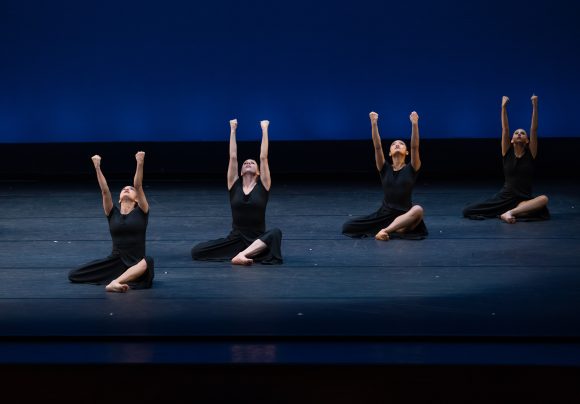
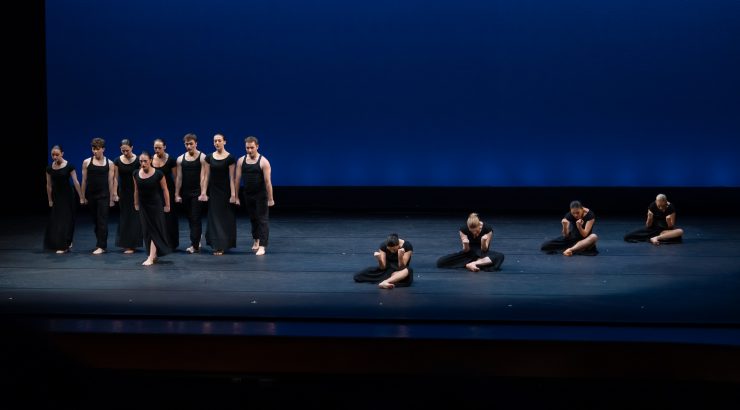
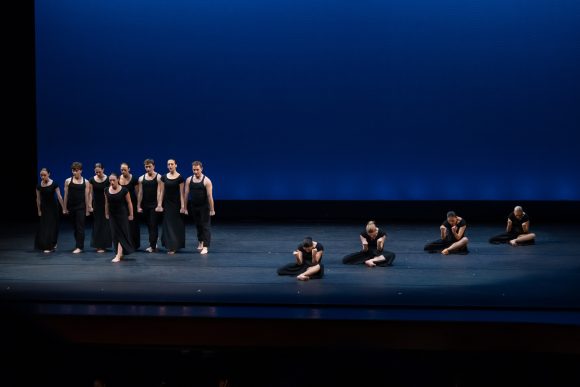
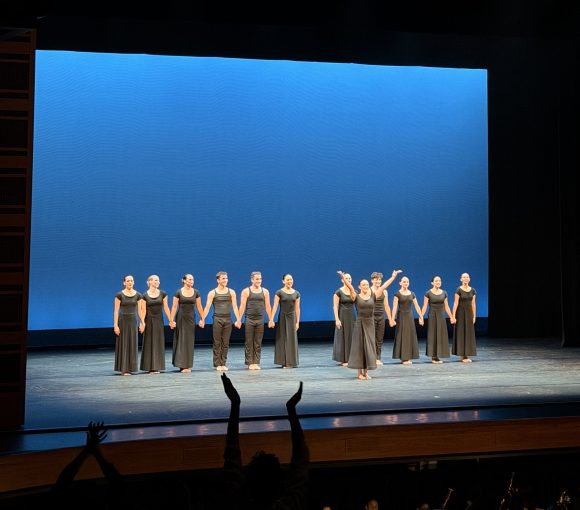
Chapman Dancers have once again received a once-in-a-lifetime performance opportunity through the university’s College of Performing Arts (CoPA). As part of the Marybelle Musco Contemporary Dance Series at the Musco Center for the Arts, 17 dancers graced the Musco Stage with the world-renowned Martha Graham Dance Company after months of rehearsals, diving headfirst into the wonder that is the Graham Technique, directly taught by members of the Martha Graham Dance Company. The performance included a collaboration with CoPA’s music department, with live music played by 34 student musicians in The Chapman Orchestra, led by conductor Dr. Danko Druško. Three seniors shared what it was like to visit a nearly 100-year-old piece – experiencing the pointed Graham Technique as well as an emotional connection to Steps in the Street.
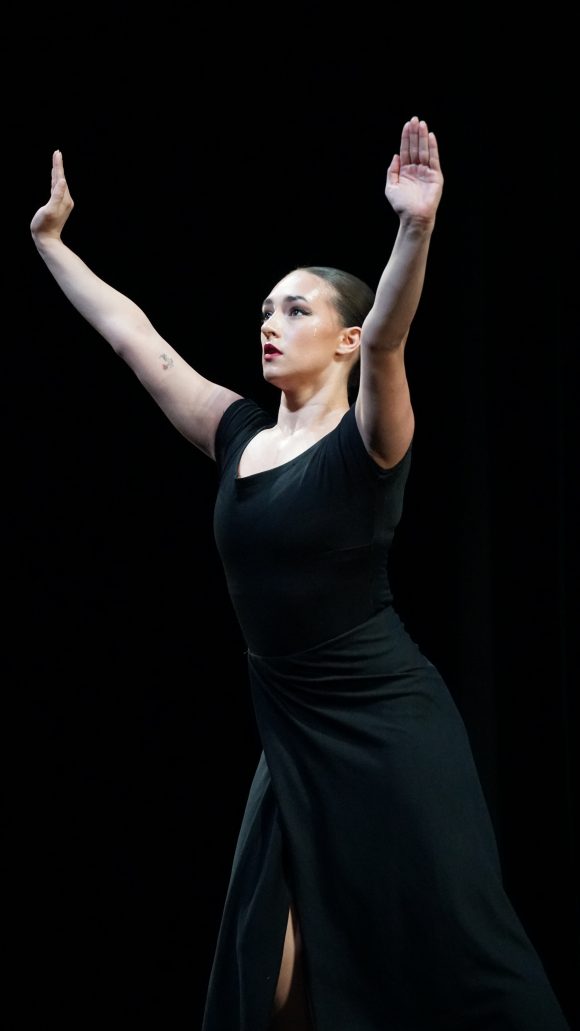
Soloist, Gabby Keeler
After auditioning for the Graham Residency on campus last May, the student dancers kick-started their time with Graham technique in an introductory class taught by former Dance Department Chair and now CoPA’s Associate Dean, Julianne O’Brien. With a demonstrative, lecture-style performance at Masters at Chapman, one of the dance department’s annual dance concerts held each fall, O’Brien walked the dancers and the crowd through the basics and history of Graham Technique.
How did these months of training change your understanding of Graham Technique and its history?
Gabby Keeler ‘26: “…Integrating the Graham Technique into my training profoundly shifted my relationship to movement. The work demanded presence. It required activation. Most of all, it called for ownership and vulnerability, willingness to fully inhabit the essence of my body without hesitation. What struck me most was the depth of strength and awareness embedded in the simplest movements. A contraction. A shift of breath. A spiral. Nothing is ornamental; everything is intentional. That simplicity felt expansive rather than limiting. It pushed me to constantly explore how to access those qualities organically, not just in set phrases, but throughout my entire body and practice. Through this work, I found empowerment not in performing the technique, but in surrendering to its demands. Allowing the physicality to reveal clarity, honesty, and grounded strength.”
Entering Interterm, the university’s voluntary four-week academic session in January between the fall and spring semesters, the dancers worked closely with Martha Graham Dance Company Rehearsal Director, Elizabeth Auclair, who taught them a codified Graham class and led rehearsals Monday through Friday throughout January to prepare them for their performance in February at the Musco Center. Auclair set Steps in the Street, which was originally choreographed by Martha Graham in 1926.
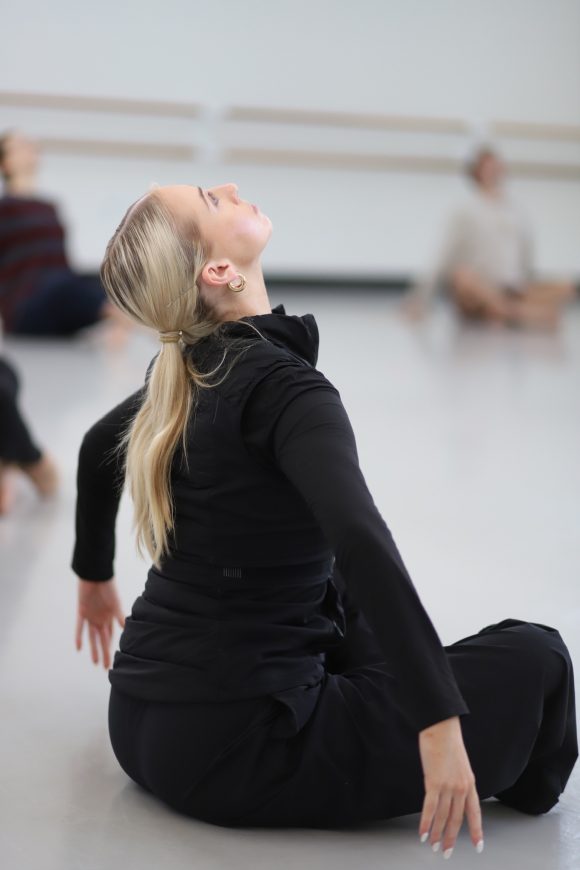
Grace Gontarek in Graham Technique class
What did this experience teach you about professionalism or rehearsal discipline at a company level?
Grace Gontarek ‘26: “Working alongside the Martha Graham Dance Company and my peers elevated my understanding of professionalism. The level of adaptability, authenticity, and attentiveness required in Graham technique is like no other. It almost felt like walking into a dance class with no prior experience…humbling in the best way. I learned that grit and passion are essential, but discipline and eagerness to refine are what sustain you in a company environment. Rehearsals demanded full presence. Corrections were specific and rooted in intention, not aesthetics. You had to be alert, quick to adjust, and deeply committed to the collective vision. It reinforced that professionalism isn’t just about showing up prepared; it’s about meeting the process halfway, every single day.”
The Graham dancers had the opportunity to work with physical therapist and Chapman Alum, Rob Tsai (‘08, ‘18), to prepare for the rigor of Graham Technique, and especially the physical intensity of the particular piece they were to perform. Fang remarked that they had “all cumulatively probably surpassed 1,000,000 jumps throughout this process.” Focusing on mobility in the lower half and stability in their core, the dancers were set up with a training program in the fall, including personalized exercises for their strengths and weaknesses, as well as check-ins with Tsai and current Chapman Physical Therapy students.
How did Chapman’s dance curriculum support you in handling the physical and emotional demands of Graham work?
Gonterak ‘26: “Chapman’s curriculum prepared us in ways I didn’t fully realize until this experience. Steps in the Street requires significant agility and stamina, particularly because of its repeated jumps and weighted use of the body. Training intentionally before entering the process allowed us to adapt our bodies with care and intelligence.
Beyond physical preparation, Chapman’s well-rounded training across styles meant we were already accustomed to adapting to new movement languages. We’re encouraged to embody concepts deeply rather than perform them at surface level. Courses like Somatics emphasize kinesthetic awareness, connecting to movement from within rather than manufacturing an image. That foundation was invaluable in Graham’s work, where authenticity cannot be faked.”
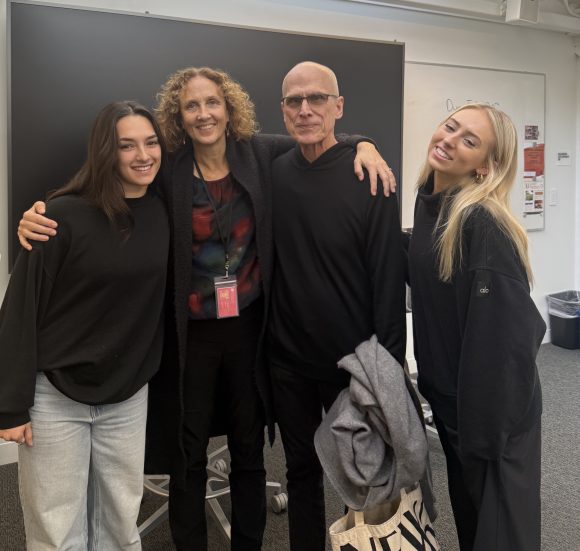
Gabby Keeler, Julianne OBrien, Peter Sparling, and Grace Gontarek
How did your training at Chapman prepare you technically and artistically to step into a Graham company rehearsal environment?
Mandy Fang ‘26: “I love that Chapman has given me my confidence in my artistic voice, and so though I have never been exposed to traditional Graham technique, I felt empowered and nurtured to give it my all and let myself be vulnerable enough to start from the basics.”
Gontarek ‘26: “Chapman prepared me for a Graham company rehearsal environment in ways that go far beyond just learning combinations in class. Technically, we’re trained to be versatile and highly adaptable. Our curriculum pushes us to shift between movement languages quickly and with integrity, which is essential when stepping into a codified technique like Graham. We’re used to being detail-oriented, so when faced with the rigor of contractions, spirals, and grounded footwork, I had a framework to rely on rather than starting from scratch. Artistically, Chapman emphasizes depth over decoration. We’re constantly asked to investigate intention, to understand why we’re moving and what we’re communicating. That mindset was crucial in a Graham rehearsal, where the choreography cannot exist without emotional clarity.”
Steps in the Street was originally choreographed as a powerful, somber protest against the rise of fascism in Europe. With the subtitle, “Devastation – Homelessness – Exile,” the dancers knew this piece would not be lighthearted, but they prepared themselves to acknowledge the themes of isolation, war, and tragedy.
Was there a moment when the meaning or emotional weight of Steps in the Street really clicked for you?
Fang ‘26: “This dance was the first opportunity I had to connect my moral beliefs with dance and performance. It felt like a physical and visceral response to my frustration with everything wrong in the political state of our society. It can be so difficult to know how and when to articulate feelings about current events and so the opportunity to do so in this piece was an honor. It is bittersweet that very similarly unfortunate circumstances that urged Martha Graham to choreograph this piece are the same ones we see almost a full century later.”
Graham choreographed Steps in the Street in response to recent wars that had passed and ones brewing, as well as her refusal to perform at the 1936 Olympics in Germany.
Keeler ‘26: “The emotional weight of Steps in the Street felt immediate. From the very beginning, there is a palpable tension, there’s a sense of moving against resistance, as if the body is pushing through an unseen force. It feels like striving forward even when there is nothing left to give. What made the work truly click for me was recognizing how deeply its original context resonates today. Created during a time of global unrest, the piece embodies collective grief, protest, and endurance. That same urgency feels present in the world now. You can sense the power of bodies wanting to be heard, on surviving, on finding strength through shared struggle. The movement doesn’t feel decorative–it feels necessary and intentional. And that necessity is what gives it its lasting emotional force.”
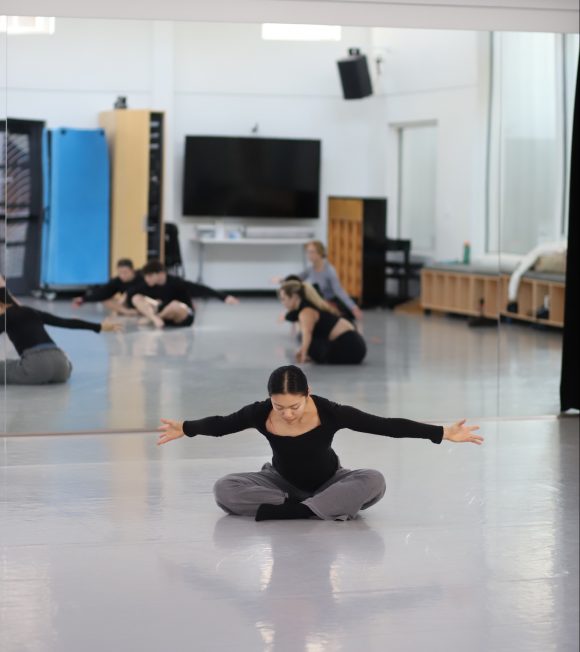
Dancer, Mandy Fang
If you had to describe performing this piece in three words, what would they be?
Fang ‘26: “Empowering, striking, provoking.”
Keeler ‘26: “Triumphant, exhilarated, transcendent.”
Gontarek ‘26: “Immersive, embodied, disciplined.”
Throughout this rigorous, emotion-evoking, and transformative journey, our Chapman dancers grew in their technique and artistry as they explored the rich history of the Graham Company and Technique. As their quotes indicate, the students are honored to contribute to Graham’s centennial year and gave a remarkable performance on February 11th at the Musco Center for the Arts, right on Chapman’s campus. With gratitude for her four years at Chapman, senior Grace Gontarek shared, “Ultimately, this experience affirmed that our training doesn’t just prepare us to dance…it prepares us to carry history, emotion, and responsibility with integrity.”