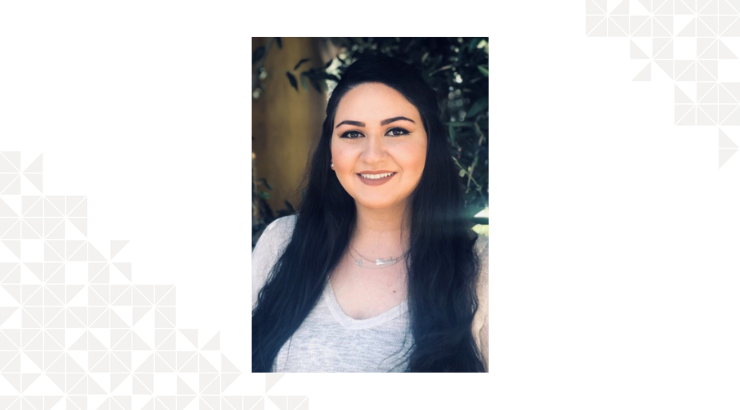
Sevana Karagoulian, a second-year doctoral student in Leadership Studies at Chapman University’s Donna Ford Attallah College of Educational Studies, has been selected to participate in the eighth annual Scheidt Family Seminar on Genocide Studies and Prevention at the University of Connecticut this June. For Karagoulian, the opportunity is more than an academic milestone — it is deeply connected to her own heritage.
As a member of the Armenian diaspora, she spent 15 years in an Armenian school where the 1915 Armenian Genocide was embedded into every part of the curriculum. “I often found myself wondering if others from genocide-affected diaspora have also felt their culture’s influence to such an extent,” Karagoulian said. This inspired her dissertation on how college students from post-genocide diasporic communities experience agency and identity in decision-making in young adulthood. Her research takes an interdisciplinary approach, drawing on genocide and diaspora studies, trauma research and educational frameworks to understand how historical violence and trauma continue to shape the lives of students today.
“I understand genocide prevention not just as stopping future atrocities, but also as supporting communities in building resilience in the aftermath of genocide,” Karagoulian said. “That resilience begins with breaking cycles of fear and control and replacing them with boundary-setting and personal agency, so future generations can thrive and choose cultural belonging without force.”
Karagoulian credits much of her scholarly growth to her mentor, Professor Whitney McIntyre Miller, whose Integral Peace Leadership framework has guided both her intellectual development and her work as a researcher. Through McIntyre Miller’s Peace Leadership Learning Lab and coursework, Karagoulian found her dissertation path. “She has encouraged me to pursue the research that matters most to me, even when it feels intimidating, rather than taking the safe route,” Karagoulian said.
The weeklong seminar at the University of Connecticut will allow Karagoulian to engage with practitioners and scholars across genocide studies, helping her connect personal experience with interdisciplinary research. She hopes her research will offer insights and support to students navigating the pressures and expectations of their families and cultures and contribute toward recognition and reconciliation for the Armenian community.