73 posts categorized in

Environment and Sustainability


Creating a metric to measure fire resistance of plants Jack de Bruyn, Jesse Arevalo Baez, Tyler Edwards, Cole Reiher, Evan Hughes

May 9, 2023 by Grand Challenges Initiative | Student presentations

With the rise of global warming, wildfires have become an increasing problem. Global warming raises temperatures, which leads to an increase in the frequency and severity of wildfires. These wildfires, in turn, put more carbon into the atmosphere, creating a dangerous feedback loop. Additionally, the increased severity of these wildfires puts people living in wildfire-prone

SolarShine – A Robotic Cleaning System for Residential Solar Panels Nikhil Ahuja, Apoorva Chilukuri, Caroline Robinson, Kara Tangenberg

May 9, 2023 by Grand Challenges Initiative | Student presentations

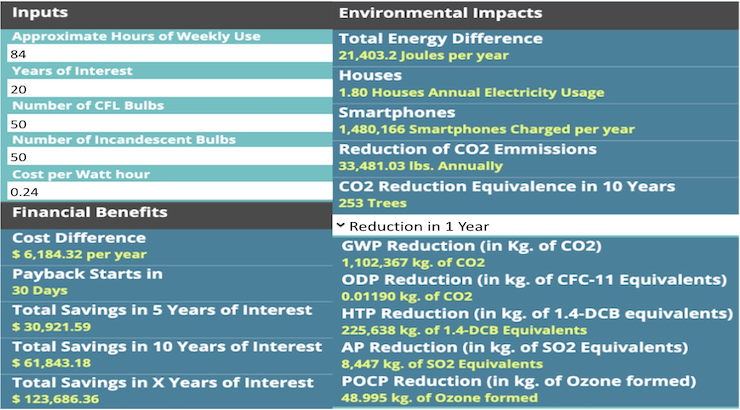
Global warming is increasing at an alarming rate, with non-renewable energy sources to blame. They emit excessive amounts of CO2 into the atmosphere, yet the world continues to use them over renewables. With solar energy specifically, the cost and labor that comes with solar panel installation are what drive people away from using this resource.

Outstanding Research Publication Award Highlights Utility of Real-Time Data for Responding to Disasters Award Honors Postdoctoral Research in Science and Engineering

May 19, 2022 by | Grand Challenges Initiative

This year’s submissions for the 3rd annual Chapman University Grand Challenges Initiative Outstanding Research Publication Award included fascinating results that added to the world’s scientific knowledge in a diverse array of subjects such as the assessment of hazard scales, leaderless mRNAs, and animal cell-size scaling. The articles submitted serve as a testament to Chapman University’s

Photodegradation of Oceanic Plastics Devyn Pon, Benji Persons, Anthony Saadeh

May 12, 2022 by | Student presentations

Less carbon dioxide absorption, reduction of phytoplankton population, organismal absorption and ingestion of microplastics, human health concerns: all directly tied to oceanic microplastics. The most common types of commonly used plastics are polystyrene, polypropylene and polyethylene. High concentrations of these types of plastics were tested individually in oceanic conditions and under an ultraviolet light for

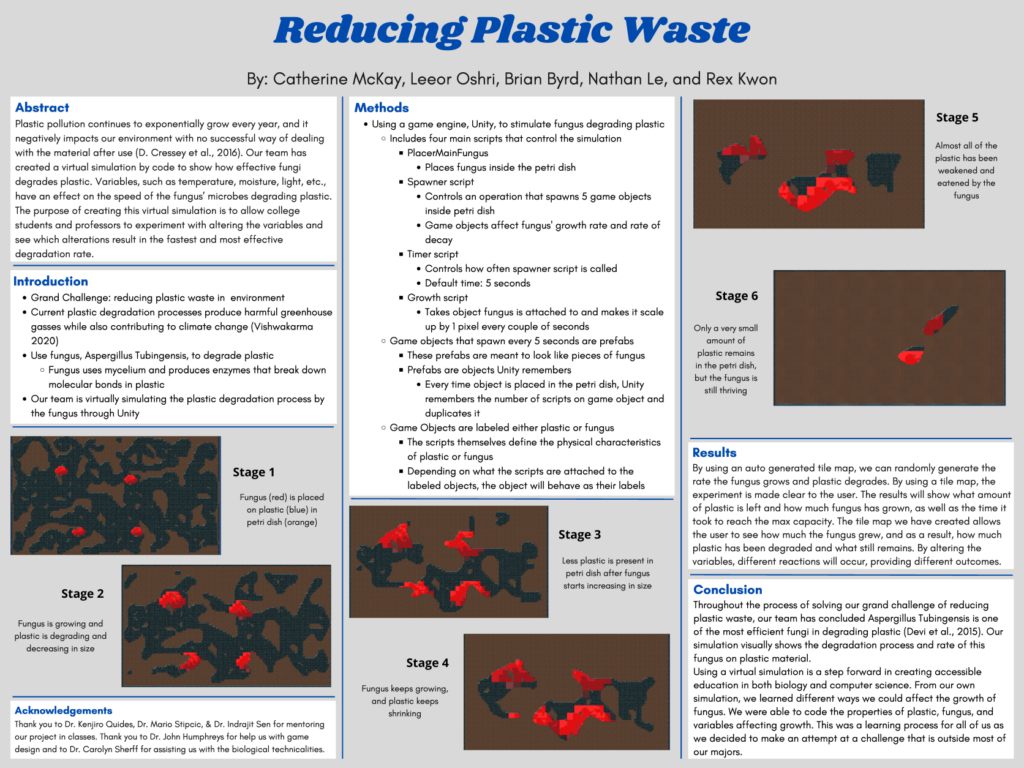
Reducing Plastic Waste Catherine McKay, Leeor Oshri, Brian Byrd, Nathan Le, and Rex Kwon
May 12, 2022 by | Student presentations

Our grand challenge to solve was the problem of reducing plastic waste. Through thorough research, we have decided to focus our solution on the fungus, Aspergillus tubingensis, and its decomposing properties. This fungus has been found to break down the molecular bonds in plastic materials, speeding up/aiding in the decomposition process. We have used the

Marine Gut Impaction & Alternative Plastic Noelle Clark, Sebastian Myhr, Ishan Sharma, Zoë von Allmen

May 12, 2022 by | Student presentations

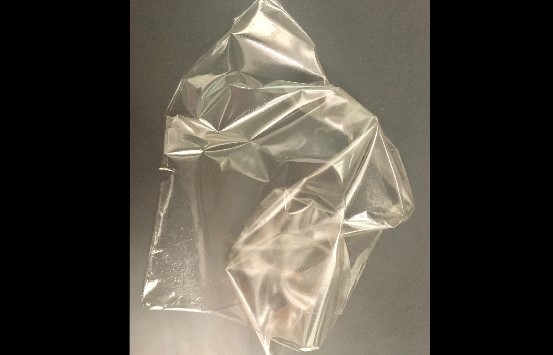
The growing number of plastic bags being introduced to ocean systems is causing marine animals to accidentally consume harmful plastics, eventually leading to gut impaction and death. Regular plastic bags do not degrade and rely on individuals to recycle them to prevent permanent pollution. Current biodegradable plastic bags require industrial composting and are not digestible

Log In
Open Main Menu