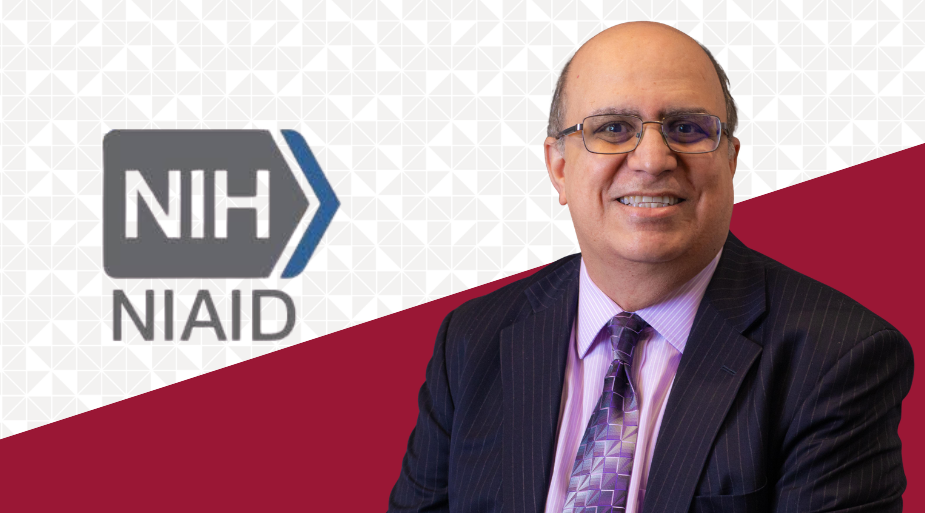
Keykavous Parang, Pharm.D., Ph.D., in collaboration with researchers from the Lundquist Institute for Biomedical Innovation at Harbor-UCLA Medical Center, has received a Multi-PI R21/R33 grant from the National Institute of Allergy and Infectious Diseases for his research proposal “Cyclic Antifungal Peptides for Drug-Resistant Invasive Fungal Infections.” This study aims to identify, study, and test new cyclic antifungal peptides, or CAFPs. The grant provides $435,238 to both institutions for the initial R21 phase, with total funding reaching $1,810,337 if R21 milestones are met and the project advances to the R33 phase.
Invasive fungal infections such as aspergillosis and candidiasis pose a serious and growing public health threat. The fungi responsible are increasingly resistant to first-line therapies, and the development of new antifungal drugs has lagged behind the pace of that resistance. Parang and team have identified lead peptides that boost the effectiveness of existing antifungal drugs by disrupting fungal cell membranes. Their highly adjustable design allows for rapid optimization and combination with current therapies.
“I am grateful to the NIH and excited to begin on this project that will uniquely contribute to care for patients who urgently need new antifungal options,” says Parang, who has spent over two decades developing novel peptide-based therapies.
This award marks Parang’s continued momentum in the field. Last June, he received another NIH grant supporting his work on peptide-drug conjugates (PDCs). Parang and CUSP’s Dr. Sun “Coco” Yang are designing and evaluating PDCs to reduce the toxicity of doxorubicin, a highly effective but very toxic chemotherapy drug. Parang’s research has been consistently supported since 2000 through the NIH, the National Science Foundation (NSF), the American Cancer Society, and the pharmaceutical industry.