Global Warming Causes Rainforest Soil to Release Trapped Carbon at Record Rates, Schmid Professor’s Paper Finds
February 16, 2026
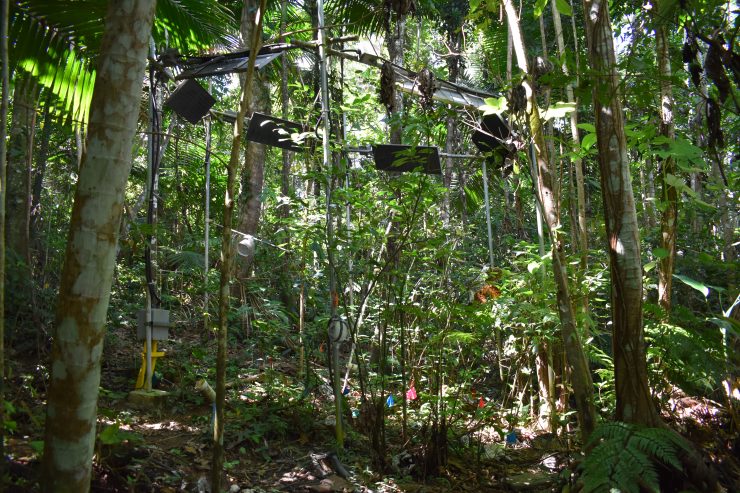
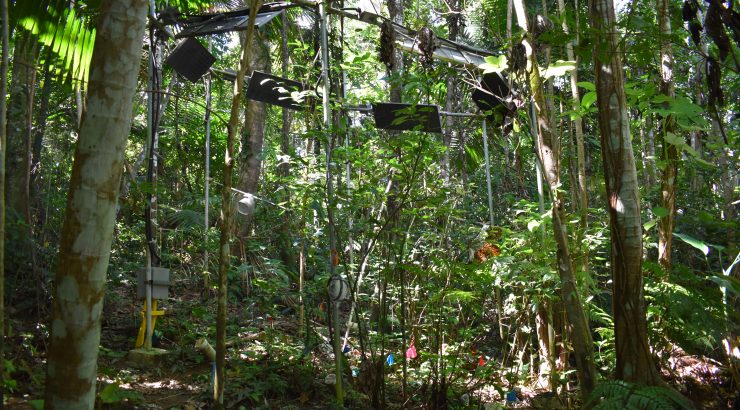
TRACE is a Puerto Rico-based warming experiment, studying how higher temperatures impact tropical rainforests in plots like this one. (Photo Courtesy of TRACE)
A new paper by Schmid College Professor Christine O’Connell found that rising global temperatures could release record amounts of greenhouse gases from rain forest soils.
Christine O’Connell, Ph.D, is a soil ecologist and an assistant professor of biology at Schmid College. She has spent the past ten years studying rain forest soils and their role in regulating the global climate. Her latest paper explores how global warming impacts tropical rain forests’ ability to trap greenhouse gases, and what that means for humanity as the planet warms.
“Rain forests hold a lot of carbon. Imagine an enormous tropical rain forest with really tall trees. The biomass of those trees is filled with carbon. So when that carbon is no longer locked up in either soil or vegetation, it’s in the atmosphere acting as a greenhouse gas. It’s very important that we understand how that’s shifting in time,” says O’Connell.
O’Connell is one of a team of ecologists working on the “Tropical Responses to Altered Climate Experiment,” or TRACE. The project is based in the Luquillo Experimental Forest in Puerto Rico, and aims to understand what happens to tropical rain forest ecosystems when temperatures increase.
TRACE uses infrared heating systems to raise the temperature of protected forest plots by four degrees Celsius, the extreme temperature shift researchers predict could happen by the year 2100. The plots all share the same plant and animal life, the same rainfall, and the same starting temperature.
To understand the effects of the temperature increase, the TRACE team monitors everything in these plots from soil gas emissions to frog behavior, plant growth and so much more. O’Connell’s research focused on the amount of soil carbon released from the warmed plots.
“Soil carbon is the organic material in soils. It makes soils really fertile. It’s carbon that’s utilized by fungi and bacteria that live in soils, but it’s also being held in soils and not in the atmosphere, warming the environment. Tropical soils are really rich in soil carbon. We monitored how much carbon dioxide is being released by these soils over a one-year period in the immediate onset of warming. We found that warmed soils released much more carbon, but the magnitude of that change was highly unexpected,” says O’Connell.
O’Connell’s team recorded some of the highest carbon dioxide losses from soils ever seen on the planet. Their research suggests that as Earth’s atmosphere warms, the rate at which greenhouse gases enter the atmosphere will increase exponentially, causing further warming.
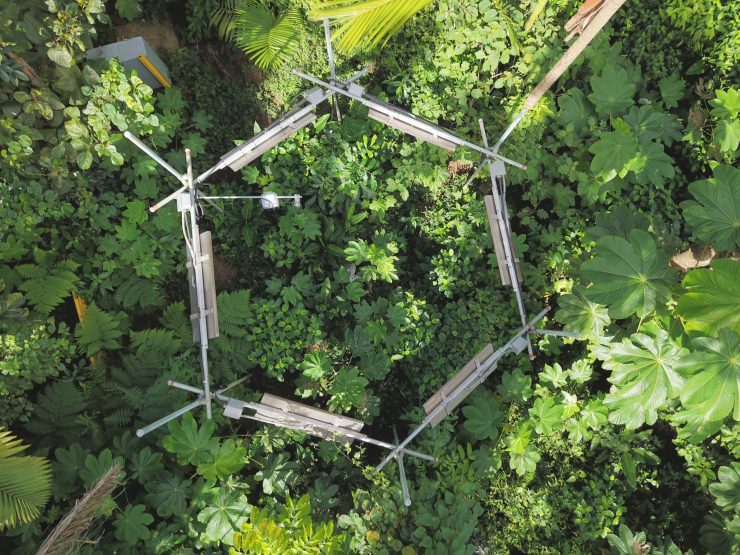
An aerial view of one of the six TRACE plots studied in O’Connell’s paper. (Photo Courtesy of TRACE)
Working with TRACE allows for innovative research, but also presents unique challenges. The project lost power for nearly a year in the wake of Hurricanes Irma and Maria in 2017, and the seasonal rains regularly impact their equipment. They have also encountered challenges with the local wildlife growing or crawling into their sensors.
“I’m so lucky to be able to work in this kind of system. It’s the kind of thing you dream about when you’re a kid. But one time I opened a sensor box and a frog was living inside. It was sort of like, ‘is this data busted? Can I just let the frog out and still use that data?’ What were the consequences of an animal living inside of this sensor box? There are often creative challenges like that when you have to wing it a bit,” says O’Connell.
Scientists regard rain forests as canaries in the coal mine for climate change. O’Connell says that her paper’s findings emphasize the urgency of preventing climate change from reaching “tipping points,” which would accelerate global warming.
“The consequences of climate change are going to be numerous and vast,” says O’Connel, “It’s extremely important that we both combat the climate crisis now before it’s gotten too severe, and continue to study the ways in which we can navigate our changing globe.”