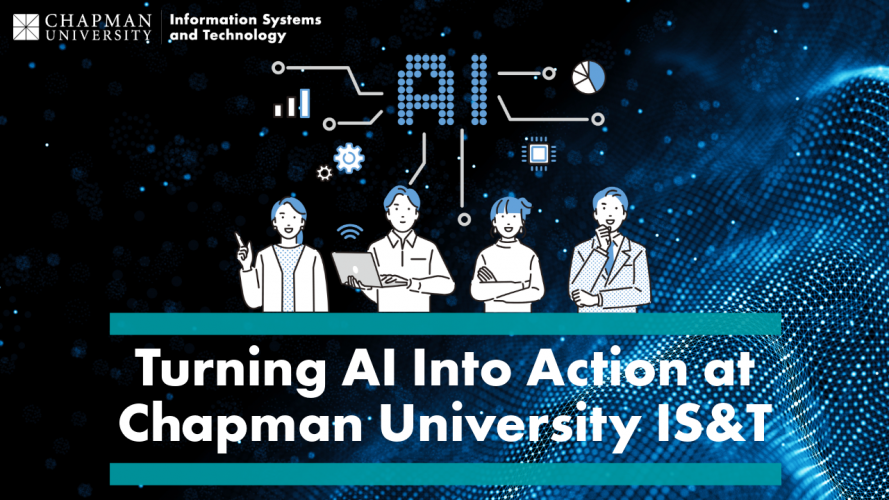
Artificial intelligence is rapidly reshaping how we work, learn, and collaborate. From drafting content and summarizing information to streamlining workflows and supporting decision-making, AI is no longer a future concept; it’s a present-day tool. Recognizing this shift, Chapman University Information Systems & Technology (IS&T) launched the AI Ambassadors Program, a pilot initiative designed to help our campus prepare for what’s next.
The result? A growing community of staff equipped with practical AI skills, a shared language around responsible use, and a roadmap for expanding AI education across the university.
The AI Ambassadors Program was a 12-week training initiative that ran from October 2025 through January 2026, bringing together IS&T staff in a collaborative, hands-on learning environment. The program focused on building AI literacy, practical skills, and confidence in using Chapman-approved AI tools responsibly in everyday work.
Participants met bi‑weekly in hybrid sessions that blended instruction, discussion, and experimentation. Topics included:
- Foundations of generative AI and key terminology
- Prompt engineering and critical thinking
- Responsible and ethical AI use at Chapman
- Chapman approved AI tools such as Microsoft Copilot, PantherAI, Grammarly, Canva, Adobe, and Zoom AI Companion.
- Real-world applications and workflow experimentation
Rather than focusing solely on theory, the program emphasized learning by doing, encouraging participants to apply AI tools directly to their roles and challenges.
By the end of the program, the impact was clear. All participants reported significant growth in their understanding of AI and in their confidence in using it in their work, with 100% of survey respondents agreeing that the sessions increased their knowledge of AI.
Participants moved beyond experimentation into meaningful application. Many now use tools like Microsoft Copilot or Panther AI in their day-to-day work. A core component of the program was the capstone project, where each Ambassador demonstrated how AI could address a real workplace need. These projects showcased practical, immediately functional solutions.
Beyond individual skill building, the AI Ambassadors Program fostered a cross-team community of practice. Participants shared ideas, tested tools together, asked questions, and learned from one another during sessions and in ongoing discussions. This collaborative approach helped normalize experimentation and encouraged responsible, thoughtful use of AI across IS&T.
The long-term goal was not just training, but upskilling the campus over time, creating a base level of AI understanding that staff can carry into future projects and share with colleagues beyond IS&T.
The success of the pilot program has laid the groundwork for what comes next. IS&T now has:
- A trained cohort of AI Ambassadors ready to support and guide others
- Reusable training materials and a scalable program model
- Clear insights into how staff are already applying AI in meaningful ways.
IS&T is exploring Phase 2 opportunities, including expanding AI training to additional IS&T team members, potentially inviting other campus partners, and continuing to build a network of AI champions. As AI tools continue to evolve, the focus will remain on responsible use, transparency, and human-centered adoption, ensuring that technology enhances, rather than replaces, the work we do.