What Happens in Pharmacy School Clinical Rotations?
The classes you take as a Doctor of Pharmacy (Pharm.D.) student will expose you to every aspect of the profession. Clinical rotations are where you’ll put those lessons to work.
From once-a-week rotations in your first year to full-time rotation in your later studies, these hands-on opportunities build confidence and help you identify your professional strengths and interests. Engage with patients, collaborate with medical teams and begin to see where you fit into this evolving healthcare field.
Understanding the Pharm.D. Curriculum Structure
The Pharm.D. program curriculum is designed to build knowledge and skills progressively, blending foundational science with hands-on clinical training. Early coursework typically focuses on biomedical sciences, pharmacology, and foundational clinical principles that prepare students to understand how medications work in the body and how they are developed, regulated and used safely.
As you advance through the program, the curriculum shifts toward applied learning through patient-centered care and evidence-based decision-making. Classroom learning is closely integrated with simulations, case-based discussions and skills labs to reinforce real-world problem solving.
The curriculum culminates in pharmacy clinical experiences, often referred to as rotations. These immersive, supervised experiences place you in a variety of healthcare settings where you will apply your classroom knowledge across diverse patient populations. This is also an opportunity for you to learn how to be a part of a healthcare delivery team and refine your communication and collaboration skills as you build confidence in your practice.
Together, this structured progression ensures graduates are well prepared for licensure and a wide range of pharmacy career paths.
ACPE Requirements and Accreditation Standards
Pharmacy schools are accredited by the Accreditation Council for Pharmacy Education (ACPE), a nonprofit group that sets national standards for professional pharmacy degree programs. By studying at an ACPE-accredited school, you can trust you are receiving a high-quality education that prepares you for licensure. And it tells employers that you have earned a degree that meets the evolving demands of the pharmacy profession.
In-depth, hands-on rotations are an integral part of all ACPE-accredited Pharm.D. programs. Regardless of the program you choose, you’ll complete rotations in settings including:
- Community pharmacies
- Hospital/health-system pharmacies
- Ambulatory care facilities
- Inpatient/acute care (general medicine or specialty)
What Are Pharmacy Clinical Rotations?
As a Pharm.D. student, you participate in two different types of rotations: Introductory Pharmacy Practice Experiences (IPPEs) and Advanced Pharmacy Practice Experiences (APPEs).
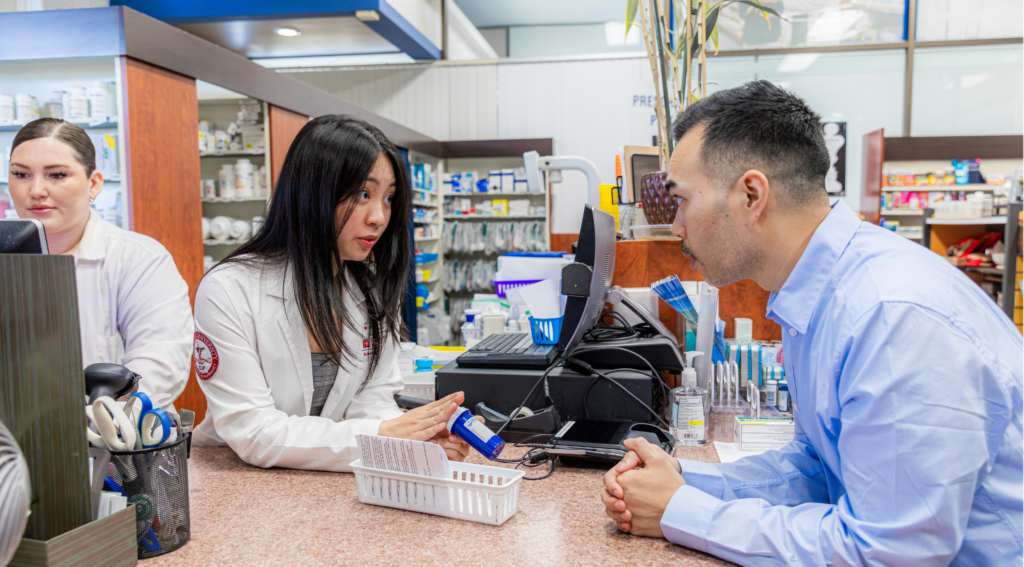
During both types of rotations, you work under the supervision of licensed pharmacists known as preceptors. These guides provide feedback, encouragement and mentorship as you navigate the responsibilities and expectations you find in different workplaces.
By the time you complete your rotations, you’ll have developed skills such as:
- Providing direct patient care
- Managing medication therapy
- Educating patients on proper medication use
- Consulting with healthcare professionals on treatment options and potential complications
- Collaborating with interdisciplinary care teams
- Completing documentation, including medication use evaluations
Introductory Pharmacy Practice Experiences
Students complete IPPEs during their first two years of study while also taking traditional didactic courses. These introductory experiences give you an overview of what you can expect in the field and the opportunity to observe healthcare delivery where it happens, in real time.
You’ll build professional relationships with practicing pharmacists to understand the realities of the profession and how their training prepared them for day-to-day responsibilities and challenges.
Under ACPE standards, all accredited Pharm.D. programs must provide at least 300 hours of IPPE training, including 150 hours spent in a community pharmacy and hospital/health system.
Advanced Pharmacy Practice Experiences
You’ll typically complete APPE rotations during your third year in the program. During APPEs, you complete six rotations: four required experiences and two electives in practice areas of your choice.
Under ACPE guidelines, Pharm.D. students must complete at least 36 weeks (1,440 hours) of APPE rotations, which typically last four to six weeks each. Unlike your introductory rotations, which are a mix of both observational and hands-on, APPE rotations are almost entirely hands-on practice. You work directly with patients and other practitioners as you build the clinical experience and professional judgment that will guide your practice.
Where Can You Complete a Pharm.D. Clinical Experience?
As a Pharm.D. student, your pharmacy rotations may take place anywhere pharmacists practice. By experiencing different professional settings — and working with a broad range of providers and patients — you can ultimately discover where you want to spend your career.
Placement settings include:
- Community hospitals
- Veterans Affairs (VA) centers
- Outpatient and primary care clinics
- Retail pharmacies
- Long-term care and skilled nursing facilities
- Hospices
- Health insurers
- Pharmaceutical companies
- Psychiatric hospitals
Typically, you’ll work a standard 40-hour workweek as part of your rotation. But because pharmacists don’t necessarily work 9 to 5, your schedules may vary, too. Depending on your rotation, you may be required to work evenings or weekends, giving you an even more realistic look at the rhythms of a typical workplace.
In addition to your four required rotations, you also have the opportunity to complete elective rotations in specialties of your choosing. You might focus on specific populations in pediatric, cardiology, rare disease or oncology rotations; work in drug development, medical affairs or the pharmaceutical industry; or focus on academia and research, to name a few options.
Why Are Clinical Rotations So Important in a Pharm.D. Program?
Clinical rotations create a critical bridge between classroom knowledge and patient care. Over nearly 2,000 hours of first-hand training, you learn to apply your skills and training to real-world situations. Not everything will go as planned; you’ll often confront situations that don’t follow what you’ve learned in class. But you’ll always have expert supervision to monitor your progress, as well as the chance to ask questions, adapt to new situations and challenges and grow through your mistakes.
These are critical steps on your journey to providing safe patient care once you’re on your own. At the same time, rotations expose you to various medical specialties and focus areas and build foundational knowledge you’ll draw on throughout your career.
The experience you gain across IPPEs and APPEs bolsters your confidence, while also telling prospective employers that you’re capable of meeting the challenges inherent to the job.
In addition to fulfilling requirements for all ACPE-accredited programs, your rotations provide the preparation you need to pass both the North American Pharmacist Licensure Exam (NAPLEX) and the Multistate Pharmacy Jurisprudence Examination (MPJE) — both of which are required to become a licensed pharmacist.
Preparing for Clinical Rotation Success
Clinical rotations are rigorous by design. You can take these steps to make them more manageable.
Ask others for guidance and mentorship. Rotations are a rite of passage for every pharmacist — and one most of your faculty will have faced as well. Ask them for advice on the experience, and draw on them for support throughout.
Connect with others in your cohort. It helps to know you’re not alone. By networking with other Pharm.D. students, you can share tips and have a ready audience for any questions or concerns you may have. Professional pharmacy organizations are also a great source of information, and many have chapters within schools of pharmacy, allowing students to join these organizations early on in their professional growth
Contact preceptors before your rotation begins. A couple of weeks before starting your next rotation, ask your preceptor what you can review ahead of time, from schedules to drugs you may encounter frequently. Show you’re eager to learn, and bring any questions you may have.
Take time for yourself. Clinical rotations are like having a full-time job, with long hours and regular assignments. Self-care, though, is important. Remember to eat well, get enough sleep, exercise and participate in activities you enjoy. Finding a balance will help you perform better when you’re at work.
Experience a Pharmacy Career From the Inside in Chapman’s Pharm.D. Program
Pharmacists educate patients, improve outcomes and serve as a trusted resource to physicians and other healthcare workers. And in the Pharm.D. program, you get firsthand experience with each of those responsibilities through your clinical rotations.
You can earn your Doctor of Pharmacy degree from Chapman University’s School of Pharmacy in just 33 months. Complete your IPPEs and APPEs with over 900 rotating precepting sites, from San Diego to Northern California, gaining invaluable preparation for an in-demand career that averages a salary of $137,480 per the U.S. Bureau of Labor Statistics.
Not only is the work steady, but it’s also meaningful. In addition to engaging directly with patients to reduce hospital readmissions and manage chronic diseases, pharmacists also help shape public health policy and contribute to legislative progress.
Are you ready to make a difference? Contact us today to learn more about joining a program dedicated to delivering personalized care and improving patient outcomes wherever pharmacists work.