Exploring Holocaust Aftermath: Dr. Ionescu Examines Jewish Restitution in Eastern Europe From Our Eyes
September 23, 2025
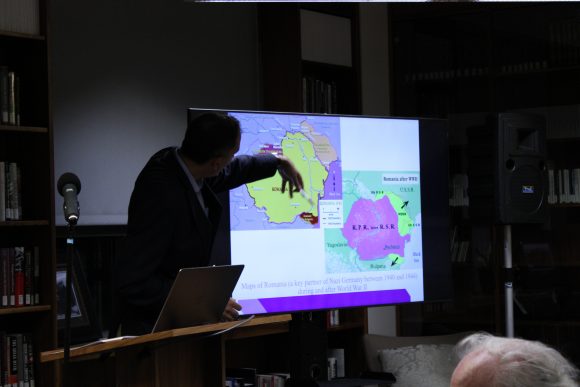
Photo by: Marisa Lamas (’27 Public Relations, Advertising, and Entertainment Marketing major, CCI minor).
This edition of Wilkinson College’s Arts, Humanities, and Social Sciences From Our Eyes features Abigail Stephens (’26 History major, Journalism & Creative Cultural Industries minor). Stephens dives into the latest Rodgers Center of Holocaust Education event with Dr. Stefan Cristian Ionescu (Holocaust History), who discusses the Holocaust’s complex legacy and debates over issues of justice, reparations, and restitution.
Since the first month of my freshman year, the Rodgers Center of Holocaust Education has been a central part of my university experience. In September 2022, I joined the center as a student researcher, transferring to my current position as Assistant Archivist and Librarian in 2023. I’ve gone to lectures, attended film screenings, taken a majority of the Holocaust Studies courses available, and yet, each and every event teaches me something new– largely thanks to the professors, guest speakers, and staff who consistently commit to expanding the breadth of study available for students through the Rodgers Center’s programming.
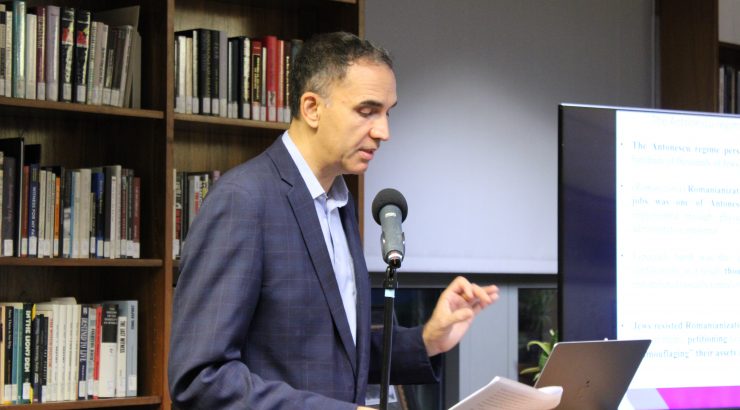
Interim Director Stefan Cristian Ionescu (Holocaust History) recently gave a talk titled “Justice and Restitution in Post-Nazi Romania: Rebuilding Jewish Lives and Communities, 1944-1950.” Dr. Ionescu’s research focuses on justice and post-war reparations within Romania and Eastern Europe. Despite being the second-largest national contributor to murder during the Holocaust, Romania struggled to confiscate Jewish property, largely due to mass resistance within the judicial system. Dr. Ionescu works to combat myths of Jewish passivity with prolific research on how persecuted individuals used legal processes to survive.
Dr. Ionescu discussed the process taken by General Ion Antonescu’s antisemitic regime as it imprisoned, deported, and murdered both Jews and Roma during WWII. One of Antonescu’s primary goals was to “Romanianize” property, confiscating land from Jewish owners. In protest, Jewish individuals flooded legal channels, filing around 40,000 lawsuits and winning 10 percent of them.
Despite low win-rates, Dr. Ionescu argues that legal resistance was still successful– Jewish plaintiffs strategically kept cases stuck in court in order to postpone deportation. Additionally, before restrictions were instituted to prevent this practice, Jews and allies sued deportees for trivial matters, bringing them back to court and enabling escape.
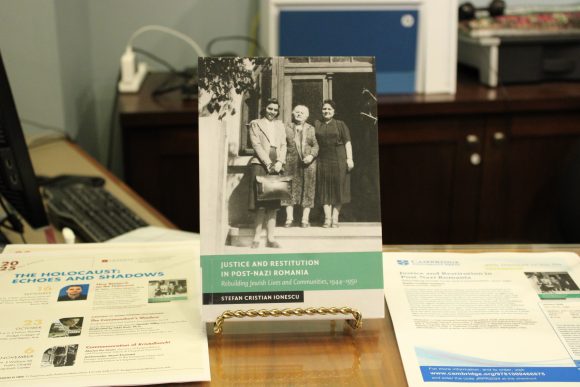
Photo by: Marisa Lamas (’27 Public Relations, Advertising, and Entertainment Marketing major, CCI minor).
His newest book, Justice and Restitution in Post-Nazi Romania: Rebuilding Jewish Lives and Communities, 1944-1950, follows the history of Jewish legal resistance post-war, when the new communist leadership began the process of property nationalization. Targeted due to their status as middle-class entrepreneurs, Jews once again engaged in court litigation. This time, two-thirds of the plaintiffs won their cases. Additionally, after the government passed restitution laws in 1945, Jews proactively litigated for the return of property, with Plaintiffs winning around 66 percent.
Despite successful resistance, post-war property seizure forever changed the makeup of Romanian minority populations. Fearing continued attacks on property ownership and civil rights, Jewish Romanians largely decided to emigrate. Despite 450,000 of the 800,000 pre-war population surviving after the Holocaust, fewer than 5,000 Jews reside in the country today.
Dr. Ionescu’s talk is a fitting representation of the academic events that faculty members hold on campus, where our campus community holds a keen understanding that teaching about past political and social conditions can inform civic participation in the present. The Holocaust did not stop and start in Germany- there are a plethora of national narratives, where creative and unorthodox methods were employed to fight discriminatory laws. Through increasing our understanding of how different Jewish communities, persecuted minorities, and their allies challenged Nazism, students are motivated to use each and every tool in their toolbox to support building a better world.
(Header photo by: Photo by: Marisa Lamas (’27 Public Relations, Advertising, and Entertainment Marketing major, CCI minor).