Environmental Journalist Rosanna Xia Leads Discussion on Sea Level Rise and Coastal Futures Engaging the World
September 24, 2025
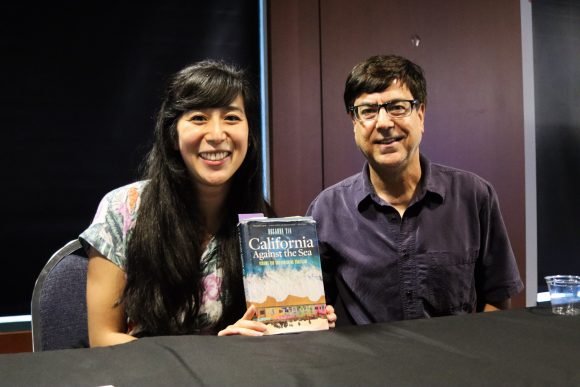
(left to right) Journalist and author Rosanna Xia and Dr. David Shafie (Political Science). Photo by Ann Hoang (’27 Writing for Film & TV and Strategic & Corporate Communication).
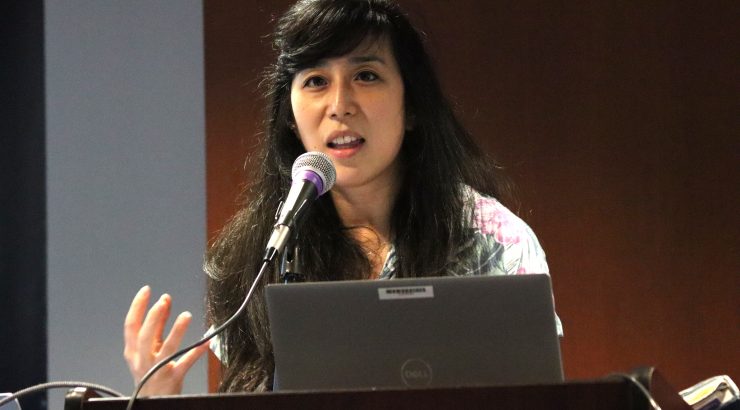
This year’s Wilkinson College Engaging the World program kicked off the series Leading the Conversation on The Environment & Building Resilient Futures with Rosanna Xia, a Los Angeles Times Reporter and environmental advocate.
Xia is the author of California Against the Sea: Visions for Our Vanishing Coastline, a book about California’s 1,200-mile coastline, which investigates how the overheated Pacific Ocean is rising and pressing in, imperiling both wildfire and coastal communities.
As a reporter, her focus has been on sea level rise and ocean acidification along the coastline. Throughout her years of travelling and speaking with different communities affected by environmental changes along the coast, she’s learned that in order to tell more engaging stories, she has to connect with her audience both emotionally and philosophically, and not just intellectually.
“The key to writing more powerful stories is to invoke feelings and rely on common values, rather than provide an audience only with numbers or data,” said Xia.
This rings especially true in the realm of scientific communication because audiences will connect more to a piece of literature if it relates to their own values.
“Adapting to sea level rise is challenging, but there are things we can do if we get active in our communities and plan for the future.”
– Dr. David Shafie (Political Science)
Xia’s presentation was deeply rooted in environmental justice and optimism. She discussed how we must look at climate change from the perspective of what a community can gain, not what it could lose. “We must start putting more value in qualitative research, rather than just quantitative data, because we can get a much more holistic view of the local situation,” she said.
Xia argued that communities should be involved in every step of the process because they know all the nuances of the issue they are facing. She told the audience that she knows the power she holds as a reporter, and when given the chance, she tries to ensure through her work that communities that have not been given a voice at the table have the opportunity to make their voices heard.
As the audience listened closely, Xia explored the definitions of restoration and resilience. Previously, these two words were used in the context of turning back the clock and rebuilding exactly what had been lost in the same location. Rather than having the strength to remain unchanged, Xia believes that resilience is having the strength to change.
“Climate adaptation is about a choice for humans and how we embrace and overcome adverse changes. We have the opportunity to transform systems in our world that aren’t helping everyone, and we can build new solutions for the future that will.”
(Pictured in header: Rosanna Xia, journalist, speaks at Chapman University. Photo by Ann Hoang (’27 Writing for Film & TV and Strategic & Corporate Communication).