Nadia Murad Speaks at Chapman as Part of Engaging the World Series and Presidential Inauguration Event
October 13, 2025
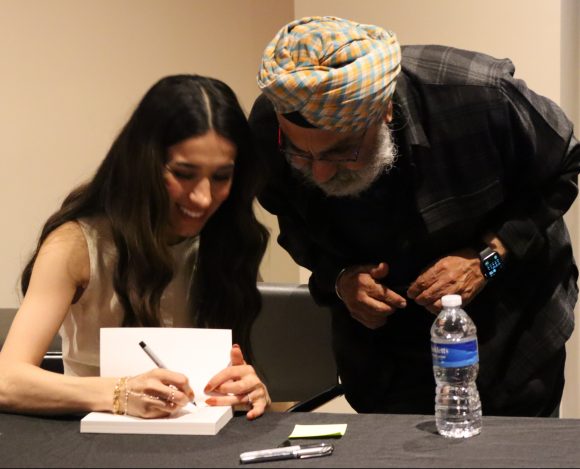
Nadia Murad signs her book for Bicky Singh, Sikhlens Founder and friend of Wilkinson College. Photo by Vioet Gude (’26 Broadcast Journalism).
Wilkinson College of Arts, Humanities, and Social Sciences is dedicated to fostering community conversations around humanity, unity, and justice through its annual Engaging the World (ETW) series. ETW is designed to inspire thoughtful dialogue and reflection, promoting social awareness, respect, peace, and kindness throughout the campus.
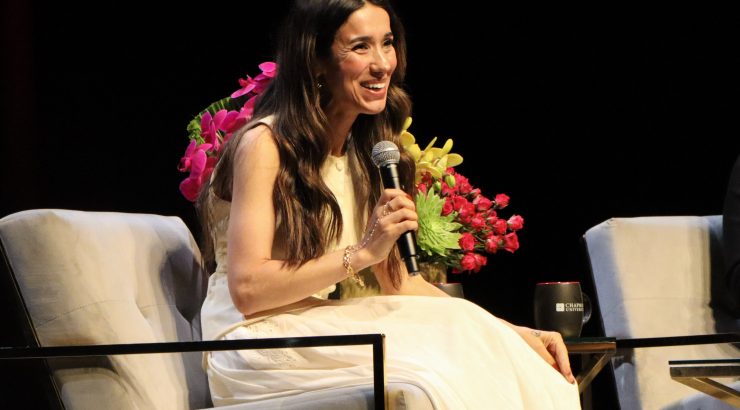
As part of the 2025–2026 Engaging the World: The Environment and Building Resilient Futures series, we were honored to welcome Nobel Peace Prize Laureate (2018) and Chapman Presidential Fellow Nadia Murad to campus as the keynote speaker. The evening also marked a historic occasion, commemorating the inauguration of Matthew Parlow as Chapman University’s 14th president. Murad, a survivor of ISIS captivity, is the author of The Last Girl: My Story of Captivity, and My Fight Against the Islamic State, and founder of Nadia’s Initiative, a mission focused on rebuilding communities in crisis and advocating for survivors of sexual violence.
Murad is no stranger to Chapman University. She has been a special guest on several occasions over the past few years, from speaking engagements as a Presidential Fellow to delivering the Commencement address at Chapman in 2022.
“It’s always a pleasure to be back at Chapman with friends and meeting new students,” she said.
Murad’s life in Sinjar, Iraq, was torn apart when ISIS invaded her homeland to eliminate the Yazidi people. For many years, the Yazidis had faced relentless persecution, but the attack in 2014 brought unimaginable suffering, especially for women like Murad and her two sisters, who were subjected to sexual violence.
Sharing her story is not something she set out to do, but after surviving captivity, she refused to stay quiet and became a powerful voice for her community and for survivors of sexual violence around the world.
“It’s not something that I wanted to do. It’s not a dream of mine to be an activist, but what happened to me, I realized I couldn’t just go back and do nothing,” said Murad.
Murad views her book as an important record of what she and many others went through during their captivity and the crimes that were committed. She grew up isolated in a small village called Kocho, hearing from her family and community about the many genocides that her people had gone through, but she said it was hard for her to believe because nothing was documented.
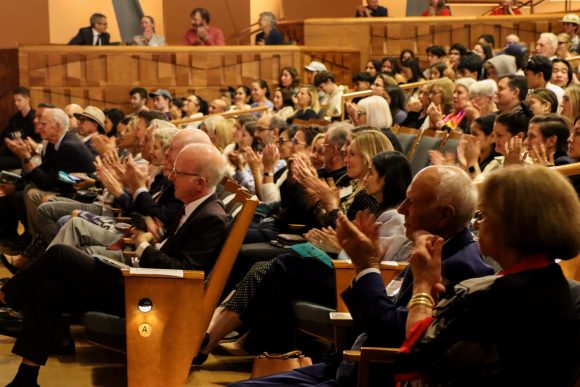
A packed house at the Musco Center for the Arts. Those in attendance were there for “An Evening with Nadia Murad: A Conversation with Wilkinson College of Arts, Humanities, and Social Sciences Dean Jennifer Keene,” as part of Wilkinson’s ETW Series. Photo by Violet Gude (’29 Broadcast Journalism).
“There were a few reasons [why she wrote the book],” she said. “It’s important for future generations and for students, and I believe in documentation.”
Murad shared that when she started writing her story, it was very different then talking about it. With writing, she could note small details that she couldn’t cover in an hour-long lecture.
Her story and advocacy work have inspired many people worldwide. Murad shared the story of how she gave the late Pope Francis her book, which inspired his trip to Iraq in 2021.
“I thought he was not allowed to read it because he is a busy man with a lot of responsibilities, but then I suddenly heard that Pope Francis was down in Iraq and getting on the plane, he was holding my book, and he said that this book was the reason that he decided to go to Iraq.”
Murad and the six thousand other Yazidi women and children taken into captivity and enslaved by the Islamic State of Iraq were not the only ones affected by this targeted violence. According to Murad, Yazidi men and older women were killed immediately. The men were ordered to convert to Sunni Islam or die. According to Nadia’s Initiative, over 5,000 men and older women were killed. Among those men and women were six of her brothers, her mother, and her niece. In 2019, the Iraqi government started releasing the names of the remains they identified a couple of times a year. The number of names on the list varies every time. Just recently, the Iraqi government released a list of twenty-two people. On that list were two of her brothers, numbers 11 and 12.
“This is what genocide does. It reduces human beings to lists and numbers.” – Nadia Murad, Time Magazine
This past August, Murad buried her brothers, Elias Murad and Jalo Murad.
“You know, it’s considered like we are lucky. A lot of people out there have been waiting for so long, and they say it’s so lucky we get to bury them,” she said.
On August 13, Murad published a story about her brothers and returning to Iraq to bury them in Time Magazine. In her story, she says, “I will continue to advocate for a world in which we are all human beings first; a world where we accept our differences, and no one is denied the right to exist.”
Thank you, Nadia, for your courage and your voice. Your story serves as an important reminder of our shared humanity and the work that still needs to be done.
(Photo header: Nobel Peace Prize Laureate (2018) and Chapman Presidential Fellow Nadia Murad as the keynote speaker at the 2025–2026 Engaging the World: The Environment and Building Resilient Futures series. Photo by Vioet Gude (’26 Broadcast Journalism).