From Our Eyes: On Beauty, Theology, and Changing the World With Dr. Susan Ross
February 13, 2026
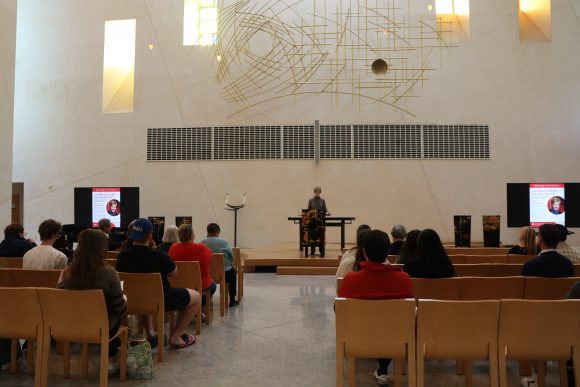
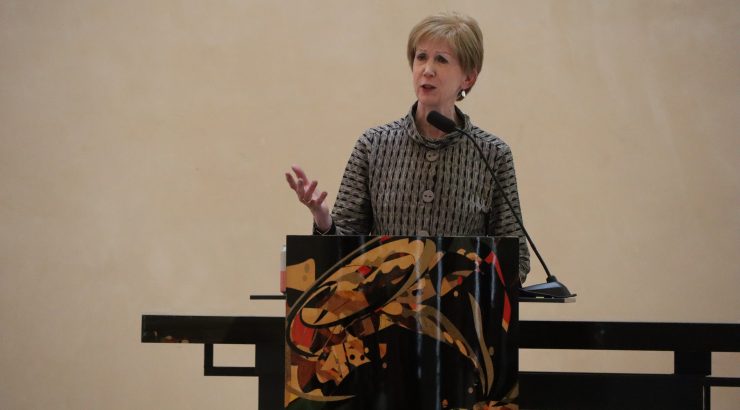
Dr. Susan Ross 2026 Griset Lecturer, “Can Beauty Really Save the World? Theological Aesthetics in a Time of Chaos.” Photo by Violet Gude (’29 Broadcast Journalism major).
This edition of Wilkinson College’s Arts, Humanities, and Social Sciences From Our Eyes is written by newsletter editor Selah Sanchez (’27, Creative Writing; CCI minor). Sanchez recently attended a lecture by Dr. Susan Ross, Griset Lecturer and author of For the Beauty of the Earth: Women, Sacramentality, and Justice, and reflects on how the talk inspired her to draw connections between honesty and tragedy, as well as beauty and deception.
Recently, I attended an event by visiting scholar Dr. Susan Ross. She gave a lecture as part of the Griset Lectureship, in which scholars speak on theology, ethics, and their intersections with modern life.
I wasn’t sure what to expect from the title of the talk: “Can Beauty Really Save the World? Theological Aesthetics in a Time of Chaos.” Part of me felt skeptical about the nature of its answer. In today’s world, it can be hard to find beauty, and beauty can be hard to create. I am also a firm believer that art should disturb the comfortable and comfort the disturbed. Some of the most inspirational, impactful works of art sought to expose tragedy as explicitly raw. Nevertheless, I attended from a place of curiosity and concern for the state of the world.
In her lecture, Dr. Ross focused on three ongoing problems in the world and how theological aesthetics apply to them, using music as the lens to explore them. She drew from different forms, including an opera, Black spirituals, and even an avant-garde musical project called “bug music.” All sought to find humanity in unlikely places and offered a response to tragedy that offered hope. Ross also emphasized that empathy and imagination are major factors in what policies are put in place in government and other authorities, and therefore, through challenging the comfortable through the art we engage with or create, we can enact change.
I was compelled by how Dr. Ross weaved the idea of theological aesthetics into something universal, and asked very real questions about how certain groups of people respond to suffering and anguish– for example, why do we see an emphasis on certain themes in Black spirituals? How did spirituals utilize hidden messages and harbor strength and support for enslaved people? What can be learned from them today?
In writing this, I think I unintentionally formed a connection between honesty and tragedy, and beauty and deception when that wasn’t the point of the lecture at all. It made me think of what I am learning in my War, Memory, and Literature class: beauty can help make sense of depravity, and rebuild what was broken in adversity– as proven in several works of poetry about war. Beauty is a broad term, and perhaps it is not the aesthetic appeal that makes a work beautiful, but its effectiveness at stirring emotions and empathy.
I think at the very core, whether something is aesthetically beautiful or not is not necessarily the point, and Dr. Ross was trying to promote authenticity, and how that inherently is a beautiful thing. Dr. Ross stressed art as a connection, as a way to experience empathy even among a room full of fundamentally different people. To quote her, “To forget the nuance and beauty of the world is to lose our humanity.” In this world, it is good to be reminded of our collective humanity in a way that can’t be expressed in mere words, and in a way that inspires communication even after the curtain is drawn.
(Photo header: Dr. Susan Ross Griset Lecturer and author of For the Beauty of the Earth: Women, Sacramentality, and Justice. Photo by Violet Gude (’29 Broadcast Journalism major).