From Our Eyes: Encountering the Lanzón – A Student’s Journey into Peru’s Sacred Past
February 19, 2026
This edition of From Our Eyes features Forest Delaney (’26 Art History and Business Administration). Delaney is currently completing a senior thesis in Art History, which explores the ancient site of Chavín de Huántar (900–200 BCE) and the 15-foot stone monolith known as the Lanzón, which resides there. Through the lens of phenomenology, the research examines the experiential nature of the site, investigating how visitors to Chavín de Huántar may have encountered and moved through this sacred space. Through Chapman grants, including the Center for Undergraduate Excellence’s Scholarly Creative Grant and Wilkinson’s Maureen Bellettini Scholarship for the Arts, Delaney traveled to Peru to visit the site in person, bringing firsthand experience to this remarkable research.
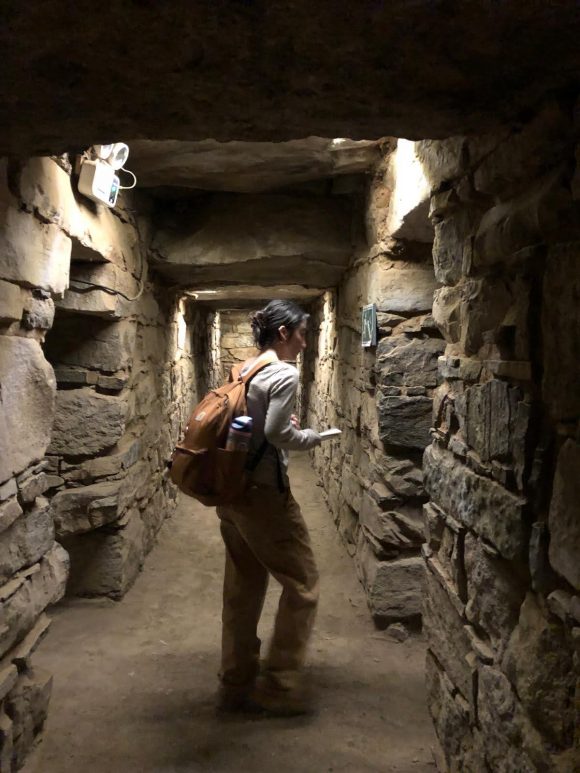
Forest Delaney (’26 Art History and Business Administration) inside the Labyrinth Gallery of Chavín de Huántar, Ancash, Peru. Photo Courtesy of Forest Delaney.
I’ve spent the past year reading about Chavín de Huántar—its underground, labyrinth-like chambers, the stone monolith oracle within, and the sacred landscape that surrounds it. But no amount of research could have prepared me for what it felt like to actually be there. Thanks to the generous support of Chapman’s Center for Undergraduate Excellence Creative Grant and Wilkinson College of Arts, Humanities, and Social Sciences’ Maureen Bellettini Scholarship (a scholarship given by Dr. Arturo Bellettini in memory of his late wife, Maureen Bellettini, who was a lover of the arts. The award is used to help students with expenses such as travel, conference fees, contest entry fees, etc.), I was able to do something most students only dream of: visit the site I’d been researching in person.
In January 2026, I traveled to Peru for two weeks to visit Chavín de Huántar, the subject of my senior thesis in Art History. I first learned about this site when taking AH 205: Arts of the Ancient Americas, taught by Dr. Amy Buono (Art History), my thesis advisor, whose expertise and guidance has been invaluable in my understanding of Andean culture and the development of my thesis. My research explores the experiential nature of the site, centered on a 15-foot stone monolith known as the Lanzón, which resides within its chambers. Nearly 3,000 years old, Chavín de Huántar served as a religious and political center for the Chavín culture, nestled in the Andean highlands at approximately 10,430 feet above sea level. The complex was carefully engineered and thoughtfully constructed, drawing pilgrims from far and wide to encounter the Lanzón, the only principal ancient Peruvian cult figure still standing in its original location. It is the Lanzón—the mysterious, smiling oracle—that captivated me and led me to wonder what it would have been like for a pilgrim to encounter this site thousands of years ago.
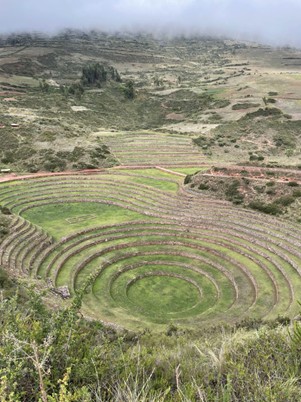
Archaeological site of Moray, an Inca ruin in Maras, Cusco, Peru. Photo courtesy of Forest Delaney.
My journey began in Lima, Peru’s bustling capital. The city was vast and vibrant, but what really defined my time there was the food. Around every corner, there were food stalls, five-star Asian-Peruvian fusion restaurants (known as Chifa), and cuisine tied closely to Peru’s rich and varied native ingredients. Two chefs, David and Annie, who owned a café near our hostel, were exceptionally helpful in guiding us to the best local spots. Annie, originally from Huaraz, told me about her own visit to Chavín de Huántar. She described it vividly as a mysterious and slightly eerie place, overflowing with some kind of energy. I started to get very excited, and perhaps a bit apprehensive about meeting El Lanzón.
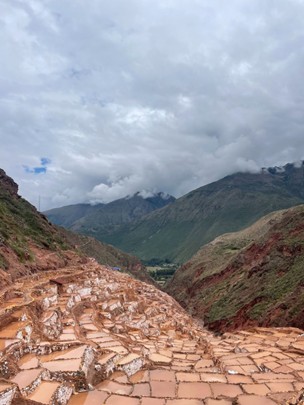
Salt Mines of Maras, Urubamba, Cusco, Peru. Photo courtesy of Forest Delaney.
A quick flight to Huaraz, a small mountain city serving as the center of Peru’s trekking culture, and a white-knuckle ride through the mountains later, I had made it to Chavín de Huántar. The town itself was remote; you could walk from one end to the other in roughly 15 minutes. Replicas of Chavín artifacts were everywhere: tenon heads adorned hotel exteriors, and Lanzón replicas stood in backyards and plazas. These replicas were just a taste of what I would experience at the archaeological site on the southern end of town.
Chavín de Huántar sits nestled between the Cordillera Negra and Cordillera Blanca mountain ranges at the joining point of two rivers. The landscape that surrounds the site is stunning, monumental, and enchanting. The mountains loom above you, powerful and steady, and the Mosna River’s constant rush reminds you that the environment around you is alive. Within the temple walls, though, any remnant of the outside world disappears; as I descended alone into the subterranean chambers of Galería El Lanzón, the outside world went quiet, and I could hardly remember the expansive landscape from which I had just come. The walls in the gallery were tight and only grew narrower as I approached the oracle at the end of the passageway, creating a kind of vertigo effect as I moved closer. The Lanzón stood still, preserved in time and space, yet simultaneously alive and imposing. This was especially apparent when, right before being whisked away by a security guard—who must have suspected I was taking photos against the rules—I felt a light breeze touch the back of my neck and heard faint echoes from far away.
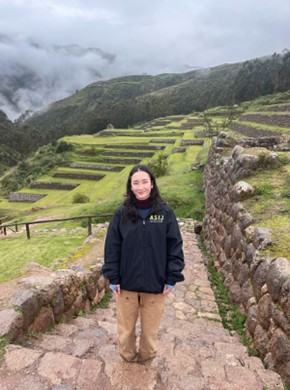
Forest Delaney (’26 Art History and Business Administration)at the archaeological complex of Chinchero, once the palace of Inca emperor Túpac Yupanqui, Urubamba, Cusco, Peru. Photo courtesy of Forest Delaney.
The remainder of my time in Peru was spent in Cusco, the Inca capital, contemplating my life-changing encounter with El Lanzón and admiring the layers of history visible throughout the city. Expertly cut Inca stones peeked through brick-lined streets and Spanish colonial buildings, and ancient structures were countless. In the Sacred Valley, I visited sites like Chinchero and Ollantaytambo, each revealing another layer of Inca history. The sheer abundance of archaeological sites made it feel like I could spend a lifetime there and still only scratch the surface.
Throughout all that I had seen and experienced, though, I remained most captivated by Chavín de Huántar: its enigmatic nature, the energy of the landscape surrounding it, and the mysterious and powerful Lanzón within. My research had prepared me to understand the site intellectually, but nothing compared to the sensory experience of actually being there. In those underground chambers, I came as close as I ever could to understanding what ancient pilgrims felt when they made this journey. That’s something no amount of reading could have given me, and it’s a reminder that the closest we can come to truth is often by going and seeking it out for ourselves.
(Pictured in header: Forest Delaney (’26 Art History and Business Administration) at the archaeological site of Chavín de Huántar, Ancash, Peru. Photo courtesy of Forest Delaney. Photo courtesy of Forest Delaney.)