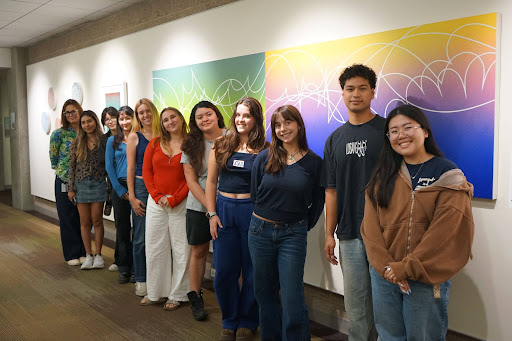
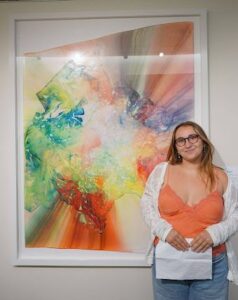
This edition of From Our Eyes highlights a student-curated art installation from the Escalette Permanent Art Collection, written by Shae Hruby (’26 Film Production; Studio Art minor). Hruby takes us through the installation process of Chromatopia and how her involvement impacted what is currently on view in the Doy and Dee Henley Galleria on the 2nd floor of Argyros Forum. The exhibition was curated in collaboration with the Escalette Collection and AH 350: Chromophobia – Chromophilia (Dr. Amy Buono), an Art History course that examined the cross-cultural lives of color in our global world, both as a societal fear and as a passion.
The title Chromatopia comes from the Greek roots of Chroma (color) and topos (place, spot), forming Chromatopia (color spot). I chose to think of it as a spot rather than a place because this exhibition occupies a small nook on Chapman’s larger campus. Though tucked in a corner hallway of Argyros Forum, as you walk through it, for the first fifteen seconds, you are immersed in a flow of color. As a group, we voted on the title and helped curate the exhibition. Working on this installation was an honor because it allowed us, as students, to make a lasting impact on the Chapman community.
We had forty-one artworks from the Escalette Collection to choose from. Each used color as an essential part of its construction and consumption. While negotiating our selections as a class was challenging, deciding which works to leave out was even more difficult. With only fifteen students and a wide range of compelling pieces, every choice felt significant. Being entrusted with shaping an exhibition that will remain on display for years to come was both exciting and rewarding.
Once each person had chosen a piece, we began researching the individual artworks and the artists who created them. We wanted to know why color was important to this piece and the artist, and if their other works engaged with similar themes. We focused on the colors and how they could enhance or detract from the artwork’s messaging and consumption. It was very important for us to curate the exhibition as a collective, guiding the viewer through different dimensions of color as an experience. In our class, we discussed how color is more than its appearance; it is about its history and formation. Likewise, the artworks in Chromatopia are not only visually striking but also rich in meaning and context. As a class, we worked together to arrange the exhibition to guide viewers through both the visual and conceptual dimensions of color.
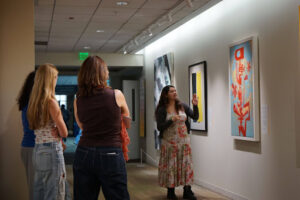
The next step was organizing the artworks into color-based thematic groupings. Out of the multiple ideas proposed, we selected four themes: Color and Memory; Color and the Sacred; Color and the Everyday; and Color and Perception. Students placed their chosen artworks into the category that best reflected the core ideas of each piece, then wrote both an individual object label and, working together, the thematic introductory labels.
My chosen piece, Inna Ray’s “Color Chart for Workshop at Maturango Museum,” was placed in the Color and Perception section. Ray created a color chart composed of thumbnail-sized squares that use variations in color, texture, and brushwork to evoke moods ranging from chaotic and energetic to calm and reflective. Rather than depicting a specific or recognizable scene, Ray relied on the interaction of layered colors and textures to evoke distinct moods and imagined worlds. Her interest in exploring the relationship between the natural world and reflective inner experiences in this experimental format resonated greatly with me.
As visitors walk through the installation, they will see a range of colors living on the walls of what used to be a bare and empty space. The exhibition extends around a corner and includes activities that encourage viewers not only to observe the works but also to engage with the vivid ideas explored in Chromatopia. Come immerse yourselves in color! The show is on exhibit until spring 2029.
(Pictured in header: Art students posing in the Chromatopia exhibit. Photo courtesy of Art Department.)