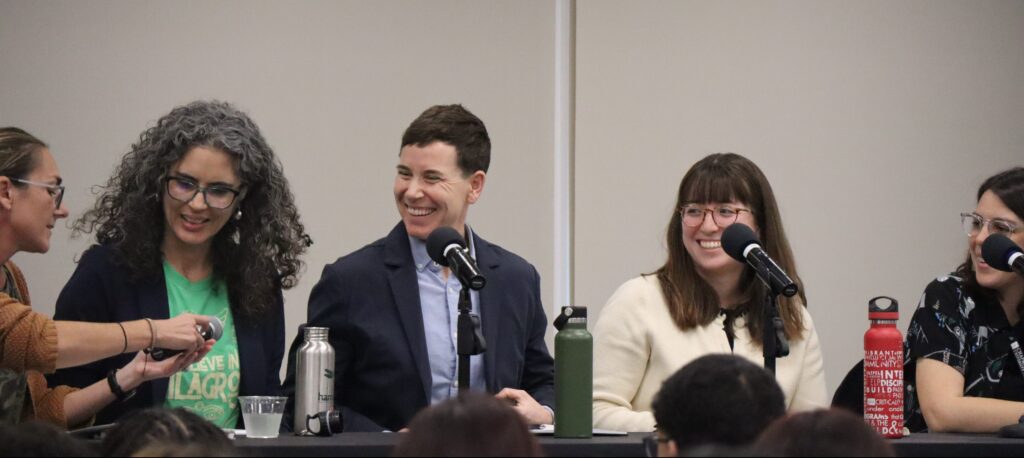
To close out Wilkinson College of Arts, Humanities, and Social Sciences 2025-2026 Engaging the World: Leading the Conversation on the Environment and Building Resilient Futures series, the college partnered with Schmid College of Science and Technology to host an Environment and Building Resilient Futures Faculty Panel. Panelists included faculty from both colleges, such as Dr. Skye Niles (Environmental Science), Dr. Richelle Tanner (Environmental Science), Dr. Sandra Alvarez (Political Science), and Dr. Christine O’Connell (Biological Sciences). Their discussion was moderated by Dr. Angela Lederach (Peace and Justice Studies), who opened the conversation with a land acknowledgement inspired by a conversation she had with Dr. Rudi Mitchell, one of the last hereditary chiefs of Omaha Nation in Nebraska. Through it, she reminded those in attendance that we must remember our relationships with one another and our relationships with the transformed Californian land on which we reside.
The panelists offered an interdisciplinary perspective on how their work was influenced by the concepts and definitions of environment and resilience. Each one highlighted different lessons they learned that further shaped these concepts through their own experiences, as well. The conversations ranged from looking at ecology to the criminal justice system within the context of these terms. For example, Dr. Alvarez’s discussed how her engagement with the people of Northeastern Columbia changed her perspective on how to look at our relationship with our surroundings.
“What [this] one nation has taught me is that we’re a part of our environment. We’re a part of the Earth and this is something that Indigenous peoples might use a term like universal kinship to talk about: the relationship between humans and all other kinds of beings on the planet,” said Dr. Alvarez.
From this perspective, climate change disasters can be seen as examples of what happens when our relationships to the environment are unbalanced. What would happen if we collaborated to restore balance to our surrounding environments? Dr. Lederach took this question further by asking, “How does collaboration across multiple disciplines take place and how is it benefiting environmental challenges, whether in your own research or things that you hope to do? What are the real challenges in developing genuine interdisciplinary collaborations?”

The panel provided well-rounded answers to Dr. Lederach’s question, maintaining a sense of earnestness mixed with hope. They each chose to share experiences that revealed possible ways in which interdisciplinary and community collaboration can confront climate change challenges. Their experiences highlighted the importance of resiliency, particularly the need for various communities to collaborate and develop practical solutions. Dr. Niles, Dr. O’Connell, and Dr. Tanner shared experiences of working with the public and collaborating with multiple organizations to raise awareness and change in their fields of study. For example, Dr. Tanner has collaborated with state and local agencies to address solutions for multifaceted environmental problems that impact populations and this in turn changed her research.
“I’m on the Santa Monica Bay Restoration Commission’s Technical Advisory Committee (SMBRC TAC) [and it’s led me to be] welcomed to projects by public agencies that I never thought that I would work with,” Dr. Tanner said.
One experience on the committee led her to speak with the Ventura Public Works Department. This agency was inspired by Dr. Tanner’s recent seminar. They shared that the seminar enabled them to consider restructuring their dam removal project to include discussions with the local communities, including tribal nations in that area, that would be impacted by this change. Through this conversation, multiple practitioners and scientists were able to partner together in finding new solutions that would benefit all individuals affected by this project.
(Photo header: (left to right) Dr. Sandra Alvarez (Political Science), Dr. Skye Niles (Environmental Science), and Dr. Richelle Tanner (Environmental Science).)