
Faculty Books: Contemporary Facets of Injustice
July 9, 2025
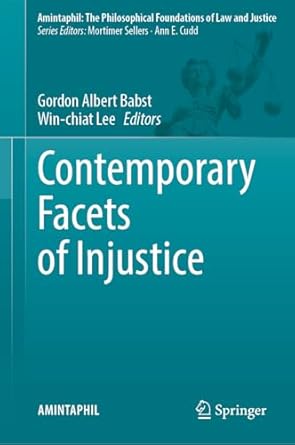 Dr. Gordon Babst (Political Science) recently published an edited volume called Contemporary Facets of Injustice, Volume 13 in the series of books, AMINTAPHIL: The Philosophical Foundations of Law and Justice. We sat down with Dr. Babst to discuss the volume, which examines issues of justice and injustice and problematizes understandings of generative AI, capital punishment, truth and reconciliation commissions, among other topics.
Voice of Wilkinson: Congratulations on the book! Tell me a little bit about Contemporary Facets of Injustice in your own words.
Dr. Gordon Babst: This work brings together legal, social, and political theorists to discuss unfolding and looming issues related to injustice that have a very practical impact on people’s lives – issues such as inequities in the food system and what the emergence of a reanimated Christian nationalism might portend for others.
VoW: You worked on this volume with Dr. Win-chiat Lee. Tell me how the two of you connected and collaborated on this project.
GB: Lee, a philosophy professor at Wake Forest University, and I are both members of a long-standing association of legal and social philosophers — The International Association for the Philosophy of Law and Social Philosophy (IVR), originally Internationale Vereinigung für Rechts- und Sozialphilosophie — and the American section of it – AMINTAPHIL. He was recently President of the Association, and I organized its 2022 Biannual Conference and served on its executive committee.
VoW: What do you hope they will gain from reading this book?
GB: I hope that readers come to appreciate the value of reflection on everyday life and the injustices that may be present in it, not only for themselves but also for many groups whose situations and daily lives may not be appreciated.
“I have found that students are very often riveted by issues and arguments about them, such as are discussed in these two volumes, and seek to deepen both their understanding and approach to injustices near and far.”
VoW: Let’s talk about the chapter you wrote in this volume.
GB: In my chapter in this volume, “Religious Liberty, Public Accommodations, and Non-discrimination: A Rapidly Emerging Injustice,” I tackle the thorny issue of when we permit one form of discrimination in public accommodations, it facilitates others, including against protected classes, members of whom, for reason of intersectionality, may get discriminated on the basis of the permitted form even if they are not intentionally targeted for reason of the prohibited form.