Wilkinson College English Faculty Participate in Prestigious Summer Residencies
August 5, 2025
Three Wilkinson College of Arts, Humanities, and Social Sciences faculty members have participated in residencies over the summer. The faculty members are Renee Hudson, Jean Ho, and Anna Leahy, all of whom are from the Department of English.
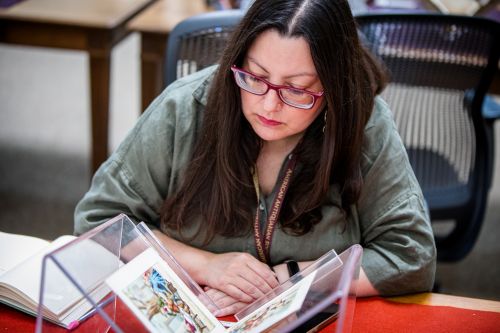
Renee Hudson (English)
Renee Hudson was in residency at the American Antiquarian Society in Worcester, Massachusetts, one of many archival trips she is making to research Latinx girlhood. At the Antiquarian Society, she studied Spanish-language children’s books and primers, to see how they depict comportment and other values of the nineteenth and twentieth centuries.
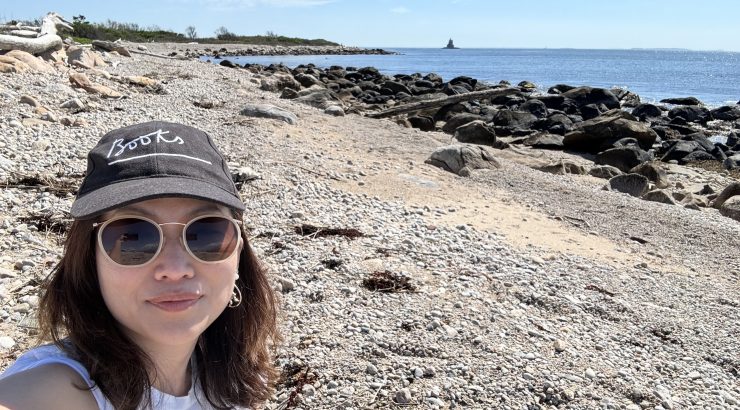
Jean Ho was a fellow at Lighthouse Works on Fishers Island in New York. While on Fishers Island, she worked on her novel about the first Chinese immigrants in Los Angeles, and how they built the city’s first Chinatown. It is a project she has been working on for several years, based on archival research she did on Chinese immigrants in Los Angeles. As part of the residency, she did two public events, an artist talk, and an open studio session.
Anna Leahy was in residency with Write On, Door County in Wisconsin, where she hosted an erasure poetry workshop for the public, reading from some recently published books, and writing, with the intention of testing how drafted poems work together.
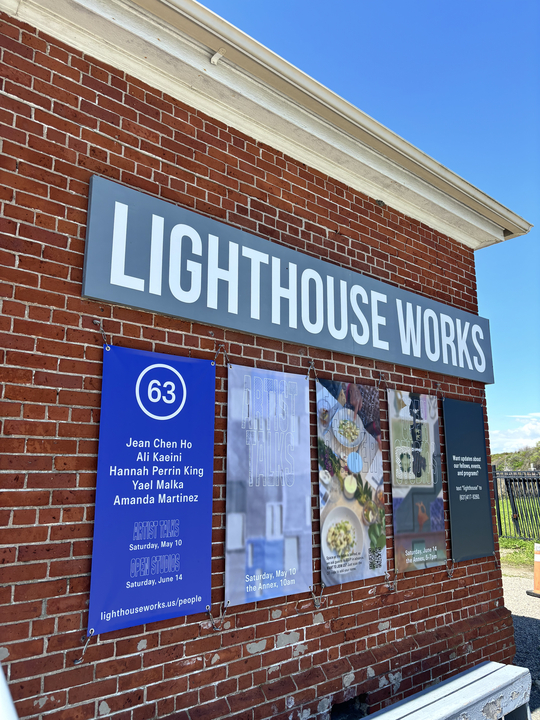
Jean Ho (English) is a fellow at Lighthouse Works on Fishers Island in New York.
These residencies are important for the research and writing all three do according to Hudson, who says “they help in a multitude of ways, one of which is that they put you in touch with a new network of people… you’re living with and working alongside other fellows, so it’s also super important for building community”.
Being able to have a network of people to learn from is something she values in her experience. “I was excited to hear more about their projects, especially because I always learn new things. Plus, it’s fun to geek out over similar things,” she said. Hudson also enjoyed having access to unique archives such as the childrens’ collection in the American Antiquarian Society. Reflecting on her research, she is hoping to shed light on Latinx girlhood as multifaceted and explore how they adapted to life in America. “I don’t think a lot of people care much about Latinx children, much less girls… at the end of the day, this project is about thinking about the multifaceted lives of Latinx girls and how they negotiated the limited roles available to them.” In the future, Hudson will be traveling to CENTRO at Hunter College in New York and the University of Houston for further archival research and hopes to publish her findings.
Similar to Hudson, Ho finds meaning in the dedicated work time and interacting with fellows. “I wanted to attend a residency that had both writers and artists, because I really appreciate the cross-disciplinary creative exchange,” she said. Having found out about Lighthouse Works from another novelist, she applied for the residency for the cross-disciplinary exchange, and because of the peaceful island environment, as Fishers Island lies just off the coast of Connecticut and Long Island, and harbors rocky beaches and Victorian-style houses. Having done much of her archival research already, her main focus was on writing her novel. This has proven to be a unique undertaking: “This is my second book, and it’s a real creative challenge to write a novel that’s based on historical facts. Even though I’m drawing on a lot of research, I’m giving myself room to imagine characters and their interior lives, which the archival records do not always show,” she said. Being able to explore the interior lives of characters in historical fiction is a way to connect the reader to the past, enabling them to see how the past and present are linked in a similar yet still multifaceted way. A main focus of her book will be an incident of racial violence against Chinese men, and the discrimination Chinese immigrants faced in Los Angeles in the nineteenth century. In her words, “At this period in California and the west coast, white men routinely terrorized Chinese immigrant laborers and set fire to the communities they lived in– out of racism and xenophobia. I’ve been working on the book for a few years, and… it’s especially uncanny to be writing this novel right now.”
Leahy focused on growing personally as a writer during her residency, and hosted a workshop on erasure poetry– a type of poetry in which an existing text is forged into a new piece of work, often by whiting out or blacking out words and accentuating or rearranging selected phrases. This was her second time at Write On, Door County, which is in an area where she used to vacation as a child. Regarding the personal value of residencies and her work, she said, “The shift in geography is often especially good for me to cultivate shifts in thinking, and, for me, there’s nothing like the alone time of a residency and the freedom from the clock. And yet, I also appreciate being in residence with others for spontaneous conversations about craft or companion texts.”
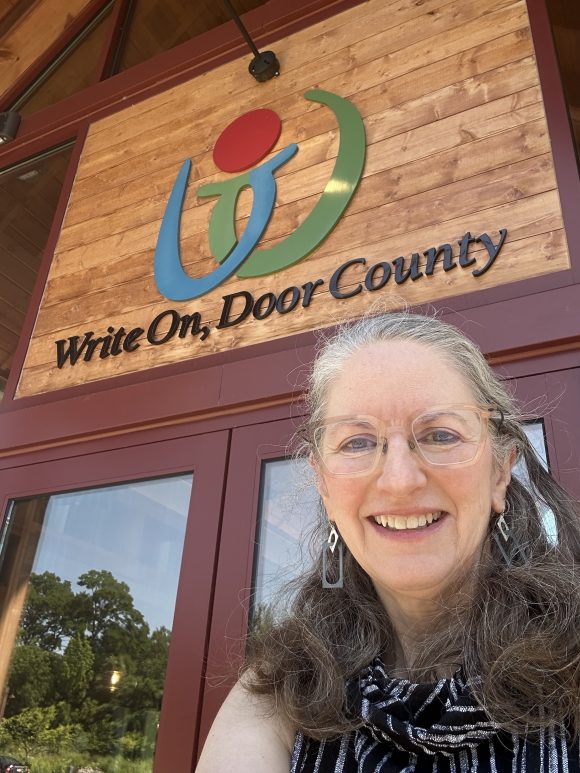
Anna Leahy (English)
Leahy shared a little bit about her personal growth through her experience as an Artist-in-Residence at Joshua Tree National Park, where she was encouraged to experience the park and spend an afternoon at Cap Rock talking to the public about poetry. She described it as “… a different way to approach a residency with permission to be, not do… I quickly found that I could hike the same trail or stare at the rock formation on back-to-back days and have a different experience each time. That experiential thinking helped me think about the poet’s focus on minutia.” Using this newfound inspiration, she could share and distribute poetry at Cap Rock, and interact with the public, encouraging them to do the same. “I especially liked talking with kids who write poems already and their parents who encourage that.”
Though their residencies are all quite unique, all act as a space for them to interact with fellow scholars, engage with the public, and have dedicated time to make progress on their work. In the words of Leahy, “The calm productivity of a residency and its break in routine and daily external demands can be especially important for those of us who are all in when we’re on the job.”
It is recommended for any aspiring artists, writers, and scholars to pursue them as an integral part of their practice. For those interested in writers’ or artists’ residencies, Leahy recommends the Poets & Writers Database. Hudson says, “Reach out to people directly, starting with the program coordinator. Also, check to see who has had the residency before and see if you know them or if you have any mutual contacts– this could be a great way to learn more about navigating the application process as well as what to expect.”
(Pictured in header: Jean Ho (English) on the beach at her residency on Fishers Island in New York.)