Reframing Liberation: Queer Identity Within Palestinian Struggle
March 19, 2026
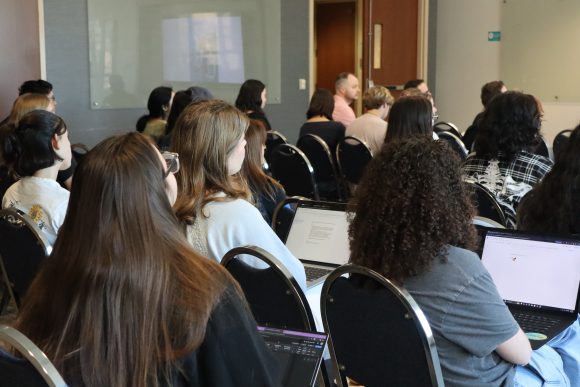
Students, faculty, and staff attended the event with Dr. Sa’ed Atshan, Associate Professor of Peace and Conflict Studies and Anthropology at Swarthmore College. Photo by Violet Gude (’29 Broadcast Journalism major).
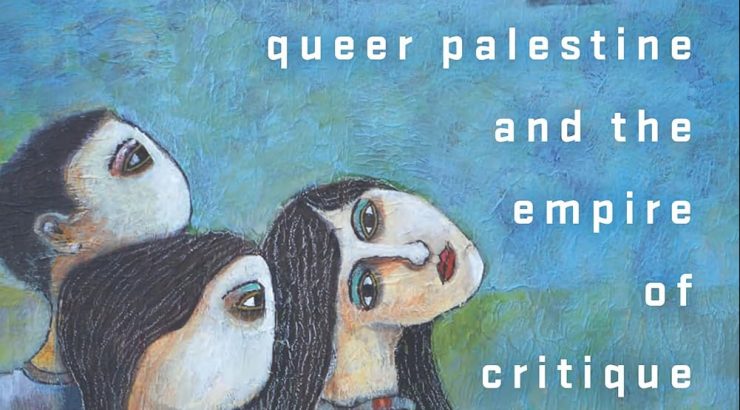
Peace and Justice Studies and LGBTQ+ Studies recently hosted Dr. Sa’ed Atshan, Associate Professor of Peace and Conflict Studies and Anthropology and Chair of the Department of Peace and Conflict Studies at Swarthmore College, as part of a series called Organizing Under Duress. As the author of Queer Palestine and the Empire of Critique (2020), his work centers around queerness in the Palestinian context, examining movements for queer liberation as deeply ingrained within the struggle for anti-imperial liberation. As a queer Palestinian scholar, Dr. Atshan brings a unique and critical expertise to this conversation, reflecting on his own reality as well as broader phenomena and experiences.
Dr. Atshan situated his work within the historical formation of the Palestinian queer liberation movement, identifying the feminist movement as a driving force. As the Palestinian feminist movement evolved, activists and scholars drew links between external oppression and internal social inequalities, which emphasized that neither takes precedence. Instead, they are intertwined and reinforce each other.
Dr. Atshan addressed the ongoing debate about queer liberation and its rejection by some in favor of the struggle against military occupation. In response, his work applies lessons from feminist thought to the queer context, asserting that “our bodies are simultaneously queer and Palestinian.” These identities are inseparable, and both must be confronted to achieve genuine liberation.
Further elaborating on the connections between “queer and Palestinian”, his discussion explored not only internal forces of suppression, but also external, oppressive systems which work to erase queer Palestinians, and further reinforce violent occupation. For example, Dr. Atshan defined the phenomenon of “pink washing,” which describes propaganda used by the Israeli state that draws attention to an advanced record of LGBTQ+ rights in Israel. This falsified notion of Israel as a Western trailblazer of queer rights is used to depict Palestinian society as contrarily homophobic and “backwards,” legitimizing the violence carried out under the Israeli state. This system of propaganda has real impacts on the perception of the liberatory struggle, where “through this representation of Israel as this homoerotic utopia, then there’s this erasure of the bodies and subjectivities and ghosts and spirits of Palestinians who have faced and continue to face ethnic cleansing in the land,” said Dr. Atshan. In reality, both societies contain a struggle for queer liberation against homophobia, and this recognition is critical to dismantling justifications of violence.
Dr. Atshan examines the internal and external forces of oppression against the Palestinian queer liberation movement, highlighting what he calls an “empire of critique.” He argues for the necessity of queer liberation amidst anti-colonial and anti-imperial liberation as inseparable movements in the struggle for full liberation of all Palestinians. In applying this to the trans-national solidarity context, he notes, “whenever there’s a major Palestinian solidarity mobilization, you will always find the queers, and they’re always disproportionately represented with rainbow flags, with anti-pinkwashing signs.” The question is not which struggle should be fought first, but rather in what ways these liberatory movements are one in the same.
Dr. Atshan’s talk affirmed students’ power to make change at both macro and micro levels. “Anti-colonial liberation and anti-imperialism are fundamentally queer. And queer liberation is fundamentally anti-colonial and anti-imperial,” he said.
In a shift from “radical purism” to “radical pluralism,” no one can be free until everyone is free.