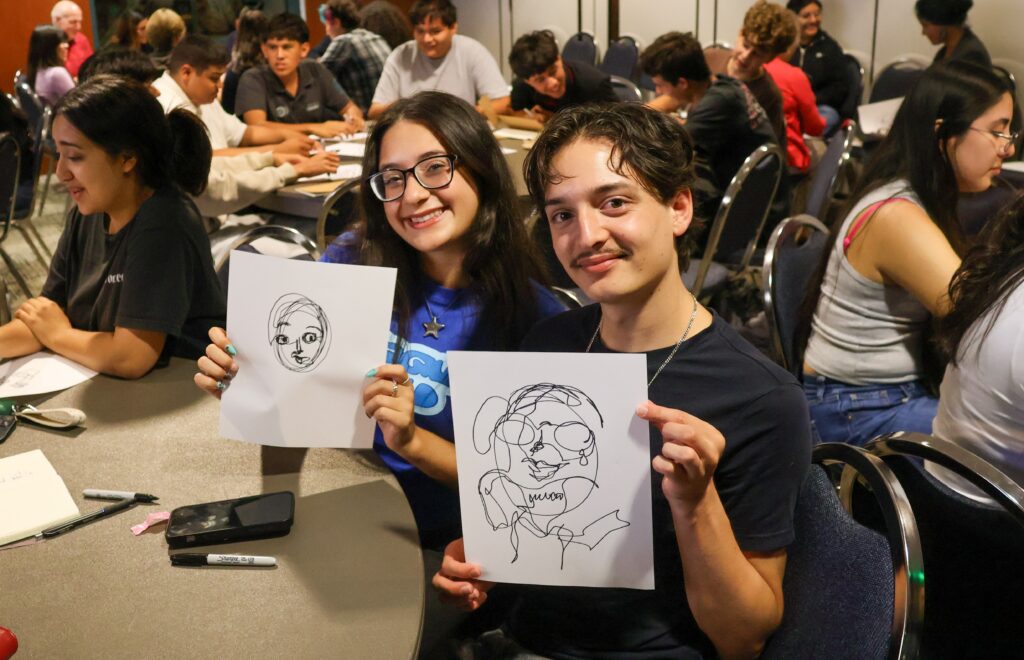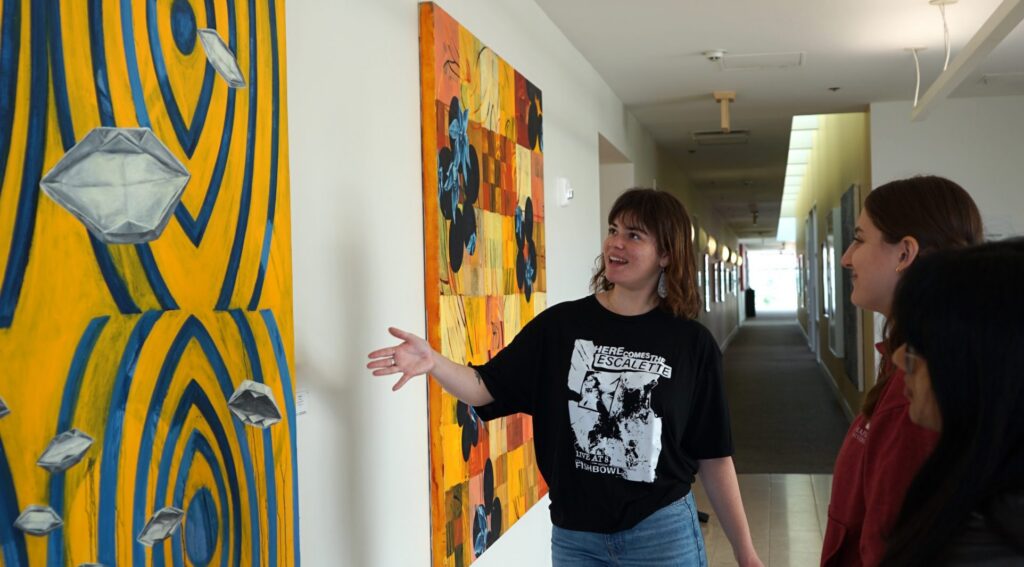
This special edition of From Our Eyes is written by Hayden Yoss (‘25 Art History), but features more than just Yoss’ view. Yoss interviewed Chapman students from different areas across campus, asking them about the Phyllis and Ross Escalette Permanent Collection of Art, “museum without walls.” Yoss was interested in finding out what non-art major students thought of the art pieces throughout the Chapman campus.
At Chapman University, art is not confined to galleries. Art lives in our hallways, courtyards, classrooms, and study spaces. The Phyllis and Ross Escalette Permanent Collection of Art in Wilkinson College of Arts, Humanities, and Social Sciences, known as Chapman’s “museum without walls,” is a unique and dominant presence on campus. But beyond its aesthetic appeal, it actively shapes how students across all disciplines see the world, learn, and engage with each other.
To explore this impact, I interviewed students from different colleges across Chapman: Crean College of Health and Behavioral Sciences, College of Performing Arts (COPA), Argyros College of Business and Economics, Attallah College of Educational Studies, and Wilkinson College of Arts, Humanities, and Social Sciences. Their thoughts demonstrate what many feel but do not always say: Art matters everywhere.
Seeing Chapman’s Campus Through a New Lens
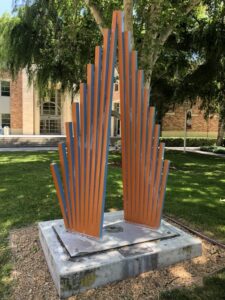
Many students mentioned that although they pass the artworks daily, they are only just beginning to realize their deeper meaning. Rachel Meyer (‘25 Sociology)in Wilkinson College, said, “I don’t think I’ve ever interacted with the Escalette Collection in-depth, but I’ve seen the sculptures, like the one in front of Oliphant Hall, [titled Obid (1983) by Roslyn Mazzilli] throughout my four years, and I’m more interested now. Realizing I haven’t taken advantage of the art Chapman has to offer made me want to learn more.”
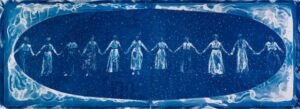
Others were deeply impacted by specific works. For example, Livia Jadwin (‘25 Health Sciences)in Crean College brought up Lia Halloran’s (Art) Paper Dolls (2017) in the Keck Center for Science and Engineering (1 University Dr), Floor 3, Hallway 308. “It represents the connection of being a human through space and time; we are all connected, and we are all human,” she said. These moments of reflection often happen when we least expect them, looking around during a study break, walking to class, or waiting for the elevator.
The Educational Power of Art
Regardless of their major, every student I spoke with found a connection to art in their field of study.
“Art can tell us a lot that sometimes words can’t describe,” Meyer explained. “In my Sociology Borders and Migration class, we looked at children’s drawings and objects left in the desert from their migration journey. These pieces speak to emotion and experience, just like the art in the Escalette Collection.”
Even students in very different fields saw surprising intersections. Sydney Kolker (‘25 Accounting)in Argyros College said, “Art adds personality to a space and reminds me that creativity is essential, even in structured academic fields.” Similarly, Jadwin emphasized that in health sciences, “Art is used to see the unseeable, like the breakdown of bodily systems. We depend on it when we don’t have access to cadavers.”
Art Speaks to Everyone
Though not all students initially saw the Escalette Collection as relevant to their majors, many were surprised to find out that art can enrich learning in any field. From the perspective of future educators, Sofia Fernandez (‘25 Education) in Attallah College emphasized that fostering creativity in young students is essential. “Creative activities can boost student engagement and morale. Even in academics, creativity helps students become more well-rounded and see different perspectives,” she said.
Additionally, Meyer said, “You may find something that applies to your major even when you least expect it. Art is in everything
from political science to physics. It just takes a certain eye to see it.” Kolker repeated this thought, encouraging students to reflect. “Art can challenge how we think, make us more observant, and connect to broader issues, like politics, identity, and innovation.”
The Escalette Collection belongs not just to art majors but to everyone. Whether you are composing music, solving equations, or learning to heal the human body, creativity and visual storytelling enrich your perspective. Pause next time you pass a sculpture, mural, or painting on your way to class. Ask what it might be saying. You might find that it has more to do with your life and studies than you ever realized. As Briana Boyd (‘25 Strategic & Corporate Communication, Film, Music ) put it best, “You never will know unless you just give it a shot and take a few minutes out of your day.”